Filmlexikon.
Support
Four-Point Lighting
Lighting · Terms

Four-Point Lighting

Murnau AI illustration
color temperature flow roll take

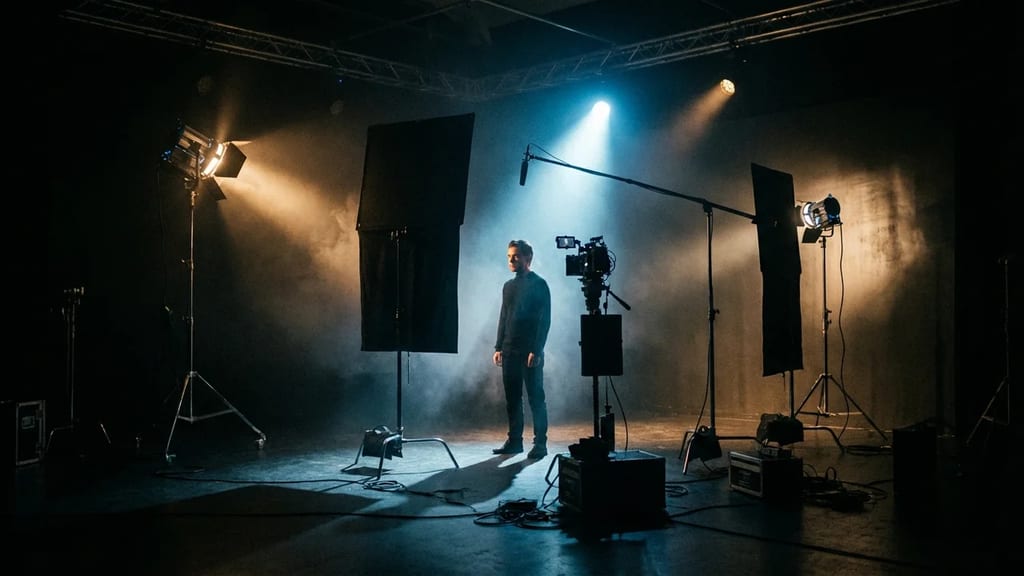
Four-point lighting technique using key light, fill light, rim light, and background light to separate subject from background with 2–3 stops of contrast reduction.

Technical Details

The background light typically operates with 500W-2K Tungsten or LED panels in the 2700K-5600K color temperature range. Positioning is 3-5 meters behind the subject with a beam angle of 40-60 degrees. Modern setups utilize DMX-controllable fixtures with 16-bit dimming for precise brightness gradation. The ratio between the key light and background light is standardly 4:1 to 8:1, measured with a spot meter on an 18% gray card. Flags and barndoors limit light spill to ±15 degrees from the desired area.

History & Development

Four-point lighting evolved in 1925 at Paramount Studios under cinematographer Karl Struss for "Ben Hur." The additional background light solved the problem of flat studio backdrops in CinemaScope formats from 1953 onwards. Director George Stevens perfected the system with motorized background light arrays in 1956 for "Giant." Digital cinema cameras since 2007, due to their sensor characteristics, require more precise background light control than 35mm film, making LED systems with real-time preview modes standard.

Practical Application in Film

Roger Deakins used LED wall background lighting with 1000 nits luminance for "Blade Runner 2049" (2017) to separate subjects in interiors. Emmanuel Lubezki employed natural background light in "The Revenant" (2015) using 12K HMIs as sun simulation, positioned 8-12 meters behind the actors. Horror productions like "Hereditary" (2018) work with color temperature-variable background lights (2000K-8000K) for mood modulation. Dialogue scenes require constant background light intensity during shot-reverse-shot editing, achieved through memory presets on lighting consoles.

Comparison & Alternatives

Compared to three-point lighting, the background light reduces the contrast between subject and background by 2-3 stops. LED volume technology replaces traditional background lights with 2.6mm pixel pitch displays offering 4000 nits peak brightness. Practical lights on set can take over background light functions but require additional lights with CTO/CTB filters for color temperature matching. In low-budget productions, China balls with 2K bulbs replace costly background light setups, but provide less precise light distribution.

From the crafts

Perspectives

Cinematographer

Ich positioniere das Background Light grundsätzlich 45 Grad seitlich zum Hintergrund, um Textur zu betonen ohne Überbelichtung zu riskieren. Bei digitalen Kameras messe ich die Hintergrund-Belichtung immer 1,5 Blenden unter dem Key Light, damit der Sensor die Motivtrennung optimal erfasst. Das Background Light bestimmt maßgeblich, ob mein Bild Tiefe bekommt oder flach wirkt.

Director

Ich nutze das Background Light gezielt für emotionale Akzente – warmes 3200K-Licht für intime Szenen, kaltes 5600K für Bedrohung. Die Intensität des Background Lights steuert unbewusst die Aufmerksamkeit des Zuschauers auf Gesichter versus Umgebung. Bei Charakterentwicklung dimme ich das Background Light progressiv herunter, um Isolation visuell zu verstärken.

Producer

Vier-Punkt-Beleuchtung bedeutet 25-30% höhere Stromkosten und zusätzliche Crew-Stunden für Setup. Ich kalkuliere einen extra Beleuchter und 4-6 zusätzliche Fixtures pro Drehtag, plus Generator-Upgrade auf mindestens 100kVA. Der Zeitgewinn beim Color Grading durch saubere Motivtrennung amortisiert jedoch die Mehrkosten in der Post-Production.

More in the lexikon

Related terms

Test your knowledge

Quiz

1. Zu welchem Department gehört „Vier-Punkt-Beleuchtung"?

2. Wie viele verschiedene Fachperspektiven bietet dieser Eintrag?

Report an error
From the Filmfarm ecosystem

Understand visual language, budget productions, connect crew.

The Lexikon is part of the Filmfarm ecosystem — alongside budgeting (FilmBalance), an industry magazine (FilmCircus) and crew networking (FilmCall, CrewMesh). One shared vocabulary for the whole production.

FilmFarm FilmRadarComing soonFilmPulseComing soonFilmNumbersComing soonFilmCapitalComing soonFilmLabComing soonFilmBalanceComing soonFilmCircusComing soon