Filmlexikon.
Support
Foreground
Art Department · Terms

Foreground

Murnau AI illustration
15lb sandbag 20 c stand 216 diffusion 250 diffusion 251 diffusion 25lb sandbag 35lb sandbag 40 c stand

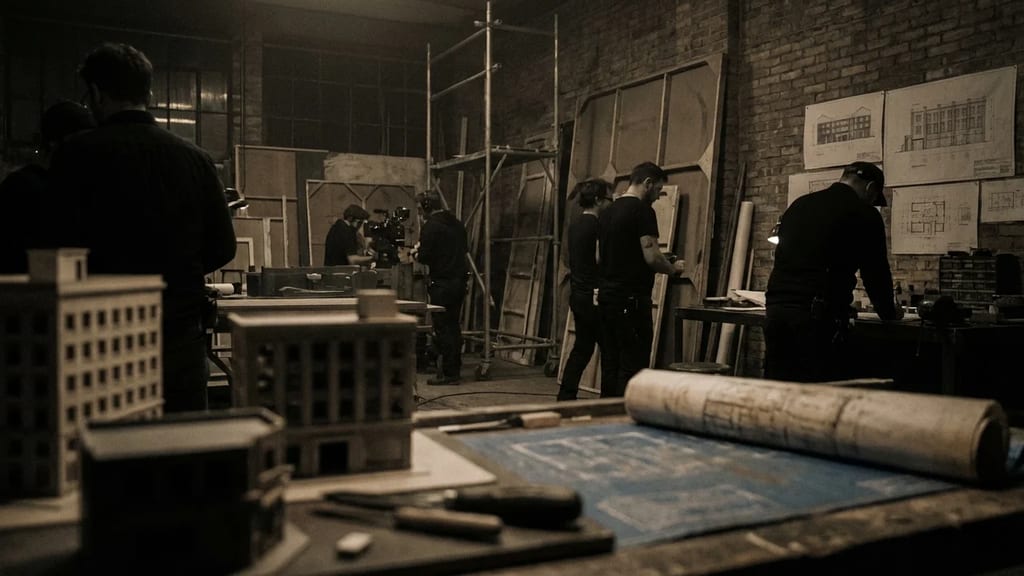
Picture area between camera and main subject (0.6–3 m distance), often defocused for depth effect or filled with practical elements for atmosphere.

Technical Details

At a focal length of 35mm and an aperture of f/2.8, the hyperfocal distance is approximately 6 meters, allowing foreground elements under 3 meters to be intentionally blurred. Modern cinema cameras utilize Super35 format sensors (24.89 × 18.66mm), which capture a horizontal field of view of 60° at a 50mm focal length, encompassing a foreground area. Split diopter filters enable simultaneous sharpness of foreground and background despite shallow depth of field. Focus pulling between the foreground and the main plane requires precise distance measurements and is typically performed with follow focus systems at markings from 0.6m to 3m.

History & Development

In 1941, Orson Welles established deliberate foreground composition with "Citizen Kane" through extreme wide-angle shots and deep focus. Gregg Toland systematically utilized depth of field from 0.9m to infinity at an aperture of f/8 for the first time. The French New Wave of the 1960s revolutionized foreground usage through handheld camera work and spontaneous object integration. Digital cameras since the 2000s allow for precise foreground compositing through clean plates and enhanced depth of field control via focus stacking.

Practical Application in Film

In "Once Upon a Time in the West" (1968), Sergio Leone used extreme close-ups of hands and faces as foreground mass to enhance dramatic tension. In "Blade Runner" (1982), Ridley Scott systematically placed steam, neon reflections, and architectural elements in the foreground for atmospheric density. Modern blockbusters like "Mad Max: Fury Road" (2015) employ practical foreground elements in 120fps shots for kinetic energy. The workflow includes foreground blocking during pre-visualization, precise distance measurements on set, and separate light metering for each image plane.

Comparison & Alternatives

The foreground differs from the midground (3-10m camera distance) through stronger perspective distortion and more frequent use of blur. Rack focus shifts attention between planes, while split focus renders both areas sharp simultaneously. CGI foregrounds are increasingly replacing practical elements, especially in VFX-heavy productions, but they lose the natural light interaction and depth effect of physical objects.
From the crafts

Perspectives

Cinematographer

Ich nutze Vordergrundelemente gezielt für Bildkomposition und räumliche Tiefe, wobei ich bei f/2.8 und 35mm Brennweite präzise zwischen 0,6m und 2,5m arbeite. Die Belichtungsmessung erfolgt separat für jede Ebene, da Vordergrundobjekte oft 1-2 Blendenstufen dunkler erscheinen als der Mittelgrund. Split-Diopter setze ich ein, wenn sowohl Vordergrund als auch Hintergrund scharf sein müssen, ohne die Blende zu schließen.

Director

Ich verwende den Vordergrund als narratives Werkzeug zur Spannungserzeugung und Charakterisierung, indem ich Figuren durch Objekte rahme oder deren emotionale Zustände durch Schärfeverlagerung visualisiere. Besonders bei Dialogszenen platziere ich bewusst Requisiten oder Körperteile im Vordergrund, um Intimität zu schaffen oder Distanz zu verdeutlichen. Die Vordergrundgestaltung plane ich bereits im Storyboard, da sie die gesamte Szenenblockierung beeinflusst.

Producer

Vordergrund-Aufbauten erfordern zusätzliche 15-30 Minuten Setup-Zeit pro Einstellung und kosten durchschnittlich 800-1.500 Euro täglich für Requisiten und Positionierung. Bei VFX-lastigen Szenen budgetiere ich 20% Aufschlag für Clean Plates und Tracking-Marker im Vordergrund. Die Koordination zwischen Kamera, Szenenbild und Special Effects verlängert die Vorproduktion um 2-3 Wochen bei komplexen Vordergrund-Konzepten.

More in the lexikon

Related terms

Test your knowledge

Quiz

1. Was beschreibt „Vordergrund" am besten?

2. Zu welchem Department gehört „Vordergrund"?

3. Wie viele verschiedene Fachperspektiven bietet dieser Eintrag?

Report an error
From the Filmfarm ecosystem

Understand visual language, budget productions, connect crew.

The Lexikon is part of the Filmfarm ecosystem — alongside budgeting (FilmBalance), an industry magazine (FilmCircus) and crew networking (FilmCall, CrewMesh). One shared vocabulary for the whole production.

FilmFarm FilmRadarComing soonFilmPulseComing soonFilmNumbersComing soonFilmCapitalComing soonFilmLabComing soonFilmBalanceComing soonFilmCircusComing soon