Filmlexikon.
Support
Foam Core
Lighting · Terms

Foam Core

Murnau AI illustration
color temperature flow roll take

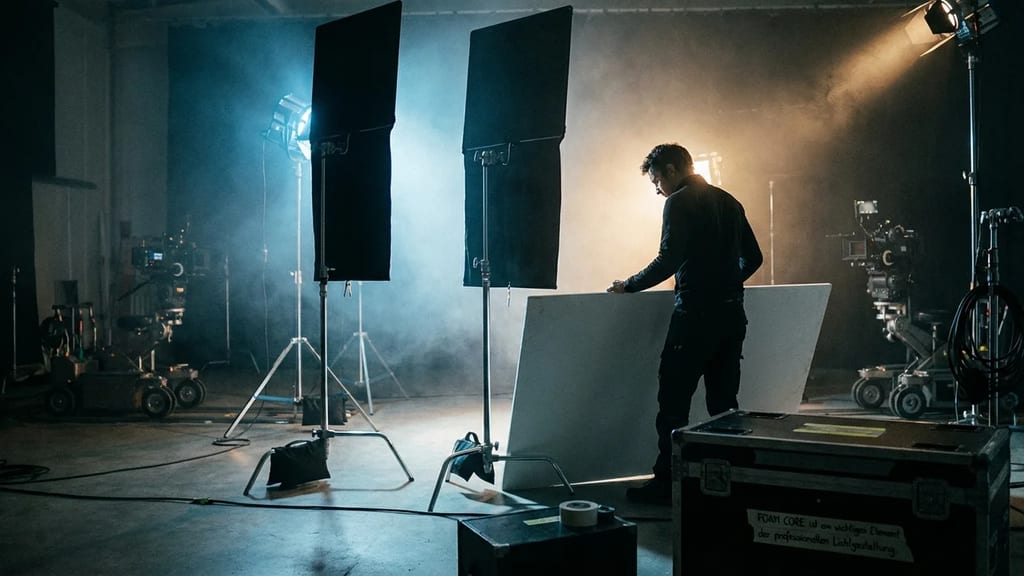
Lightweight foam board (5mm thick) with white or black surface used as reflectors or flags to control light on set.

Technical Details

Commercially available foam core boards consist of a 5 mm thick polystyrene core with a 0.2 mm paper facing. The white surface reflects 85-90% of incident light with a reflection angle of nearly 180°, creating soft, diffuse light. Black variants absorb 95% of the light. Professional versions feature a matte vinyl coating that is more scratch-resistant than paper. The weight is approximately 280g per square meter.

History & Development

Foam core was developed in 1957 by the Monsanto company for architectural models and first found professional film application in 1972 through gaffer Joe Dunton on the set of "Cabaret." The breakthrough came in 1975 with "Jaws," where the boards were used as a cost-effective alternative to heavy plywood reflectors. Since the 1980s, they have been standard equipment in every lighting department.

Practical Use in Film

On "Blade Runner" (1982), Jordan Cronenweth used hundreds of foam core boards to create the replicants' characteristic rim light. The boards are typically positioned with C-stands and super clamps or held by assistants as handheld reflectors. Especially in close-ups, they fill shadows on the face without creating hard edges. For exterior shots, they serve as bounces for sunlight or HMI lights.

Comparison & Alternatives

Unlike silver reflectors, foam core boards do not create hotspots and are cheaper than professional textile reflectors (Flexfill). LEDs have partially replaced them as fill lights, but do not offer the same natural light quality. Modern alternatives include foldable reflectors with a white gold coating or digitally controllable LED mats, which however cost 10-20 times as much.

From the crafts

Perspectives

Cinematographer

Ich verwende Foam Core hauptsächlich zum Aufhellen von Schatten bei Gesichtsaufnahmen – eine 70x100cm Platte links von der Kamera gibt mir das perfekte Fill-Light ohne Doppelschatten. Bei Low-Key-Szenen nutze ich die schwarze Seite als Flag, um unerwünschte Reflexionen zu eliminieren und den Kontrast zu verstärken.

Director

Mit Schaumstoffplatten kann ich die Stimmung einer Szene subtil steuern – weiches Bouncing für intime Momente, harte Schatten ohne Reflektor für dramatische Konflikte. Besonders bei Dialogen lasse ich den Fokuspuller kleine Platten halten, um die Augen der Schauspieler zum Leuchten zu bringen, ohne dass es künstlich wirkt.

Producer

Eine Foam Core-Platte kostet 8-15 Euro und ersetzt Equipment im Wert von mehreren hundert Euro – das ist pure Kosteneffizienz. Wir kaufen immer 20-30 Stück pro Produktion, da sie bei Transport leicht knicken, aber selbst mit Verschleiß bleiben die Beleuchtungskosten minimal im Vergleich zu gemieteten Reflektoren.

More in the lexikon

Related terms

Test your knowledge

Quiz

1. Zu welchem Department gehört „Schaumstoffplatte"?

2. Wie viele verschiedene Fachperspektiven bietet dieser Eintrag?

Report an error
From the Filmfarm ecosystem

Understand visual language, budget productions, connect crew.

The Lexikon is part of the Filmfarm ecosystem — alongside budgeting (FilmBalance), an industry magazine (FilmCircus) and crew networking (FilmCall, CrewMesh). One shared vocabulary for the whole production.

FilmFarm FilmRadarComing soonFilmPulseComing soonFilmNumbersComing soonFilmCapitalComing soonFilmLabComing soonFilmBalanceComing soonFilmCircusComing soon