Filmlexikon.
Support
Flektogon 35
Camera · Terms

Flektogon 35

Murnau AI illustration
flow para roll take

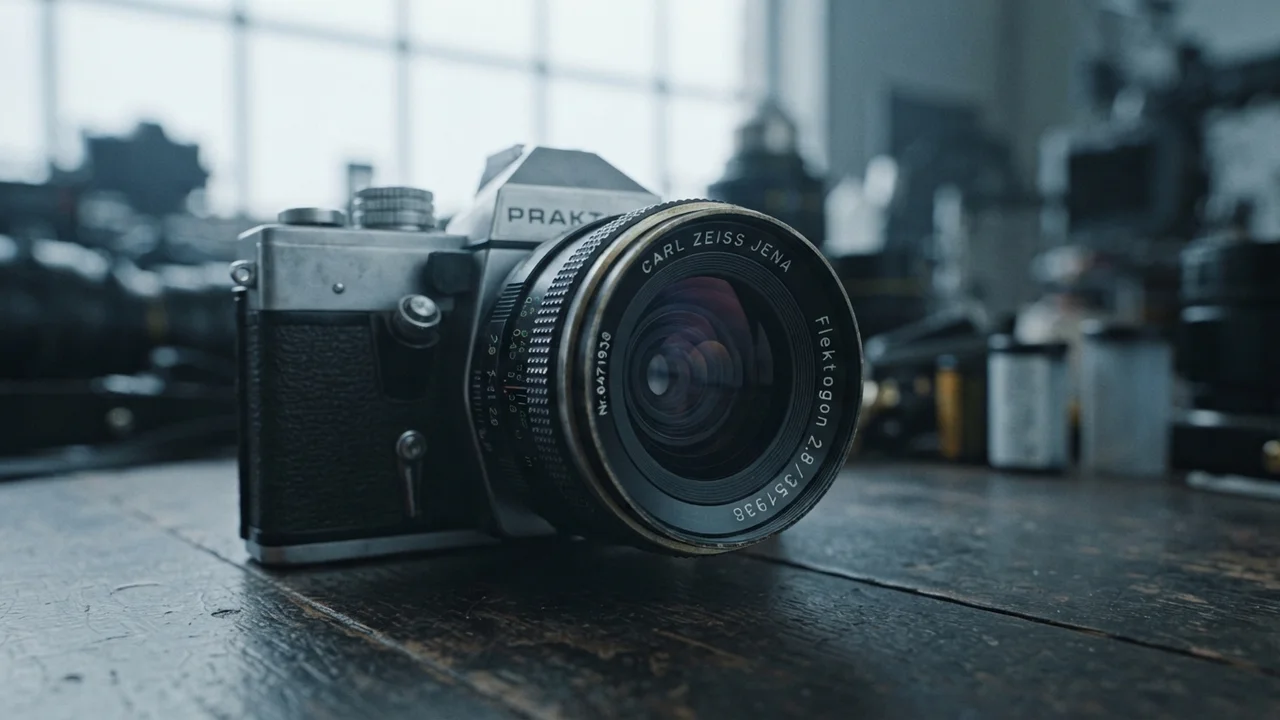
Carl Zeiss Jena wide-angle lens (35mm, f/2.4–2.8) with retrofocal design for SLR cameras; signature optic of Eastern Bloc film production, 1960s–1980s.

Technical Details

The Flektogon 35 existed in several versions: the early f/2.8 variant (1961-1975) with a preset aperture, the later f/2.4 version (1965-1990) with a semi-automatic aperture, and the final f/2.8 MC version with multi-coating. Its retrofocus design allowed for flange-distance compliant mounting on single-lens reflex cameras despite its short focal length. The lens weighed 280-320g depending on the mount and featured a 58mm filter thread. Its minimum focusing distance was 19cm, which was exceptionally close for its time.

History & Development

Carl Zeiss Jena developed the first Flektogon 35 in 1961 under the direction of Erhard Glatzel as a response to Western wide-angle designs like the Zeiss Distagon. Mass production began in 1962 for cameras in the Pentacon series. The more light-sensitive f/2.4 version followed in 1965 and was produced until the fall of the Berlin Wall in 1989. After reunification, Carl Zeiss ceased production as the lens line was not integrated into the new product range.

Practical Use in Film

Eastern European film productions extensively used the Flektogon 35 for landscape and architectural shots. DEFA utilized it in films like "The Legend of Paul and Paula" (1973) for wide-angle city views. The lens is characterized by high sharpness extending to the image corners and moderate distortion, but it is prone to flares when shooting into the light. Its retrofocus design produces a characteristic bokeh rendering with a slight nervousness in out-of-focus areas.

Comparison & Alternatives

Unlike the West German Zeiss Distagon 35mm, the Flektogon has a different lens arrangement with fewer elements, leading to a different rendering. Modern alternatives like the Zeiss Distagon T* 35mm f/2 or Sigma Art 35mm f/1.4 offer higher light sensitivity and better coatings, but they do not achieve the specific image characteristics of the Flektogon. Collectors today particularly value the MC versions due to their rarity and the distinctive East German image look.

From the crafts

Perspectives

Cinematographer

Das Flektogon 35 liefert mir einen sehr charakteristischen Look mit leichtem Kontrast-Abfall zu den Rändern, der Bilder organischer wirken lässt als moderne Konstruktionen. Die Naheinstellgrenze von 19cm ermöglicht dramatische Vordergrund-Hintergrund-Kompositionen, allerdings muss ich bei Sonnenlicht eine Gegenlichtblende verwenden, da es stark zu Flares neigt.

Director

Ich nutze das Flektogon bewusst für Szenen, die eine nostalgische oder authentische Anmutung brauchen - der leichte Vintage-Look unterstützt perfekt Rückblenden oder Erinnerungssequenzen. Die spezifische Art, wie es Hauttöne und Farben rendert, verleiht Charakterporträts eine warme, menschliche Qualität, die bei digitalen Objektiven oft verloren geht.

Producer

Vintage-Objektive wie das Flektogon sind mittlerweile Kostenfaktor geworden - gute Exemplare kosten 800-1500 Euro und brauchen oft Wartung oder Adapter für moderne Kameras. Dafür spare ich mir teure Post-Production-Looks, da der charakteristische Bildstil direkt in der Kamera entsteht, was unterm Strich Zeit und Budget spart.

More in the lexikon

Related terms

Test your knowledge

Quiz

1. Zu welchem Department gehört „Flektogon 35"?

2. Wie viele verschiedene Fachperspektiven bietet dieser Eintrag?

Report an error
From the Filmfarm ecosystem

Understand visual language, budget productions, connect crew.

The Lexikon is part of the Filmfarm ecosystem — alongside budgeting (FilmBalance), an industry magazine (FilmCircus) and crew networking (FilmCall, CrewMesh). One shared vocabulary for the whole production.

FilmFarm FilmRadarComing soonFilmPulseComing soonFilmNumbersComing soonFilmCapitalComing soonFilmLabComing soonFilmBalanceComing soonFilmCircusComing soon