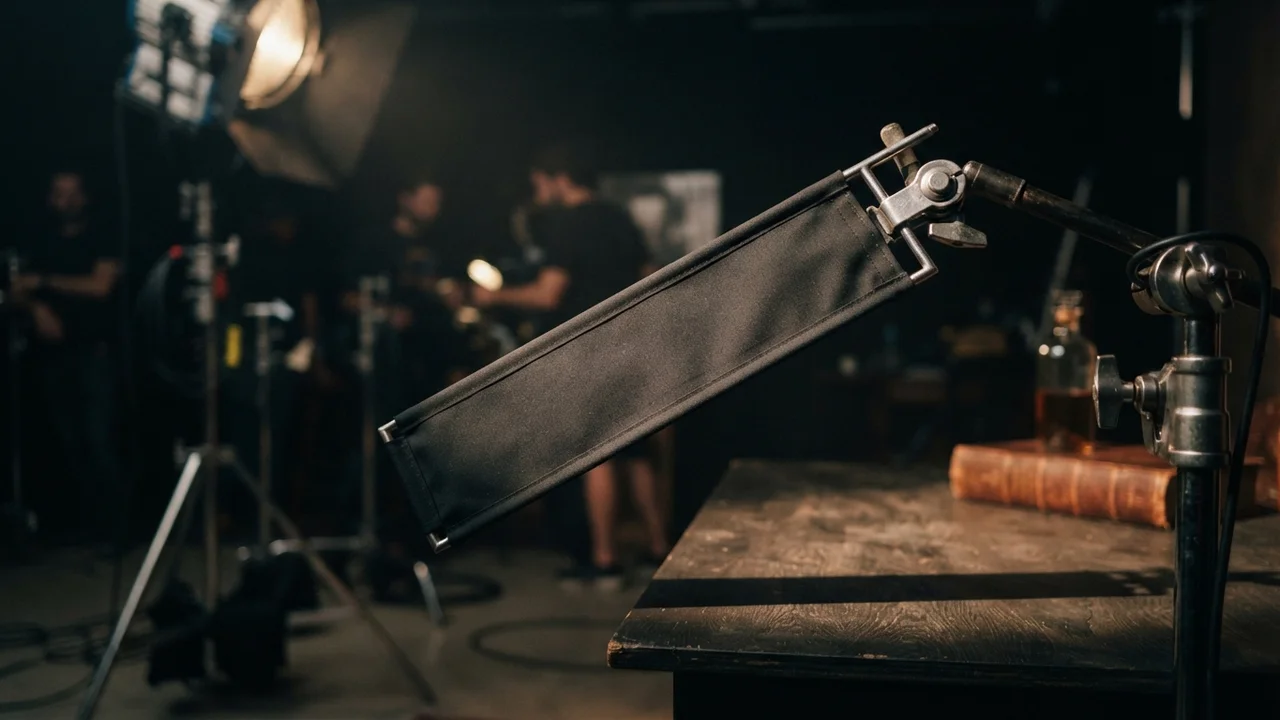
Technical Details
Fingers consist of a rectangular aluminum frame with stretched black molton (cotton fabric, 300-400 g/m²) or duvetyne. The frame features a standard 5/8-inch spud (Baby Pin) for attachment to C-stands or gripheads. Solid fingers block light completely, while silk/net fingers operate with 1/4, 1/2, or 1-stop diffusion. Professional models from manufacturers like Matthews Studio Equipment or Kupo weigh between 0.8-2.1 kg depending on size.
History & Development
Fingers evolved in Hollywood during the 1930s as miniature versions of large flags. The precise designation was established by cinematographer Gregg Toland, who first systematically used them in "Citizen Kane" (1941) for selective facial modeling. In the 1960s, Mole-Richardson introduced standardized dimensions. Modern carbon fiber variants since 2010 have reduced weight by 40% while maintaining stability.
Practical Use in Film
Fingers precisely cut off individual light sources without affecting the overall setup. In portrait shots, they shade one half of the face or prevent lens flares in backlight. Christopher Nolan used them extensively in "The Dark Knight" (2008) for precise shadow control in interrogation scenes. For product shots, they eliminate unwanted reflections on glossy surfaces. The distance to the subject determines shadow hardness: 30 cm creates soft edges, 2 meters creates hard shadows. Fingers also enable selective lighting of individual eyes in close-ups.
Comparison & Alternatives
Fingers differ from cutters by their narrower width and greater mobility. Barn doors on lighting fixtures offer less precision as they remain mounted on the light source. Gobos, on the other hand, project shadows with defined patterns. Modern LED panels with app control partially replace mechanical fingers with digital masking functions. Cucoloris (cookies) create textured rather than linear shadows. During fast-paced shoots, crews prefer fingers due to their flexible positioning over permanently mounted solutions.