Filmlexikon.
Support
Film Burn
Editing · Terms

Film Burn

Murnau AI illustration
film transition butt cut straight cut negative cutting frame accurate cut out take blooper cut back

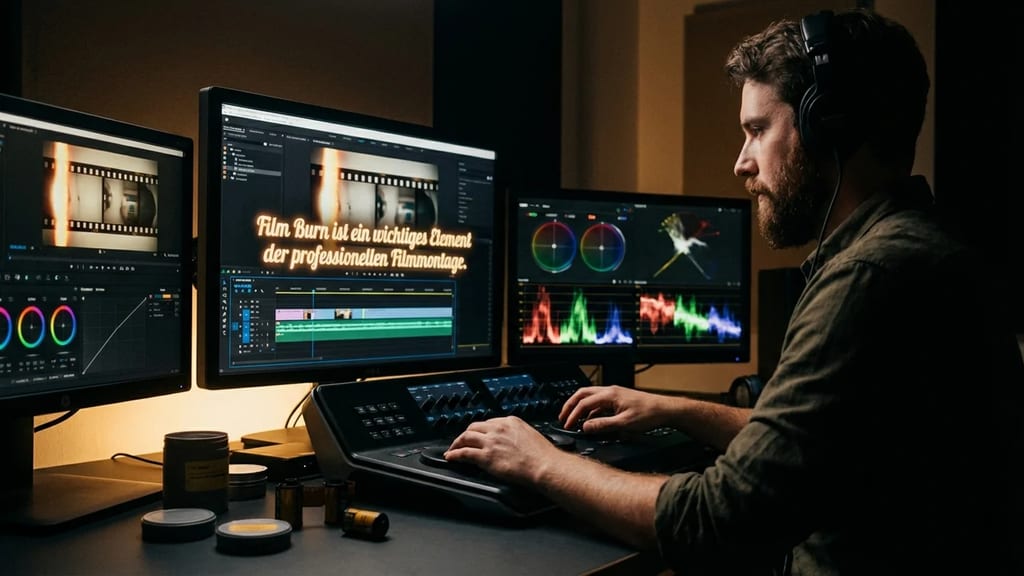
Film burn: overexposure effect created by light striking film stock at 18–20 stops above normal exposure, or digitally emulated in post-production.

Technical Details

True film burn occurs at exposure levels 18-20 stops above the norm, where the silver halide crystals become fully saturated. The characteristic shape results from the geometry of the film gate openings or lens flare. Digitally simulated versions use alpha channel masks with 60-80% opacity, combined with color temperatures between 3200K and 6500K. Standard plugins like FilmConvert or Magic Bullet offer pre-made film burn variants with adjustable intensity from 10-100%.

History & Development

Film burns first appeared in the 1890s during early camera experiments but were treated as unwanted production errors until the 1960s. Derek Jarman consciously used light leaks and burns as a stylistic device in "Sebastiane" (1976). Systematic application began in the 1990s with music videos by Chris Cunningham and Spike Jonze. Since 2010, digital film burn filters have become established in post-production, fueled by Instagram filters and vintage trends in mainstream cinema.

Practical Use in Film

Christopher Nolan used genuine film burns for dream sequences in "Interstellar" (2014), shot with faulty 65mm IMAX magazines. Spike Jonze's "Her" (2013) utilizes subtle digital burns for intimate smartphone scenes. In advertising, 40% of all fashion spots use film burn effects for organic nostalgia. The workflow usually occurs in color correction: burn layers are placed over the grading, with tracking data for camera movement. Advantages: immediate vintage atmosphere, masks harsh digital edges. Disadvantages: can be distracting, difficult to control with real burns.

Comparison & Alternatives

Film burn differs from light leaks in intensity – burns are completely overexposed, while light leaks still show color information. Lens flares are caused by lens reflections, not film material defects. Modern alternatives include ARRI Alexa Look Files with integrated burn simulation or BlackMagic DaVinci Resolve plugins. For high-budget productions, real burns are created with controlled 16mm film strips and digitally composited. Low-budget projects use free After Effects presets or practical LED panels on set.
From the crafts

Perspectives

Cinematographer

Ich verwende Film Burns sparsam, da sie schnell die Aufmerksamkeit von der eigentlichen Bildkomposition ablenken können. Bei kontrollierten Burns setze ich kleine LED-Panels außerhalb des Objektivs ein, um natürliche Lichteintritte zu simulieren – das funktioniert besser als digitale Post-Effects. Der Trick liegt darin, den Burn im Sucher zu kontrollieren und maximal 30% des Bildbereichs zu betreffen.

Director

Film Burns nutze ich gezielt für emotionale Übergänge oder um subjektive Wahrnehmung zu visualisieren – besonders bei Erinnerungssequenzen oder unter Drogeneinfluss. In "Manchester by the Sea" hat Kenneth Lonergan ähnliche Techniken für Flashbacks verwendet, um die fragmentierte Erinnerung des Protagonisten zu unterstreichen. Wichtig ist die Dosierung: zu viele Burns verwässern die narrative Wirkung komplett.

Producer

Echte Film Burns bedeuten 15-20% Mehrkosten durch zusätzliche Takes und Filmmaterial-Verschwendung, plus Risiko für unbrauchbare Aufnahmen. Digital nachgestellte Varianten kosten 2-3 Stunden Color Grading pro Filmminute, also etwa 800-1200 Euro zusätzlich bei Standard-Tagessätzen. Ich kalkuliere immer beide Optionen durch – bei Budgets unter 500.000 Euro empfehle ich grundsätzlich die digitale Lösung.

More in the lexikon

Related terms

Test your knowledge

Quiz

1. Was beschreibt „Film Burn" am besten?

2. Zu welchem Department gehört „Film Burn"?

3. Wie viele verschiedene Fachperspektiven bietet dieser Eintrag?

Report an error
From the Filmfarm ecosystem

Understand visual language, budget productions, connect crew.

The Lexikon is part of the Filmfarm ecosystem — alongside budgeting (FilmBalance), an industry magazine (FilmCircus) and crew networking (FilmCall, CrewMesh). One shared vocabulary for the whole production.

FilmFarm FilmRadarComing soonFilmPulseComing soonFilmNumbersComing soonFilmCapitalComing soonFilmLabComing soonFilmBalanceComing soonFilmCircusComing soon