Filmlexikon.
Support
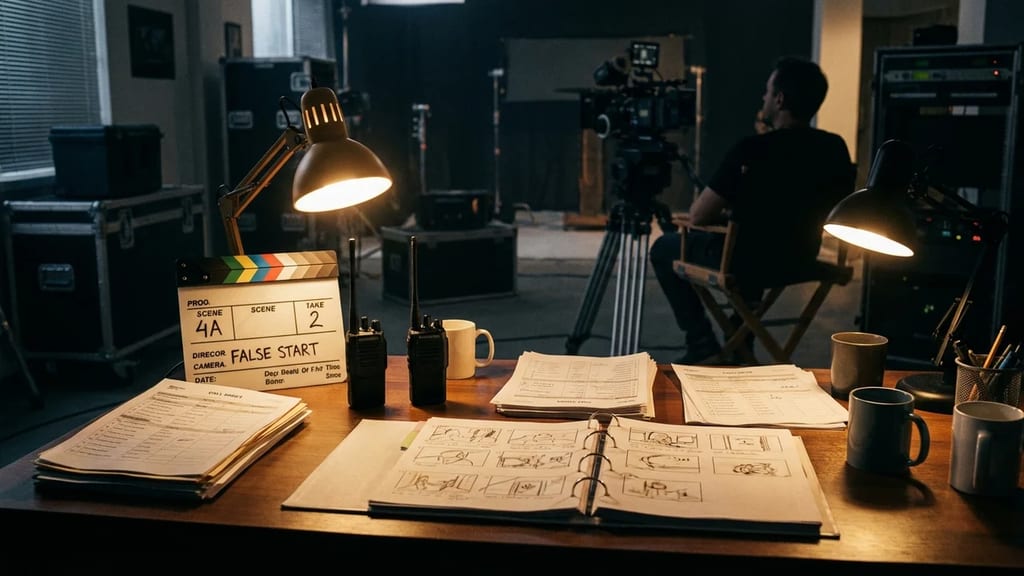
False Start
Production · Terms

False Start

Murnau AI illustration
first day of shoot forced call pre roll time

Aborted take within the first few minutes due to technical failure, performance issues, or production defects; requires resetting and restarting.

Technical Details

False starts are classified into three categories: Type-A (technical defects such as camera failure or sound issues), Type-B (performance errors by actors), and Type-C (organizational shortcomings like missing props or incorrect set lighting). Modern productions document false starts digitally in the Daily Production Report (DPR) with precise timestamps. For budgets exceeding $20 million, more than three Type-A false starts per shooting day automatically trigger an insurance notification.

History & Development

The first documented false start occurred in 1962 during the filming of "Lawrence of Arabia," when David Lean stopped shooting after 12 minutes because the 65mm Panavision cameras overheated at desert temperatures of 47°C. In 1974, the Directors Guild of America (DGA) introduced official false start protocols after Francis Ford Coppola had to restart seven times within a week on "The Conversation." Today, false starts are reduced by an average of 73% through pre-light checks and technical rehearsals.

Practical Application in Film

Steven Spielberg aborted shooting 23 times during "Jaws" in 1975 before the mechanical shark prop worked – a false start record that remains unbroken to this day. Christopher Nolan fundamentally plans for 15% buffer time for false starts, especially with practical effects like the truck flip sequences in "The Dark Knight." Digital-heavy productions like Marvel films reduce false starts through pre-visualization to under 2% of all setups, while independent productions with limited resources show up to an 18% false start rate.

Comparison & Alternatives

False starts differ from pickups (subsequent additional shots) and reshoots (complete re-recordings of entire sequences). While a false start occurs within the first minutes of recording, pickups take place in post-production. Modern Virtual Production with LED walls reduces weather-related false starts by 89%, but can create new technical false start sources through real-time rendering issues.

From the crafts

Perspectives

Cinematographer

Ich checke alle Kamera-Settings doppelt vor dem ersten "Action", weil ein Fehlstart durch falsche ISO-Werte oder defekte ND-Filter den ganzen Lichttag kosten kann. Bei komplexen Steadicam-Moves teste ich mindestens dreimal die komplette Bewegung, denn ein Fehlstart wegen technischer Probleme wirft mich als DoP sofort in Rechtfertigungszwang gegenüber der Produktion.

Director

Ein Fehlstart zerstört nicht nur den Rhythmus am Set, sondern auch die emotionale Energie der Schauspieler, die oft Stunden brauchen, um wieder in den Flow zu kommen. Ich nutze bewusst "Warm-up-Takes" als Puffer – lieber einen geplanten Probelauf als einen spontanen Fehlstart, der das Vertrauen des Teams erschüttert.

Producer

Jeder Fehlstart kostet mich durchschnittlich 8.400 Dollar bei einer Standard-Union-Crew von 45 Personen, plus Equipment-Standzeiten und mögliche Overtime-Zuschläge. Ich führe detaillierte Fehlstart-Statistiken und wechsele Heads of Department, wenn die Rate über 5% pro Drehtag steigt – das ist der Break-Even-Point für Effizienzmaßnahmen.

More in the lexikon

Related terms

Test your knowledge

Quiz

1. Zu welchem Department gehört „Fehlstart"?

2. Wie viele verschiedene Fachperspektiven bietet dieser Eintrag?

Report an error
From the Filmfarm ecosystem

Understand visual language, budget productions, connect crew.

The Lexikon is part of the Filmfarm ecosystem — alongside budgeting (FilmBalance), an industry magazine (FilmCircus) and crew networking (FilmCall, CrewMesh). One shared vocabulary for the whole production.

FilmFarm FilmRadarComing soonFilmPulseComing soonFilmNumbersComing soonFilmCapitalComing soonFilmLabComing soonFilmBalanceComing soonFilmCircusComing soon