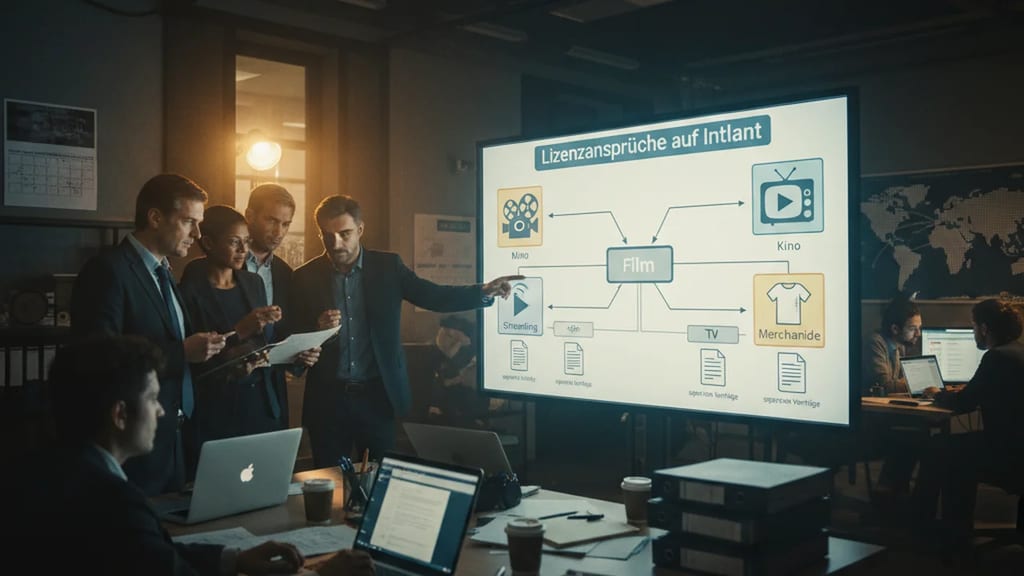
Rights to exhibit, distribute and monetize content — cinema, streaming, TV, home video each a separate deal. Who owns what, where, and for how long.
You're part of the editing team, and the producer calls: the distributor wants to release the film in cinemas, while a streaming platform is making an offer, and a TV station is getting in touch. Who is allowed to show what? When? Where? This is governed by exploitation rights — and they need to be negotiated and documented individually for each medium, each region, and each time period. Without clear rights management, your film grinds to a halt, earns nothing, and ends up in legal gray areas.
On set or in the cutting room, you often notice little of this — until your producer calls in a panic because a background song hasn't been cleared, or because an actor hasn't granted their image usage rights for streaming. This is the real problem: Exploitation rights are not one thing, but a hundred. The director has copyright on the film itself. The actors have personality rights. Composers, photographers, set designers — everyone holds a piece of the pie. The distributor buys the rights for theatrical release in specific countries for a certain period. The streaming service buys different rights. TV broadcasting again buys others. And each format — whether 4K, HD, mobile devices — can be regulated separately.
In practice, it works like this: the producer or line producer negotiates with talent, crew, and licensees. One contract for theatrical distribution in Europe for 7 years. Another for SVOD (Subscription Video on Demand) worldwide for 10 years. A third for Free-TV in Germany only. And then additional rights: can the streamer create trailers? Can they put the poster with your face on a bus? Can they show making-of content? Every question costs or saves money. On set itself, you make sure that no prominent brand logos or protected artworks appear in the frame — because these are also exploitation rights that you would otherwise have to buy out later.
The typical exploitation cascade looks like this: Theatrical Release (exclusive, 4-6 weeks) — then Premium VOD (paid online, 4-8 weeks) — then Pay TV (cable subscription) — then SVOD (Netflix, Amazon) — then Free TV (public broadcasters, cable). Each stage is licensed, time-limited, and geographically restricted. And a clock is always ticking: when do your rights expire? Then you have to renegotiate or you lose the platform.
As a DoP or editor, this doesn't directly concern you — but you'll feel it if the film can't be finished because music clearance is stalled, or if an expensive reshoot suddenly becomes necessary because a location release was forgotten. The nightmare of every producer: a film that no one is allowed to show because the rights are a mess.
Related terms
Quiz
1. Was beschreibt „Verwertungsrechte" am besten?
2. Zu welchem Department gehört „Verwertungsrechte"?