Cinematographer
Understanding emulsion characteristics helps cinematographers make informed film stock selections. Emulsion performance directly affects the visual output of cinematography.
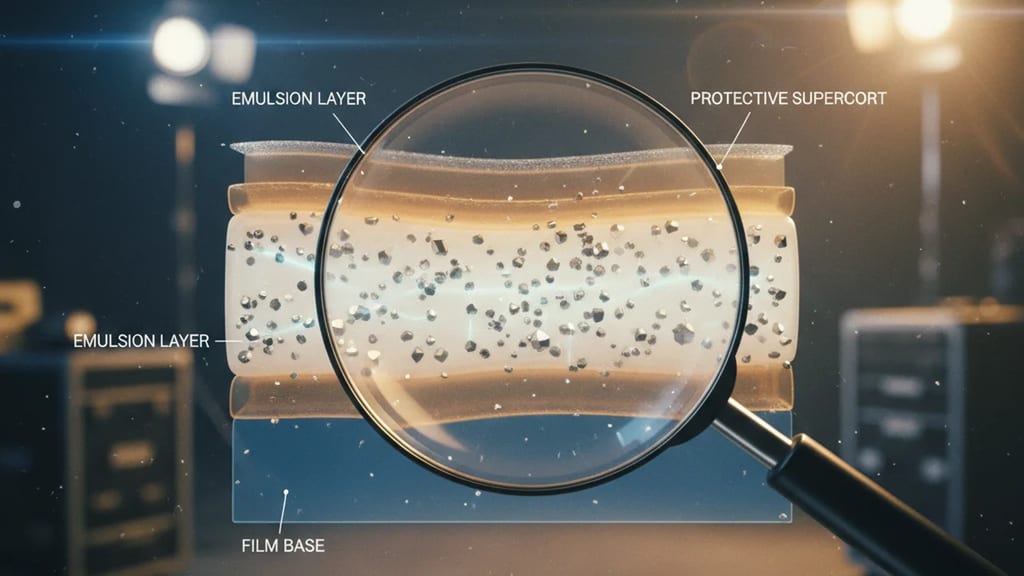
Film emulsion is the light-sensitive layer coating motion picture film, consisting of silver halide crystals suspended in gelatin. Emulsion quality, grain structure, and color rendering determine a film stock's fundamental characteristics.
Film emulsion is the light-sensitive layer on cinema film that enables analog cinematography. Billions of silver halide crystals in gelatin determine the sensitivity, grain, color rendition, and photographic behavior of the film stock.
Chemical Composition:
Multilayer Structure (Color Emulsion):
Black and White Emulsion:
Exposure to Image:
Development:
Crystal Properties:
ISO Rating:
Sensitivity Range:
Color Coupler Chemistry:
Color Science:
Exposure Tolerance:
Practical Implications:
Photographic Differences:
Emulsion Evolution:
ECN-2 Chemistry:
Push/Pull Processing:
| Parameter | Characteristic |
|---|---|
| Composition | Silver halide crystals in gelatin |
| Layers (Color) | 3 color-sensitive layers |
| Crystal Size | Larger = faster, coarser |
| Grain | Integral to the medium |
| Color | Determined by dyes in layers |
| Latitude | ±1.5 stops typical |
| Sensitivity | 50-800+ ISO range |
Negative Emulsion (Standard):
Understanding emulsion characteristics helps cinematographers make informed film stock selections. Emulsion performance directly affects the visual output of cinematography.
1. Zu welchem Department gehört „Emulsion"?
The Lexikon is part of the Filmfarm ecosystem — alongside budgeting (FilmBalance), an industry magazine (FilmCircus) and crew networking (FilmCall, CrewMesh). One shared vocabulary for the whole production.