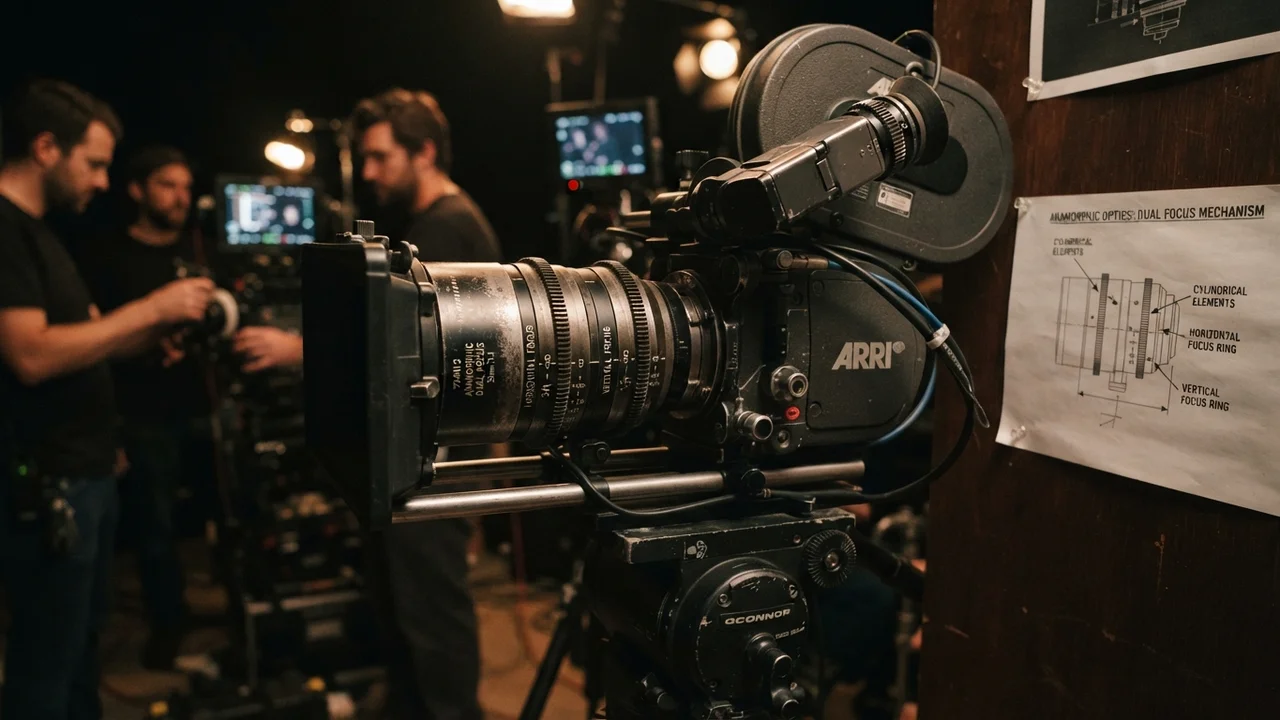
Technical Details
Dual focus anamorphic lenses consist of a front anamorphic element with focal lengths between 40mm and 100mm and a rear spherical lens. Horizontal compression is achieved by cylindrical lenses with a compression ratio of exactly 2:1. Typical apertures range from T2.8 to T4.0. The minimum focus distance varies between 0.9m and 1.5m depending on the focal length. The weight ranges between 2.5kg and 4.2kg per lens.
Classic manufacturers like Panavision, Hawk, and Kowa use different glass formulations that create characteristic bokeh effects and lens flares. The elliptical bokeh circles are caused by the cylindrical compression, while horizontal lens flares are caused by the elongated exit pupil.
History & Development
Henri Chrétien developed the first Hypergonar system for the French military in 1927. 20th Century Fox acquired the rights in 1952 and introduced CinemaScope with "The Robe" (1953). Panavision perfected dual focus technology from 1957 with the C-Series and later the E-Series in the 1970s.
Hawk Anamorphics achieved technical breakthroughs in the 1990s with improved coatings, and Kowa with more compact designs. Cooke launched the Anamorphic/i series in 2013, which offered a consistent T2.3 aperture for the first time.
Practical Use in Film
Sergio Leone used Techniscope anamorphic lenses for the Dollar Trilogy, creating iconic wide-angle close-ups. Ridley Scott used Panavision E-Series in "Blade Runner" (1982) to compress futuristic cityscapes. Christopher Nolan combines Panavision System 65 with 65mm film in "Dunkirk" (2017) for maximum resolution.
Dual focusing requires precise focus pulling by two assistants. Focus pullers must coordinate horizontal and vertical focus planes, which reduces working speed by approximately 30%.
Comparison & Alternatives
Single focus anamorphic lenses (Panavision G-Series, Arri Master Anamorphic) eliminate dual focusing through internal optical compensation. Spherical crop methods trim 16:9 sensors to 2.39:1 but forgo anamorphic characteristics.
Modern alternatives like Arri Signature Primes or Atlas Orion offer anamorphic aesthetics with spherical ease of use. Dual focus systems remain indispensable for authentic vintage looks and extreme focal lengths below 35mm.