Filmlexikon.
Support
DTS:X
Sound · Terms

DTS:X

Murnau AI illustration
dts digital theatre systems dts es dts es discrete dolby digital ex

Object-based 3D audio system by DTS Inc. supporting 48/96 kHz sampling and variable bitrate up to 24.5 Mbit/s. Enables precise spatial positioning of moving sound objects; competes with Dolby Atmos.

Technical Details

DTS:X operates with sampling rates of 48 kHz and 96 kHz at bit depths of 16 and 24 bits. The data rate varies between 768 kbit/s and 24.5 Mbit/s, depending on the configuration. The system uses MDA (Multi-Dimensional Audio) for object positioning and is backward compatible with DTS-HD Master Audio. DTS:X supports static and dynamic audio objects, with the latter able to change their position during playback. Decoding is renderer-based, allowing the system to be flexibly adapted to different speaker configurations.

History & Development

DTS Inc. announced DTS:X in April 2014 at NAB Show, with the first commercial implementation occurring in 2015. The first feature film with a DTS:X soundtrack was "Crimson Peak" (2015) by Guillermo del Toro. In 2016, it was introduced for the home cinema market with corresponding AV receivers. DTS developed the system as a direct response to Dolby Atmos, adopting the object-based audio concept. In 2018, DTS expanded the system with DTS:X Pro for professional applications, supporting up to 64 objects simultaneously.

Practical Application in Film

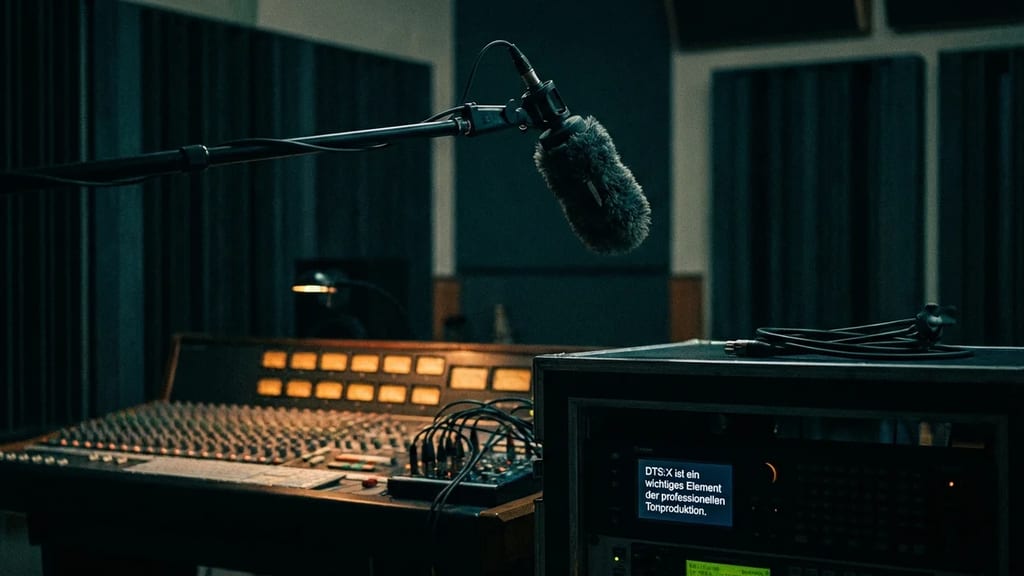
DTS:X enables precise positioning of sound effects, such as helicopters flying overhead or raindrops falling from above. "Mad Max: Fury Road" (2015) utilized DTS:X for the spatial positioning of vehicle sounds. Production takes place in specialized mixing studios with DTS:X-enabled monitoring systems. Sound engineers can move objects in real-time within the 3D space and program their movement paths. The DTS Suite mastering software allows for the creation of final DTS:X masters for cinema and home cinema.

Comparison & Alternatives

DTS:X directly competes with Dolby Atmos, but offers a more open licensing structure and allows for post-production user adjustments of object positions via an app. While Dolby Atmos is the market leader in cinemas, DTS:X positions itself more strongly in the home cinema sector. Compared to traditional 5.1 or 7.1 systems, DTS:X offers significantly more precise spatial positioning. IMAX Enhanced integrates DTS:X as an audio component. Auro-3D from Auro Technologies follows a different, channel-based approach with vertical layers.
From the crafts

Perspectives

Cinematographer

Obwohl DTS:X primär ein Audiosystem ist, beeinflusst es meine Bildgestaltung bei der Planung von Sequenzen mit spezifischen Raumbewegungen. Wenn ich weiß, dass ein Objekt akkurat im 3D-Audioraum positioniert wird, kann ich Kamerabewegungen entsprechend choreografieren, um die auditive Immersion visuell zu unterstützen. Die Kombination aus präziser Bildkomposition und objektbasiertem Audio verstärkt die räumliche Wirkung erheblich.

Director

DTS:X eröffnet mir neue narrative Möglichkeiten durch die präzise Positionierung von Geräuschen und Atmosphären im dreidimensionalen Raum. Ich kann Spannungsmomente verstärken, indem ich bedrohliche Sounds gezielt hinter dem Zuschauer platziere, oder emotionale Szenen durch subtile Raumbewegungen von Musik unterstützen. Die Technologie wird zum dramaturgischen Werkzeug, das die Immersion und emotionale Wirkung meiner Geschichte verstärkt.

Producer

DTS:X-Produktion erfordert spezialisierte Mischstudios und verlängert die Postproduktion um etwa 10-15 Prozent, was zusätzliche Budgetplanung von 50.000 bis 150.000 Euro je nach Projektgröße bedeutet. Die Lizenzkosten sind niedriger als bei Dolby Atmos, dafür ist die Marktdurchdringung geringer. Ich muss abwägen, ob die Zielgruppe und Verwertungskette die Mehrinvestition rechtfertigen, besonders bei internationalen Koproduktionen mit verschiedenen Audiostandards.

More in the lexikon

Related terms

Test your knowledge

Quiz

1. Zu welchem Department gehört „DTS:X"?

2. Wie viele verschiedene Fachperspektiven bietet dieser Eintrag?

Report an error
From the Filmfarm ecosystem

Understand visual language, budget productions, connect crew.

The Lexikon is part of the Filmfarm ecosystem — alongside budgeting (FilmBalance), an industry magazine (FilmCircus) and crew networking (FilmCall, CrewMesh). One shared vocabulary for the whole production.

FilmFarm FilmRadarComing soonFilmPulseComing soonFilmNumbersComing soonFilmCapitalComing soonFilmLabComing soonFilmBalanceComing soonFilmCircusComing soon