Filmlexikon.
Support
Double Ear
Lighting · Equipment

Double Ear

Murnau AI illustration
color temperature flow roll take

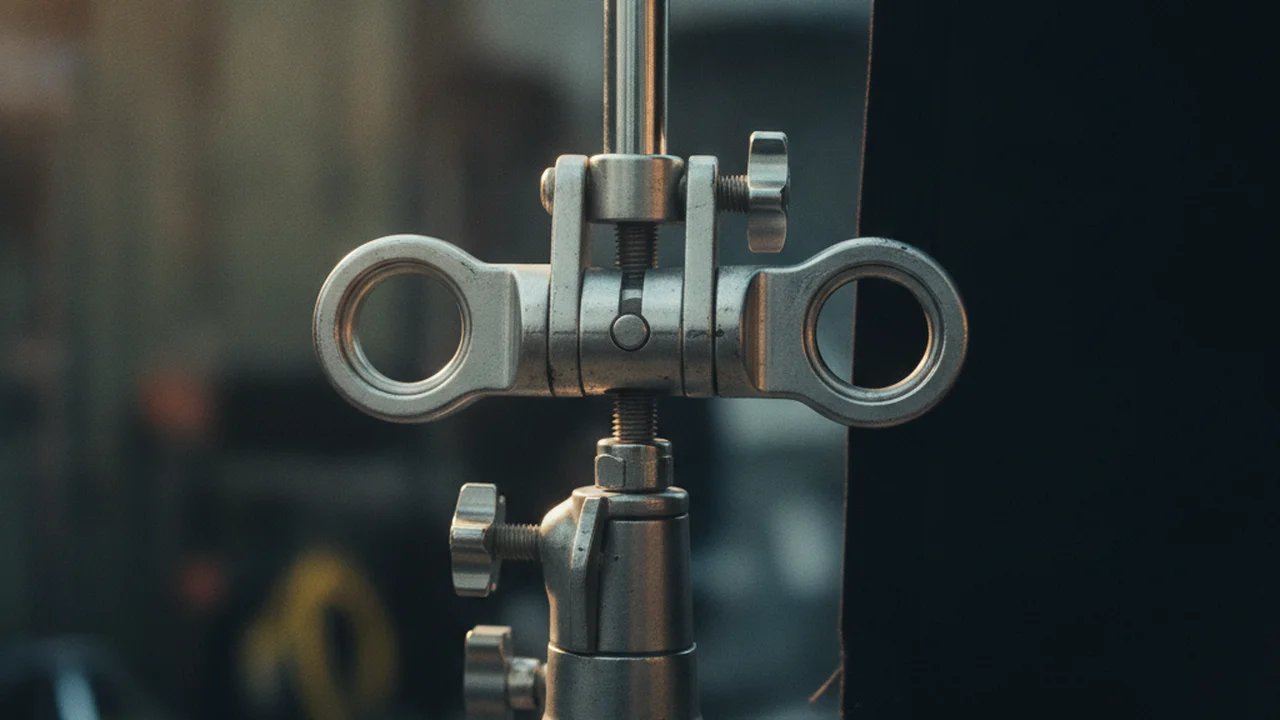
Double Ear: rigging system for heavy spotlights featuring two mounting points spaced 120mm apart, rated for up to 50kg, enabling precise pan adjustments of ±90° horizontal.

Technical Details

Standard double ear mounts support loads up to 25kg on 16mm spigots and up to 50kg on 28mm versions. The distance between the two mounting points is standard 120mm, ensuring even weight distribution. The mount allows for ±90° horizontal pan and -45° to +30° vertical tilt. High-quality versions feature friction brakes with adjustable resistance between 5-15 Nm torque. Materials are typically anodized aluminum or, for high-performance versions, steel with black powder coating.

History & Development

The double ear construction evolved in the 1950s from the need to safely position heavy studio lights. Mole-Richardson introduced the first standardized system in 1953, following several accidents with simple suspensions. By 1967, the 28mm standard was established for lights weighing over 10kg. Modern CNC-milled versions since the 1990s offer more precise tolerances and reduced play in the bearing points.

Practical Use in Film

Double ear mounts are primarily used with heavy tungsten lights such as 5kW or 10kW Fresnel spots. In "Blade Runner 2049" (2017), DoP Roger Deakins used over 200 double ear-mounted Arri T12 and T24 for interior lighting. The rigid mounting prevents unwanted movement during vibrations but leads to longer setup times compared to quickly adjustable systems. During rigging, two people must work in coordination as both mounting points need to be engaged simultaneously.

Comparison & Alternatives

In contrast to a single ear mount, the double ear offers significantly higher load capacity and stability. Junior Pins (16mm) and Senior Pins (28mm) as direct connections are faster to handle but less flexible in orientation. Modern quick-release systems like the Manfrotto Super Clamp combine the stability of the double ear with tool-free mounting but cost three times as much. Lighter-weight LED panels are increasingly making double ear mounts redundant.

From the crafts

Perspectives

Cinematographer

Ich setze Doppelohr-Fassungen ein, wenn ich schwere Tungsten-Scheinwerfer für harte Schatten oder starke Backlight-Effekte benötige, da nur sie die nötige Stabilität für präzise Lichtführung bieten. Die starre Montage gibt mir die Sicherheit, dass sich während langer Takes nichts verschiebt, auch wenn am Set Bewegung herrscht. Bei schnellen Lichtwechseln zwischen Setups vermeide ich sie jedoch wegen der umständlichen Montage.

Director

Für mich bedeuten Doppelohr-montierte Scheinwerfer die Möglichkeit, sehr starke, gerichtete Lichtakzente zu setzen, die dramatische Stimmungen verstärken – etwa harte Seitenlicht-Effekte oder markante Schatten an Wänden. Die schweren Lampen erzeugen die klassische Hollywood-Anmutung, die moderne LED-Technik oft nicht erreicht. Allerdings muss ich bei der Tagesplanung berücksichtigen, dass Lichtumbauten mit diesen Systemen deutlich mehr Zeit benötigen.

Producer

Doppelohr-Systeme bedeuten höhere Personalkosten, da immer zwei Beleuchter für das Rigging benötigt werden und die Umrüstzeiten länger dauern als bei modernen Schnellverschlüssen. Die Anschaffungskosten sind mit 150-300€ pro Fassung moderat, aber die schweren Tungsten-Scheinwerfer treiben die Stromkosten hoch und erfordern stärkere Generatoren. Bei Budgets unter 500.000€ empfehle ich meist den Umstieg auf leichtere LED-Alternativen mit einfacheren Befestigungssystemen.

More in the lexikon

Related terms

Test your knowledge

Quiz

1. Zu welchem Department gehört „Doppelohr"?

2. Wie viele verschiedene Fachperspektiven bietet dieser Eintrag?

Report an error
From the Filmfarm ecosystem

Understand visual language, budget productions, connect crew.

The Lexikon is part of the Filmfarm ecosystem — alongside budgeting (FilmBalance), an industry magazine (FilmCircus) and crew networking (FilmCall, CrewMesh). One shared vocabulary for the whole production.

FilmFarm FilmRadarComing soonFilmPulseComing soonFilmNumbersComing soonFilmCapitalComing soonFilmLabComing soonFilmBalanceComing soonFilmCircusComing soon