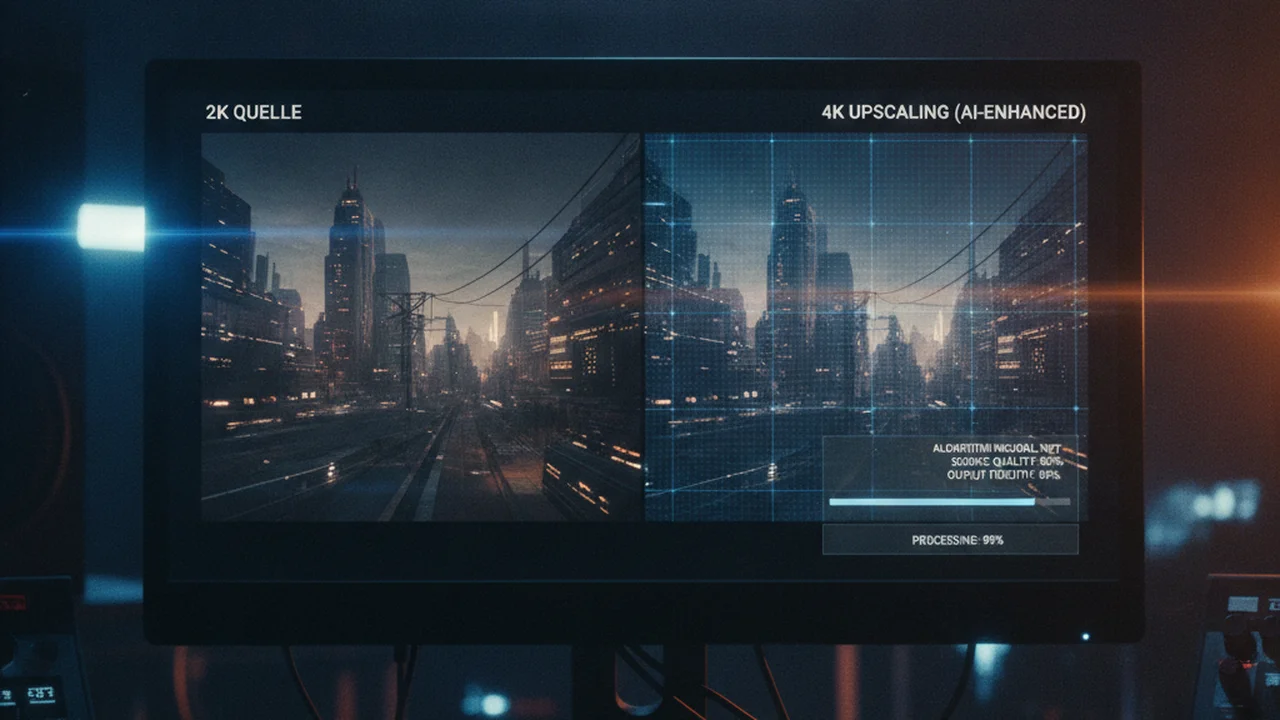
Post-production upscaling of lower-resolution footage to higher formats — 2K to 4K via AI or interpolation. Quality depends entirely on source material and algorithm.
You're sitting in front of a 2K DCP and are tasked with upscaling it for a 4K cinema release — welcome to digitally expanded cinema. It sounds simpler than it is. You can't just set the scaling factor to 2.0 and hope it looks good. What happens is: the algorithm tries to invent missing pixel information. This works if your source material is clean and processed with modern upsampling methods — but it remains a compromise.
In practice, you distinguish between two scenarios here. First situation: You have native 2K material (film scanned, digitally shot in 2K) which was always your final resolution. Here you need intelligent software — Topaz Gigapixel, Adobe Super Resolution, or specialized VFX tools like uprez modules — that utilize AI-powered interpolation. These systems analyze local structures and attempt to plausibly expand textures. The result is significantly better than naive bilinear scaling, but honestly: it's not the same as native 4K material. The second situation is more insidious: You have compressed 2K material, for example, from DCP decoding or as H.264. This is where it gets problematic — artifacts, blocking, color fringing multiply during upscaling.
On set or in post, you quickly notice where the limits lie. Fine textures — fabric, skin, bokeh quality — suffer the most. In visual effects, image expansion is an emergency tool: when VFX shots are rendered in 2K, but the master needs to be in 4K. You don't simply re-render (too expensive, too long), but intelligently scale up. Grading and sharpening afterwards are mandatory — without them, the blown-up images will appear soft and matted.
Important: Do not confuse this with interpolation, which expands temporal motion between frames. Image expansion works spatially. And yes — if the budget allows, native 4K re-rendering or native upscaling during production is always the better option. Digitally expanded cinema is pragmatism, not a quality goal.
Related terms
Quiz
1. Was beschreibt „Digitale Bildvergrößerung" am besten?
2. Zu welchem Department gehört „Digitale Bildvergrößerung"?