Technical Foundations
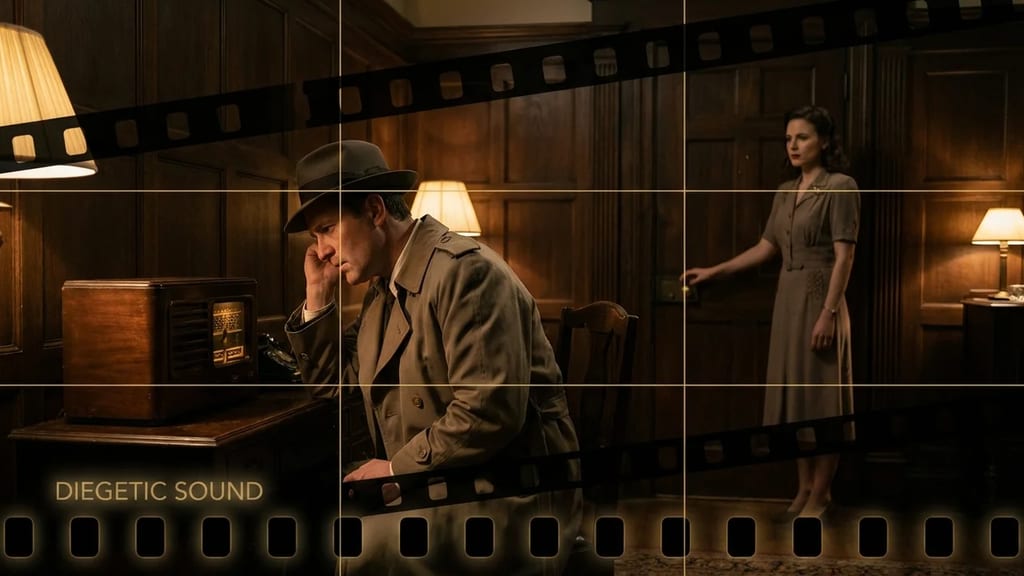
Diegetic sound (from the Greek "diegesis," meaning "narrative") is any sound that originates from the film's world and can be perceived by the characters. In contrast to non-diegetic sound (such as film score), which only the audience hears, diegetic sound is part of the physical reality of the scene.
What is diegetic sound?
Classic examples:
- Dialogue between actors
- Music from a radio (character can hear it)
- Telephone ringing
- Car engine sound when car is shown
- Footsteps when actor walks across floor
- Doorbell
- Background noise (traffic, people talking) in the scene's environment
- Music that character plays (guitar, piano)
Test rule: If the character in the film can see or react to the source, the sound is diegetic.
Non-diegetic sound for contrast
Non-diegetic sound is sound that the characters do not hear:
- Film score (orchestral music for emotional effect)
- Voice-over narration (character speaks to audience, not to other characters)
- Ambient music (sound design element for audience emotion)
- Sound effects that dramatically support the scene (thunder for fear, for example)
Example scene with diegetic and non-diegetic sound
Scenario: Character sits alone in living room, grieving
Diegetic sound:
- Character breathing (diegetic – the character is breathing)
- Clock ticking on wall (diegetic – is in the room)
- Car driving by outside (diegetic – outside in the world)
- Character could turn on radio (diegetic)
Non-diegetic sound:
- Film music score (string music) plays over scene (non-diegetic – character does not hear this)
- Voice-over narration of the character (non-diegetic – inner thoughts, not dialogue)
Sound mixer approach:
- Diegetic sound: room-based, with reverb and spatial positioning (simulates 3D room acoustics)
- Non-diegetic sound: stereo-based, no room reverb (universal "over-the-scene" music)
Technical treatment of diegetic sound
1. Room sound characteristics
Diegetic sound must replicate the acoustic properties of the room:
| Room type | Characteristics | Audio treatment |
|---|
| Small room | Little reverb, tight reflections | Short early reflection (10-20ms), minimal reverb |
| Large hall | Much reverb, long reflections | Longer reverb (2-5 seconds), broad frequency spectrum |
| Outdoors (open air) | No reflections, long distance | No reverb, distance attenuation (higher frequencies quieter) |
| Car interior | Small room, hard surfaces | Short reverb, very "dry" and close |
| Bathroom | Tile reflections, high-frequency boost | Bright, "brilliant" reverb, +3-6dB above 2kHz |
2. Spatial positioning
Diegetic sound is spatially positioned:
Example:
A scene in a living room:
- Radio plays music (left side of room)
- Car horn sounds outside (from window, right)
- Character speaks (center, loud)
In the stereo mix:
- Radio: Left (~-6 dB, 80% Left, 20% Right)
- Car horn: Right (~-8 dB, 20% Left, 80% Right)
- Character: Center (~0 dB, 50% Left, 50% Right)
This creates a 3D spatial experience – the audience can "localize" where the sounds are in the room.
3. Distance simulation
Diegetic sound becomes quieter the farther it is from the camera:
Inverse square law (fundamental acoustic principle):
If a sound source is twice as far away, the volume drops by approximately 6 dB.
Practical example:
- Character speaks from close proximity: -6 dBFS (very loud)
- Character speaks 3 meters away (in another room corner): -12 dBFS (half as loud)
- Character speaks 10 meters away (outside): -18 dBFS (very quiet, nearly inaudible)
This is consistently applied to diegetic sound.
4. Frequency filtering at distance
The farther a sound source is, the more high frequencies are absorbed (by air and material):
Near field (< 2 meters):
- Full frequency response (20 Hz - 20 kHz)
Mid distance (2-10 meters):
- Reduced highs (-6 dB above 5 kHz)
- Full bass still present
Far field (> 10 meters):
- Heavily reduced highs (-12 dB above 5 kHz)
- Mids also reduced (-3 dB above 1 kHz)
- Dominant bass
Audio technique: A low-pass filter (e.g., cutoff at 4-5 kHz) acoustically simulates distance.
5. Diegetic sound through obstacles
When diegetic sound comes through walls, doors, or other objects:
Example: dialogue through closed door
- Original dialogue (close): dialogue is clear, brilliant
- Through wooden door: dialogue is muffled, high frequencies reduced
- Through thick concrete wall: dialogue barely intelligible, only bass rumbles
Audio technique:
- Increasingly aggressive low-pass filtering
- Level reduced (absorption through material)
- Reverb diminished (wall reflects less)
Practical applications of diegetic sound
1. Radio music in scene
Setup:
A character sits in a car and listens to the radio.
Diegetic treatment:
- Radio music has limited frequency band (simulates cheap radio speaker)
- Minimal bass (below 60 Hz attenuated)
- Heavily reduced highs (above 12 kHz attenuated)
- Focus on midrange (250 Hz - 4 kHz)
- Level can change when character adjusts volume (fader moves)
- Audio can sound "distorted" if character turns it up too loud (simulates speaker clipping)
Sound mixer approach:
- Music is filtered with a bandpass EQ (only midrange frequencies pass through)
- Optional: add slight distortion/compression (sounds cheap and "real")
- Spatial: music comes from car center (stereo, but limited)
2. Telephone conversation
Setup:
Character is on a phone call with someone.
Diegetic treatment:
- Other person's voice is treated through telephone filter:
- Heavily reduced highs (above 3 kHz very quiet)
- Mono instead of stereo (telephone = mono)
- Slight distortion/compression (telephone codec effect)
- Slight delay or pitch-shift (simulates telephone processing)
- Character's voice is normal (he/she speaks in room, not through phone)
Sound mixer approach:
- Other person's voice treated with specialized telephone EQ
- Optional: vintage telephone emulation plugin (e.g., Waves StudioEQ with telephone preset)
3. Music that character plays
Setup:
Character plays guitar or piano in scene.
Diegetic treatment:
- The music is live recorded or very naturally sounding samples
- Must synchronize with actor's movement (foley synchronization)
- Acoustic properties of instrument must be realistic
- Acoustic guitar: wood resonances, string vibrations
- Piano: hammer sound, string vibrations, pedal noises
Sound mixer approach:
- Instrument recording with correct microphone placement (e.g., 30cm from soundhole)
- Minimal EQ (let it sound natural)
- Reverb/reverb according to room acoustics (not aggressive)
4. Ambient sounds (traffic, people, nature)
Setup:
Scene outdoors in front of busy street.
Diegetic treatment:
- Traffic sounds are continuously audible (not constant)
- Distant voices/people are muffled and unclear
- Nature sounds (birds, wind) have characteristic properties
Sound mixer approach:
- Multiple ambience layers:
- Distant traffic (-20 dB, low-pass filtered)
- Near birds (-15 dB, high-frequency)
- Wind (-10 dB, context-dependent)
- Dynamic variation (not static) – real environment is never constant
Common mistakes with diegetic sound
| Mistake | Symptom | Cause | Fix |
|---|
| Too much room reverb on diegetic sound | Sounds "distorted" or "unnatural" | Wrong reverb settings | More subtle reverb, specific room emulation |
| No distance simulation | Diegetic sound sounds closer than visually | No low-pass filter or level adjustment | Apply distance EQ |
| Wrong level balance | Character dialogue much louder than ambience | Dialogue peak is -3 dBFS, radio music is -25 dBFS | Better level planning, compression for dynamics control |
| Incorrect spatial positioning | Diegetic sound sounds "mono" or wrongly placed | No stereo positioning | Pan (left/right) based on visual location |
| Too artificial radio filter | Radio doesn't sound authentic | Too aggressive low-pass or distortion | More subtle filtering, check spectral balance |
Summary
Diegetic sound is the "reality" of the film – the world the characters inhabit. Good diegetic sound treatment makes the difference between a film that feels "real" and one that feels "artificial."
Best practice:
- Spatial characteristics: reverb and reflections according to room type
- Distance simulation: level and EQ based on visual distance
- Frequency filtering: reduce high frequencies at distance
- Continuous nature: ambient sounds are dynamic, not static
- Subtlety: diegetic sound should often be inaudibly subtle to be believable
A film with realistic, well-treated diegetic sound feels much "more real" and immersive than a film where everything is "score and voice-over."