Filmlexikon.
Support
Diagonal Lines
Art Department · Terms

Diagonal Lines

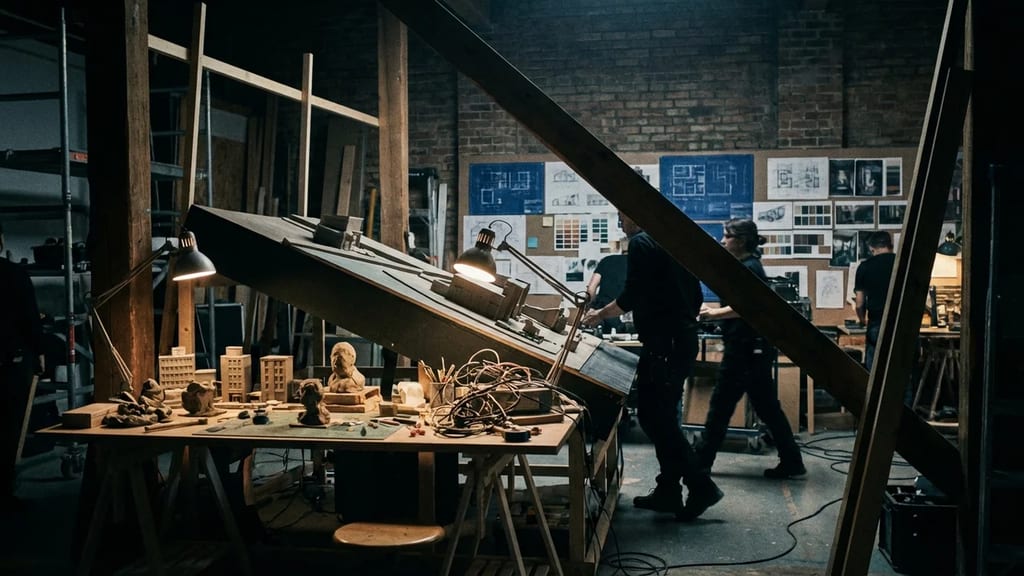
Murnau AI illustration
diagonal of the frame diagonal composition converging lines

Diagonal lines angled 15° or more from frame edges create visual dynamism and tension, contrasting with stable horizontals or commanding verticals.

Technical Details

Visually effective diagonal lines emerge from a minimum angle of 15° to the image edge and achieve maximum dynamism at 30-45°. When using wide-angle lenses (14-24mm), the diagonal effect is amplified by perspective distortion by a factor of 1.3-1.8. Telephoto lenses (85-200mm) compress diagonal structures and reduce their visual impact by approximately 40%. Three main types are distinguished: Leading Lines (guide to a focal point), Crossing Diagonals (intersect within the frame), and Implied Diagonals (created by object arrangement).

History & Development

Sergei Eisenstein systematically codified the use of diagonal composition for dramatic escalation for the first time in "The Capital" in 1929. Orson Welles perfected the technique in "Citizen Kane" in 1941 through extreme wide-angle optics (18.5mm Mitchell lenses) and deep focus. The Nouvelle Vague from 1959 consciously broke with classical diagonal rules – Godard contrasted static horizontals with expected dynamism in "Breathless." Digital color correction since the 1990s has enabled subsequent amplification of diagonal structures through selective contrast adjustment.

Practical Application in Film

Stanley Kubrick used the diagonal structures of the space station in "2001" (1968) with 50mm lenses for spatial orientation. Brian De Palma staged stair diagonals as a metaphor for power in "Scarface" (1983) – the final sequence exclusively uses 35mm focal lengths for optimal diagonal effect. Christopher Nolan constructed artificial diagonals in "Inception" (2010) through rotating sets – the hotel corridor sequence was created by a 90° rotation of the entire set. Modern Steadicam operation enhances diagonal movements through continuous camera pans along architectural lines.

Comparison & Alternatives

Horizontal lines convey calm and stability, vertical lines suggest power and strength – diagonal lines, in contrast, create unease and movement. Curved lines (Curves) appear more organic but less directed than precise diagonals. S-Curves combine diagonal elements with softer transitions. Modern CGI post-production can tilt horizontal shots retrospectively in 5°-10° increments, but artificially generated diagonals appear more static than practically photographed ones.

From the crafts

Perspectives

Cinematographer

Ich setze diagonale Linien gezielt durch Objektiv-Wahl und Kameraposition um - ein 24mm-Weitwinkel verstärkt natürliche Diagonalen, während ich mit 85mm bewusst komprimiere. Die Steadicam-Führung entlang diagonaler Architekturelemente erzeugt fließende Dynamik, wobei ich den Neigungswinkel nie über 45° treibe, da sonst die Bildwirkung kippt.

Director

Diagonale Linien transportieren emotionale Unruhe und Spannungsaufbau - ich inszeniere Konfliktsituationen bewusst entlang schräger Tischkanten oder Treppen. In Actionsequenzen verstärken sich diagonale Bewegungsachsen durch entsprechende Setgestaltung, während ich für ruhige Charaktermomente horizontale Kompositionen bevorzuge.

Producer

Diagonale Kompositionen erfordern spezifische Location-Scouting und Set-Design-Abstimmung, was etwa 15-20% mehr Vorbereitungszeit bedeutet. Rotierende Sets für künstliche Diagonalen kosten zusätzlich 50.000-150.000 Euro, rechtfertigen sich aber durch reduzierte CGI-Kosten in der Postproduktion.

More in the lexikon

Related terms

Test your knowledge

Quiz

1. Zu welchem Department gehört „Diagonale Linien"?

2. Wie viele verschiedene Fachperspektiven bietet dieser Eintrag?

Report an error
From the Filmfarm ecosystem

Understand visual language, budget productions, connect crew.

The Lexikon is part of the Filmfarm ecosystem — alongside budgeting (FilmBalance), an industry magazine (FilmCircus) and crew networking (FilmCall, CrewMesh). One shared vocabulary for the whole production.

FilmFarm FilmRadarComing soonFilmPulseComing soonFilmNumbersComing soonFilmCapitalComing soonFilmLabComing soonFilmBalanceComing soonFilmCircusComing soon