Overview
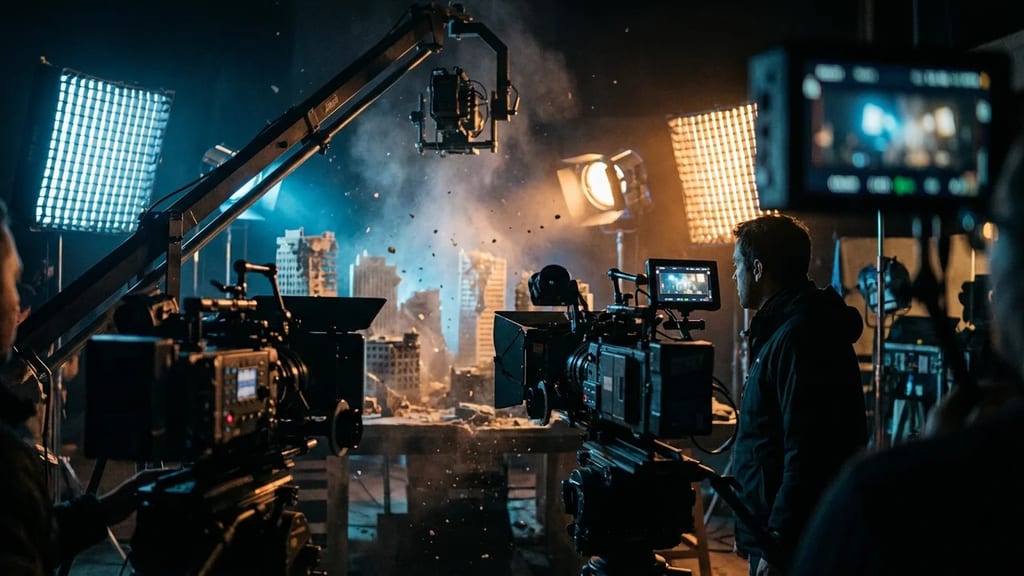
"Destruction" in the context of cinematography refers to filming an event that can physically only occur once because an object, set, or vehicle is actually destroyed – such as an explosion, a collapsing building, a car crash, or a shattering breakaway prop. Unlike with normal shots, there is no possibility for a second take: once the effect is triggered, the source material is consumed.
This leads to the central technical consequence for cinematography: such moments are typically not covered sequentially from different angles, but rather simultaneously with multiple cameras. The team positions cameras at as many vantage points and focal lengths as possible at the same time to capture the unrepeatable moment from multiple perspectives.
Distinction
The term must be distinguished from the VFX discipline of the same name: in digital effects work, "Destruction" refers to the simulated breaking and shattering of objects (rigid body simulation, Voronoi fracture, debris and particle systems, for example in Houdini) and belongs there to the domain of FX artists. In the cinematography context, on the other hand, it concerns the *recording* of a real, one-time destruction event executed on set.
Related to this is the "Overlapping Method" (coverage without a classic master shot) described in cinematography theory, which, according to Wikipedia, is used precisely when an action cannot be repeated, "such as when an item is destroyed at the end of the scene".
On-Set Application
The preparation for such shots is closely intertwined with SFX/pyrotechnics, stunts, and safety. Cameras close to the action are often operated remotely or protected because their loss is factored in.
- Terminator 2 (Cyberdyne building demolition/fireball): Since the effect of the real building demolition could only be triggered once, the team covered it with a multitude of cameras from all accessible angles and distances – including a helicopter camera and remote-controlled cameras placed close to the action, as their loss was anticipated.
- Apocalypse Now (Napalm explosion): The unrepeatable fireball was captured with multiple cameras running simultaneously (different film stocks, lenses, and speeds) from various viewpoints.
Due to this uniqueness, destruction shots count among the classic cases of a "one-take": the shot has to be right the first time – out of necessity, not style.