Overview
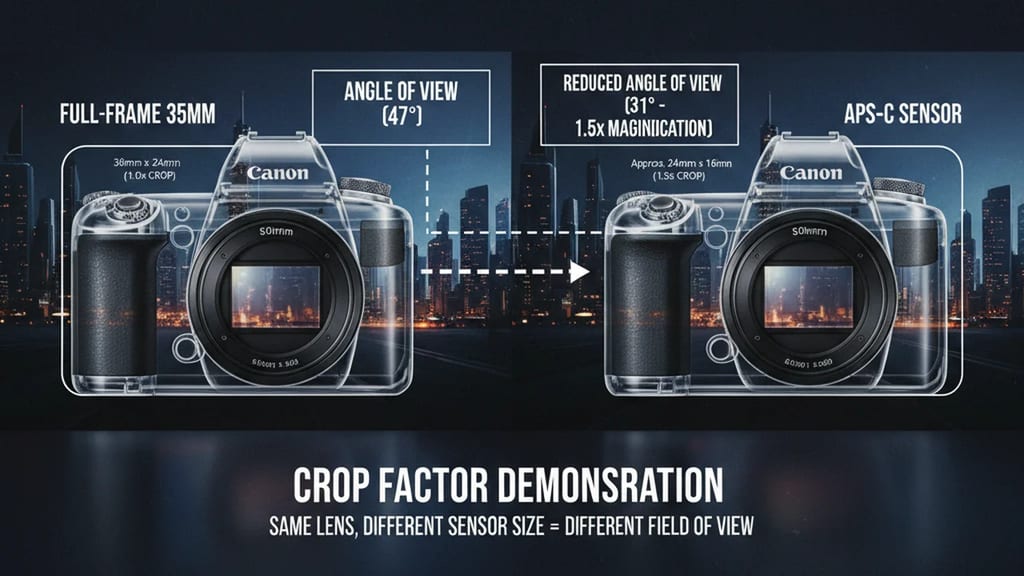
The crop factor (also known as the format factor or focal length multiplier) is a purely technical ratio in camera technology. It describes how much smaller the diagonal of an image sensor is compared to the 35mm film reference format (full frame, 36 x 24 mm). Since a smaller sensor captures a narrower field of view with the same focal length, the crop factor is used to convert the effective image impact of a lens to the familiar 35mm scale.
Important: The crop factor is not equipment, nor is it a lighting or grip tool, but a calculated metric. The physical focal length of a lens remains unchanged; only the portion of the image circle used by the smaller sensor alters the perceived field of view.
Calculation
The crop factor is derived from the ratio of the diagonal of the full-frame sensor (approximately 43.3 mm) to the diagonal of the sensor being used:
- Crop Factor = Diagonal Full Frame / Diagonal Sensor
- Equivalent Focal Length = Physical Focal Length x Crop Factor
Example: A 50mm lens on a sensor with a crop factor of 1.5 produces the same field of view as a 75mm lens on full frame (50 x 1.5 = 75).
Crop Factors of Common Sensor Formats
| Format | Crop Factor |
|---|
| Full Frame / 35mm (36 x 24 mm) | 1.0x (Reference) |
| APS-H | approx. 1.3x |
| APS-C (Nikon DX, Sony, Fujifilm, Pentax) | approx. 1.5x |
| APS-C (Canon) | approx. 1.6x |
| Micro Four Thirds | approx. 2.0x |
The Super 35 cine format, depending on the shooting mode, falls between full frame and APS-C and has a crop factor of approximately 1.4 to 1.5x compared to full frame; the exact values vary depending on the camera and the sensor area used.
Significance on Set
The crop factor is relevant for lens planning: on a cropped sensor, a wide-angle lens results in a narrower field of view, making wide-angle shots more difficult and longer focal lengths appear tighter. It plays an indirect role in lighting planning, as smaller sensors tend to offer less surface area for light capture, and the depth of field is greater at the same field of view and aperture compared to full frame.