Technical Details
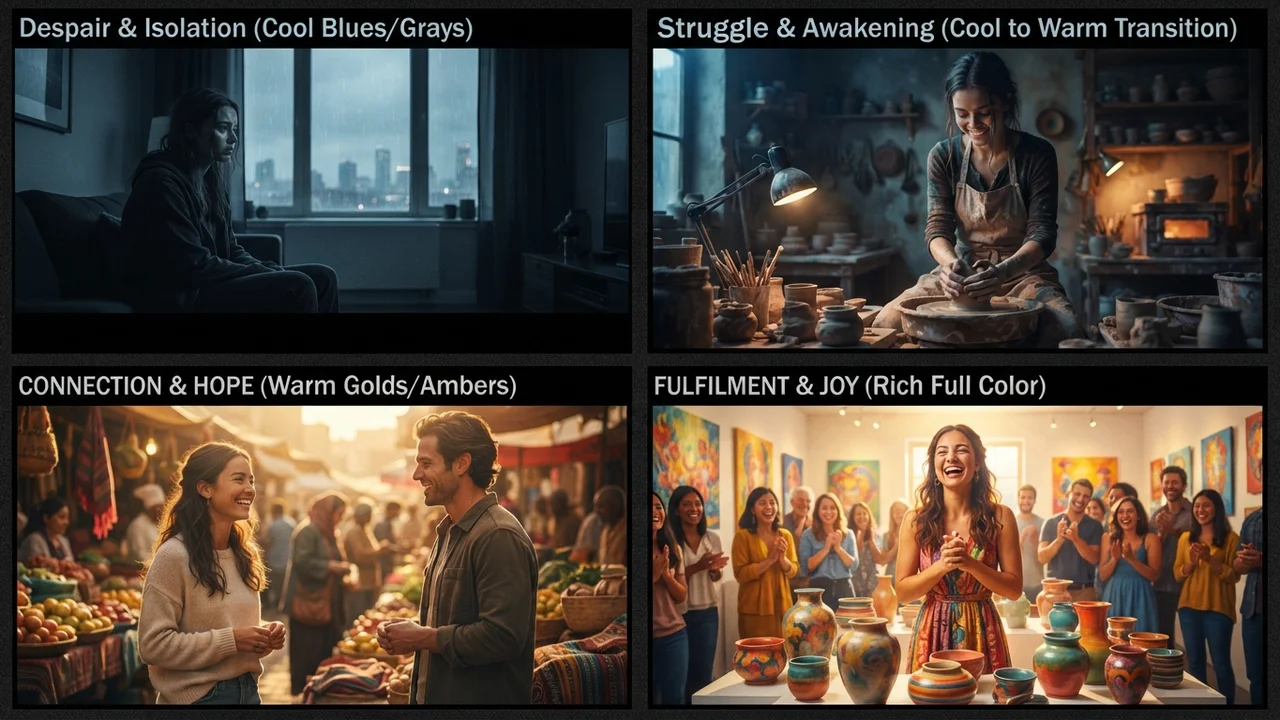
A professional color story defines primary colors (3-4 dominant tones), secondary colors (4-6 supporting hues), and accent colors (2-3 specific highlights). Documentation is done via Color Scripts with up to 200 individual frames for feature films. Modern workflows utilize DaVinci Resolve or Baselight with LUT (Look-Up Table) libraries of up to 65,536 color values per channel. Color temperature is precisely varied between 2700K (warm scenes) and 6500K (cool atmospheres).
A distinction is made between linear color stories (continuous development of a palette), cyclical systems (recurring color motifs), and contrapuntal approaches (deliberate color breaks at turning points).
History & Development
The first systematic color stories emerged in 1935 with "Becky Sharp" under Rouben Mamoulian, who specifically used three-color combinations for dramatic arcs. Powell and Pressburger perfected narrative color guidance in 1948 in "The Red Shoes" with 47 documented color transitions.
"Blade Runner" introduced digital color timing in 1982, and "Jurassic Park" established fully digital color workflows for the first time in 1993. Pixar began developing software-assisted Color Scripts from 2001 onwards, which are now the industry standard for animation and VFX-intensive productions.
Practical Application in Film
"Her" (2013) uses a four-color progression from warm orange (isolation) through red (infatuation) to cool blue (realization). "Mad Max: Fury Road" (2015) works with orange/blue contrasts in 89% of all shots. "Moonlight" (2016) develops three distinctly defined color worlds: magenta/green (childhood), blue/black (youth), yellow/blue (adulthood).
The workflow begins 8-12 weeks before the start of shooting with Color Script creation, continues through set decoration and costumes, and culminates in 2-4 weeks of color grading with up to 500 individual color corrections per feature film.
Comparison & Alternatives
Color story differs from simple color grading through its narrative conception already in pre-production. While a color palette defines static color compositions, a color story plans dynamic developments throughout the entire runtime.
Alternative approaches include monochrome color design (one dominant hue), complementary systems (two-color contrasts), or naturalistic color schemes without conceptual exaggeration. Streaming productions tend towards higher-contrast color stories due to smaller screen sizes and compressed data rates.