Overview
A Color Space defines the range of visible colors (the so-called gamut) that can be captured, processed, and reproduced, and how these colors are encoded as numerical values. A color space typically defines three components: the primary colors (position of red, green, and blue in the CIE color diagram), the white point, and the transfer function (gamma or tone curve that describes the relationship between signal value and brightness).
In film and TV production, the color space is a central parameter of color management: while image and light are physically generated on set, it is only the correct management of the color space throughout the entire chain – from camera recording through post-production to delivery – that ensures colors remain consistent and do not shift, clip, or lose detail.
Common Color Spaces in Film/TV
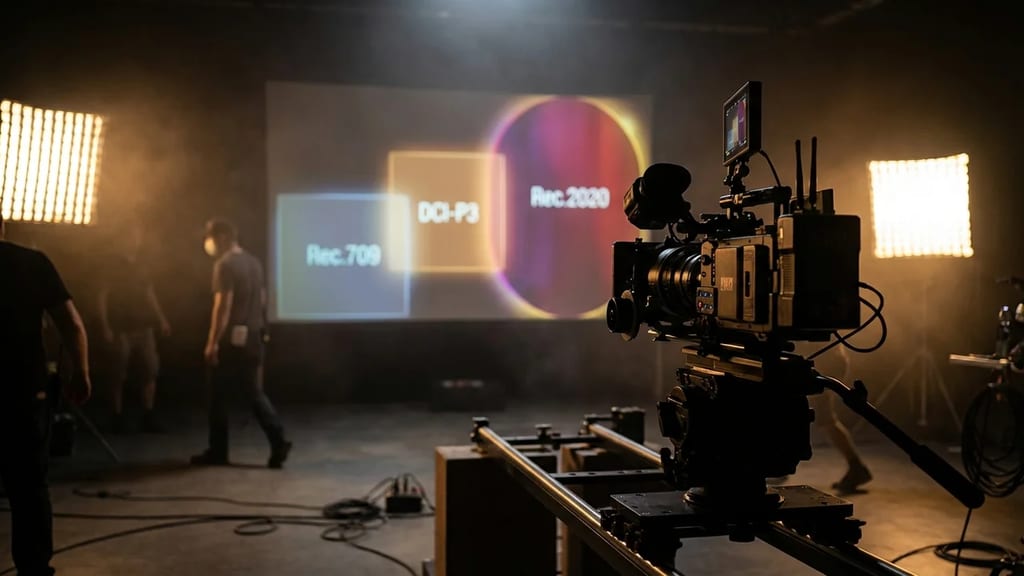
Color spaces differ primarily in the size of their gamut. Larger color spaces encompass smaller ones and can represent more saturated colors.
| Color Space | Defined by | Typical Use |
|---|
| Rec. 709 (BT.709) | ITU | HD Television, Standard Broadcast, and Web |
| DCI-P3 | Digital Cinema Initiatives (2005) | Digital Cinema Projection (DCP) |
| Rec. 2020 (BT.2020) | ITU | UHD/4K Television, HDR Playback (very wide gamut) |
| ACES / ACEScg | AMPAS (Academy) | Device-independent working and exchange color space |
In addition, there are manufacturer-specific, wide internal camera recording color spaces, usually combined with log encoding, such as ARRI Wide Gamut / LogC, Sony S-Gamut3 / S-Log3, RED REDWideGamutRGB, or Canon Cinema Gamut. These are converted in post-production into a working color space and finally into the delivery color space.
Use on Set and in Post-Production
On set, the color space is crucial for monitoring: recording monitors and on-set color (e.g., via LUT) map the camera signal recorded in a wide log color space to a displayable color space like Rec. 709, allowing image content and exposure to be assessed. The choice of recording and delivery color space must be decided early, as it influences exposure, contrast, and the assessment of light color (color temperature, saturation of light sources) on the monitor.
In post-production, the color space forms the basis of color grading. Systems like ACES serve as a device-independent framework into which camera material from different manufacturers is converted via Input Transforms, processed together, and then output via Output Transforms into the respective target color space (Rec. 709 for TV/Web, DCI-P3 for cinema, Rec. 2020 for HDR).