Overview
Color Sampling (also known as Chroma Subsampling) refers to the process by which digital cameras and codecs sample and store the color information of an image in relation to its brightness information. Instead of saving full RGB values for each pixel, the signal is decomposed into a luma component (Y', brightness) and two chroma components (Cb and Cr, color differences). The chroma resolution can then be reduced without significantly affecting the perceived image.
The reason for this lies in human perception: the eye perceives fine differences in brightness much more precisely than fine differences in color. Reducing the color resolution saves data rate and bandwidth – the perceived sharpness is largely preserved.
The Ratio Notation
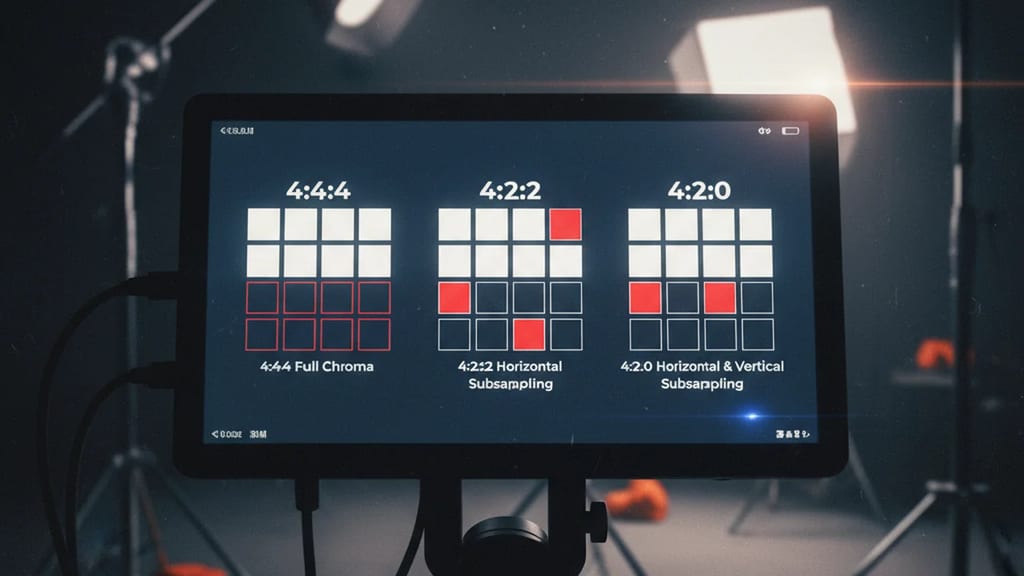
Color Sampling is specified as a ratio in the format J:a:b, which refers to an imaginary block of 4 pixels in width and 2 pixels in height:
- J – horizontal reference width of the luma signal (usually 4)
- a – number of chroma samples (Cb, Cr) in the first row of the block
- b – number of chroma samples that change between the first and second row. If b equals a, the second row is sampled independently; if b equals 0, there is no change compared to the first row – the chroma values are vertically shared (repeated).
The first number always represents the full luma resolution. The smaller the following numbers, the greater the reduction in color information.
Common Sampling Schemes
| Scheme | Chroma Resolution | Typical Use |
|---|
| 4:4:4 | Full resolution, no subsampling | High-end post-production, cinema, RGB workflows |
| 4:2:2 | Half horizontal chroma resolution | Professional broadcast, Digital Betacam, DVCPRO HD, ProRes |
| 4:2:0 | Quarter resolution (halved horizontally and vertically) | H.264/MPEG-2, Blu-ray, HDV, JPEG |
| 4:1:1 | Quarter horizontal chroma resolution | NTSC DV/DVCAM, DVCPRO |
In 4:2:0, the third number is precisely 0 because the chroma sampling does not change between the two rows: the color values are vertically combined, halving the chroma resolution horizontally and vertically. In 4:2:2, however, each row is sampled separately, which is why the vertical chroma resolution is fully preserved.
Use on Set and in Post
In practice, Color Sampling determines how much flexibility material offers in post-production. For greenscreen and keying work, as well as for extensive color grading, high chroma resolution is important because sharp color edges and clean cut-out edges are preserved. Therefore, 4:2:2 is considered the minimum standard for professional recording, while 4:4:4 (often as RGB) is used for maximum image quality in cinema pipelines.
Highly reduced schemes like 4:2:0 or 4:1:1 are primarily found in consumer-oriented formats and in heavily compressed delivery codecs. They are sufficient for playback but make keying and intensive color correction more difficult, as color edges can become frayed.