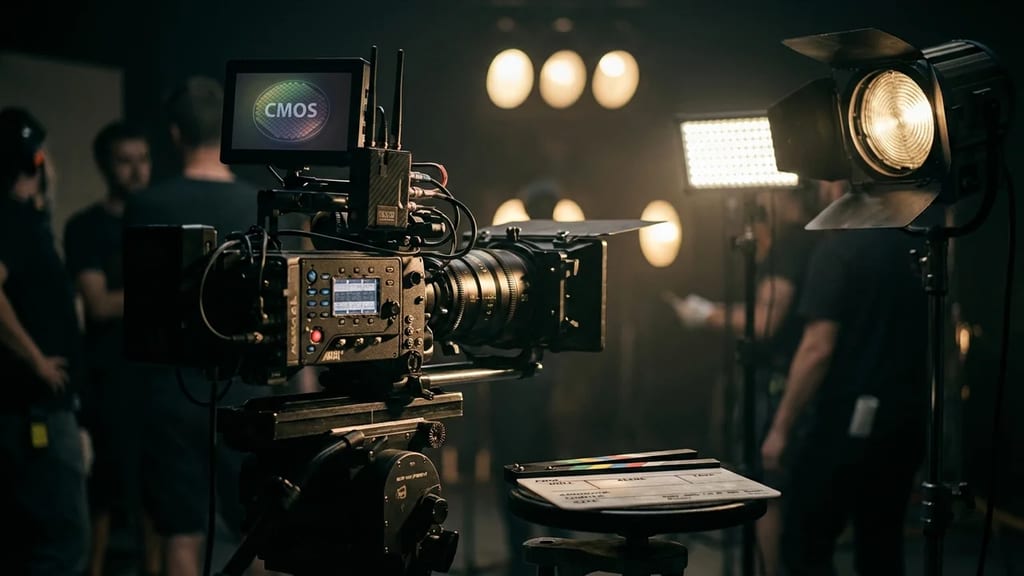
Overview
CMOS stands for Complementary Metal-Oxide-Semiconductor and refers to a semiconductor technology that forms the basis of the image sensor in camera technology. The CMOS sensor converts the light entering through the lens into electrical signals, which are then processed into a digital image. Today, practically all digital cinema cameras – including models from ARRI (ALEXA series), RED, and Sony – are based on CMOS sensors.
CMOS is the second major sensor type, alongside the older CCD (Charge-Coupled Device). While CCD sensors transport the charge of each pixel sequentially to a central amplifier, each pixel in a CMOS sensor has its own amplifier and readout circuitry (Active-Pixel Sensor, APS). This allows logic circuits, amplifiers, and analog-to-digital converters to be integrated directly onto the same chip.
Principle of Operation
In the Active-Pixel design, each pixel converts the charge collected by the photodiode element into an amplified voltage on the spot. The signals are read out row by row and column by column, processed in parallel via column amplifiers, and digitized on the chip. Advantages of this architecture:
- Low Power Consumption: Only one row of pixels needs to be actively read out at a time, and the chip operates with a low supply voltage.
- High Readout Speed: Parallel processing via columns and on-chip digitization allow for high frame rates.
- High Integration: Converters, clock generators, and processing logic are located on the same substrate as the pixel array.
Rolling Shutter vs. Global Shutter
The way a CMOS sensor is read out affects the motion rendition of the image:
| Readout Method | Functionality | Characteristics |
|---|
| Rolling Shutter | The sensor is exposed and read out row by row sequentially | Can exhibit distortions ("Jello effect", skew) with fast movements or pans; most common in cinema cameras |
| Global Shutter | All pixels are exposed and read out simultaneously | Distortion-free motion rendition, technically more complex |
The majority of CMOS sensors – especially in the cinema sector – use rolling shutter, as this allows for high image quality. Global shutter CMOS sensors are used in some Sony, Blackmagic, and AJA cameras.
On-Set Usage
For practical use on set, it is relevant that the rolling shutter can lead to distortions with very fast camera movements or fast-moving subjects; additionally, brightness bands can appear in the image with flickering light sources (e.g., undimmed LED or fluorescent lighting). ARRI has been developing its CMOS sensors together with semiconductor manufacturer onsemi since the ARRIFLEX D-20 (2005) and the first ALEXA (2010); according to the manufacturer, the ALEXA 35 achieves around 17 stops of dynamic range. CMOS sensors are now considered the standard for film-like image quality, high dynamic range, and good low-light performance.