Cinematographer
Clean Closing bedeutet: Der Take ist bis zum Schnitt verwendbar. Kein Wackler am Ende, kein Equipment im Bild – alles, was der Editor braucht.
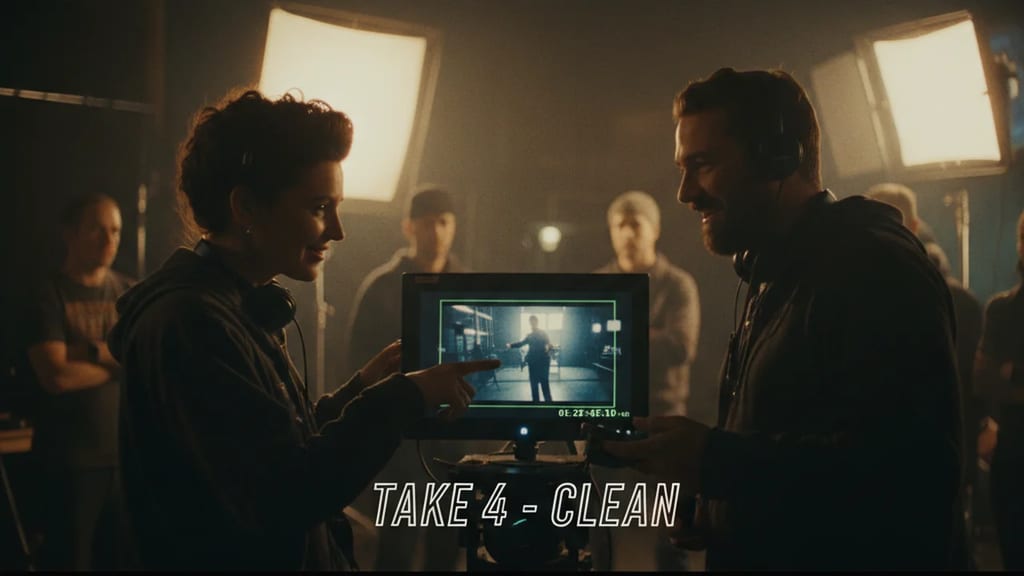
A take or shot that ends without technical problems or performance issues – properly framed action until director calls cut, with no bumps, equipment in frame, or actor mistakes near the end.
Clean Closing (Sauberer Abschluss) refers to a take or shot that ends without problems – correctly framed until the cut, without technical errors, performance issues, or visible equipment. The opposite is a "Dirty" or "Bumpy" Close.
| Aspect | Requirement |
|---|---|
| Framing | Correct until the end |
| Focus | Sharp until cut |
| Movement | Smooth, no shake |
| Performance | No errors at the end |
| Equipment | Nothing in frame |
| Sound | Clean until the end |
| Problem | Description |
|---|---|
| Camera Bump | Camera is jolted |
| Focus Drop | Focus lost |
| Boom in Frame | Microphone visible |
| Actor Break | Actor breaks character |
| Crew Movement | Shadows, reflections |
| Early Stop | Movement stops too soon |
| Phase | Relevance |
|---|---|
| Shooting | Take evaluation |
| Script | Note: "Clean" |
| Editing | Usability |
| Continuity | Connection possibility |
| Notation | Meaning |
|---|---|
| Clean | Fully usable |
| Clean Close | End usable |
| Clean Open | Beginning usable |
| Dirty | Problems present |
| Partial | Partially usable |
| Call | Meaning |
|---|---|
| "Good for edit" | Usable |
| "Clean take" | No problems |
| "We got it" | Take is good |
| "Problem at end" | Dirty Closing |
| "One more for safety" | Safety take |
| Reason | Explanation |
|---|---|
| Edit Flexibility | Length variable |
| Connections | To other shots |
| Transitions | Fades, cuts |
| Backup | If other take has issues |
| Cause | Prevention |
|---|---|
| Fatigue | Breaks, concentration |
| Timing | Clear communication |
| Equipment | Checks before take |
| Coordination | Rehearsals |
| Task | Person |
|---|---|
| Maintain Framing | Operator |
| Maintain Focus | 1st AC |
| Dolly End | Dolly Grip |
| Equipment | Entire team |
| Term | Meaning |
|---|---|
| Clean Entrance | Clean beginning |
| Clean Plate | Shot without actors |
| Clean Audio | Sound without problems |
| Clean Take | Entire take clean |
| Practice | Reason |
|---|---|
| Communication | "Rolling" to "Cut" |
| Concentration | Focused until the end |
| Safety Takes | Secure backup |
| Review | Check playback |
| Situation | Benefit of Clean Closing |
|---|---|
| Scene End | Natural exit |
| Transition | To the next shot |
| Alternative Cut | Longer version |
| Pace | Timing control |
Clean Closing is a fundamental professional practice. A take that ends cleanly gives the director and editor maximum flexibility – everyone on set is responsible for ensuring that takes remain usable until "Cut."
Clean Closing bedeutet: Der Take ist bis zum Schnitt verwendbar. Kein Wackler am Ende, kein Equipment im Bild – alles, was der Editor braucht.
Ein Clean Closing gibt mir Flexibilität im Schnitt. Ich weiß, dass ich diesen Take bis zum Ende verwenden kann, ohne im letzten Moment Probleme zu bekommen.
Clean Takes sparen Zeit in Post. Wenn Takes sauber enden, gibt es weniger Probleme mit Continuity und weniger Nacharbeit.
1. Zu welchem Department gehört „Sauberer Abschluss"?
2. Wie viele verschiedene Fachperspektiven bietet dieser Eintrag?
The Lexikon is part of the Filmfarm ecosystem — alongside budgeting (FilmBalance), an industry magazine (FilmCircus) and crew networking (FilmCall, CrewMesh). One shared vocabulary for the whole production.