Filmlexikon.
Support
Clamshell Lighting
Lighting · Terms

Clamshell Lighting

Murnau AI illustration
color temperature flow roll take

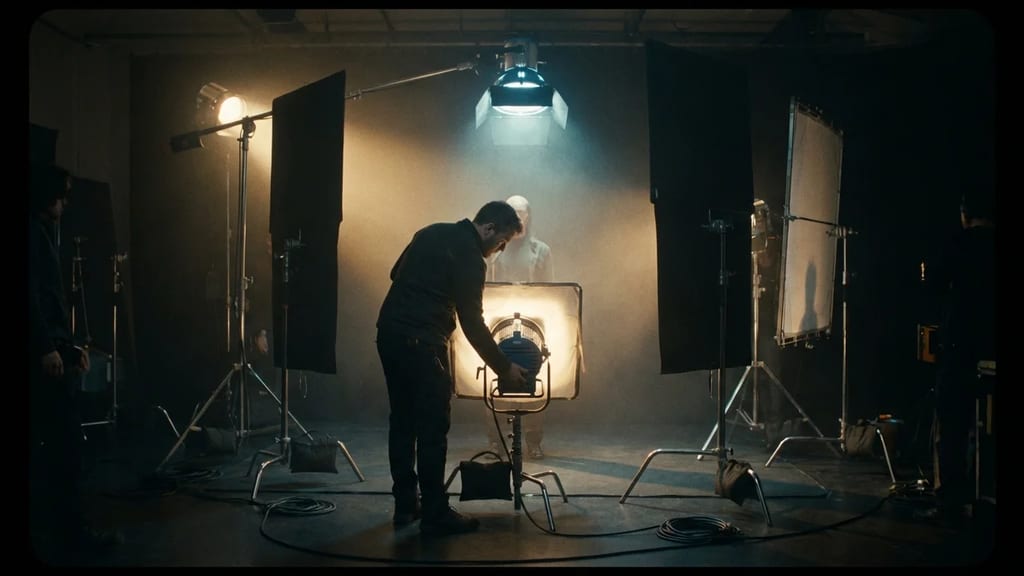
Two-source lighting setup: key light positioned 30–45° above, fill light 15–30° below camera axis. Creates soft, flattering illumination for close-ups and beauty shots.

Technical Details

The upper light source is typically positioned 30-45° above the camera axis, and the lower one 15-30° below the horizontal. Softboxes between 60x90 cm and 120x180 cm or Octaboxes with a diameter of 120-150 cm are commonly used. The fill light has 25-50% of the light output of the key light. For LED panels, the recommended minimum output is 200W for the lower light and 400-800W for the upper light. Fresnel lights require additional diffusion through frost or silk. The color temperature of both sources must match exactly – deviations exceeding 100K become visible.

History & Development

George Hurrell developed this technique in 1930 for Hollywood portraits and established it as the standard for glamour photography. Cinematographer Gregg Toland first systematically adapted the setup for film shoots in 1940 on "The Long Voyage Home." From the 1950s onwards, Clamshell Lighting became the standard for close-ups of female stars. With the introduction of HMI lights in 1972, Osram enabled higher light outputs with constant color temperature. Modern LED systems since 2010 allow for precise dimming of both levels without color shift.

Practical Application in Film

Ridley Scott systematically used Clamshell setups for Sigourney Weaver's close-ups in "Alien" (1979) to achieve eye reflections despite the dark atmosphere. Emmanuel Lubezki employed the technique in "The Revenant" (2015) with natural overhead light and reflectors as fill. Beauty shots in commercials often use 6:1 ratios for maximum contrast. The lower reflection eliminates under-eye bags and nasolabial folds, while the overhead light sculpts cheekbones. Disadvantages: unnatural lighting in extreme situations, complex setup for camera movements.

Comparison & Alternatives

Rembrandt lighting creates more dramatic shadows through side placement but is less suitable for beauty shots. Butterfly lighting uses only overhead light without fill – resulting in harsher shadows under the nose and chin. Ring lights achieve similar soft shadows but without directional light. Modern LED mats like Litepanels Gemini 2x1 combine both levels in a single panel. For corporate interviews, two Kino Flo tubes mounted one above the other often replace the classic setup. For run-and-gun productions, battery-powered LED panels like Aputure Nova P300c offer a compact alternative.

From the crafts

Perspectives

Cinematographer

Ich positioniere das untere Fill so, dass es die Iris zum Leuchten bringt, ohne Überbelichtung der Wangen – meist mit einem 1/2 CTO-Filter ausbalanciert bei Mischlicht. Die untere Kante der Softbox muss exakt auf Nasenspitzenhöhe stehen, sonst entstehen unnatürliche Aufwärtsschatten. Bei bewegten Aufnahmen verwende ich lieber zwei synchronisierte LED-Matten als separate Stative.

Director

Clamshell nutze ich gezielt für Momente emotionaler Offenheit – die weiche Ausleuchtung vermittelt Verletzlichkeit und Intimität ohne harte Charakterzeichnung. Bei Verhörszenen kehre ich das Verhältnis um: starkes Fill von unten mit schwachem Key erzeugt eine bedrohliche, unnatürliche Stimmung. Für Liebesszenen verstärke ich den unteren Reflex, um beide Partner gleichmäßig zu erfassen.

Producer

Das Setup benötigt zwei Elektriker und 45 Minuten Aufbauzeit pro Position – bei Dialogszenen also 90 Minuten für beide Seiten der 180°-Linie. Ich kalkuliere 20% Zeitaufschlag gegenüber Standard-Drei-Punkt-Beleuchtung ein. LED-Systeme sparen Stromkosten und Klimatisierung, die Anschaffung kostet jedoch 8.000-15.000€ pro komplettes Clamshell-Set. Bei Locationwechseln plane ich einen zusätzlichen Sprinter für die Softbox-Frames.

More in the lexikon

Related terms

Test your knowledge

Quiz

1. Zu welchem Department gehört „Muschelbeleuchtung"?

2. Wie viele verschiedene Fachperspektiven bietet dieser Eintrag?

Report an error
From the Filmfarm ecosystem

Understand visual language, budget productions, connect crew.

The Lexikon is part of the Filmfarm ecosystem — alongside budgeting (FilmBalance), an industry magazine (FilmCircus) and crew networking (FilmCall, CrewMesh). One shared vocabulary for the whole production.

FilmFarm FilmRadarComing soonFilmPulseComing soonFilmNumbersComing soonFilmCapitalComing soonFilmLabComing soonFilmBalanceComing soonFilmCircusComing soon