Technical Details
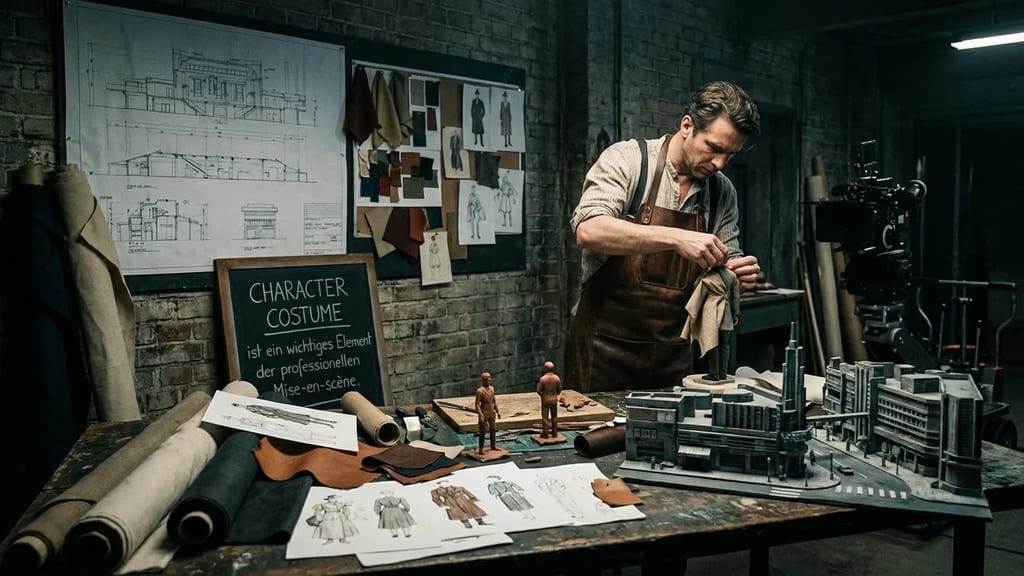
Character costumes are typically produced in three to five copies per lead actor, with one set reserved as the "hero costume" for close-ups. Material selection is based on optical criteria: silk reflects light differently than cotton in the 400-700 nanometer range, leading to different color temperatures under tungsten lighting (3200K). Synthetic materials are often avoided as they can create undesirable motion artifacts due to electrostatic charge during 24fps shooting. Special aging techniques include sandpaper treatment (220-400 grit), tea baths for discoloration, and controlled UV exposure for realistic wear and tear.
History & Development
Adrian Greenberg revolutionized character costume in 1928 at MGM with his work on "Our Dancing Daughters," using costumes as narrative tools for the first time instead of mere decoration. Edith Head refined this technique in 1950 in "All About Eve," where she visualized the psychological transformation of Bette Davis's character through costume changes. The 1960s saw a minimalist approach with Theodoros "Theo" Vakoulis's work for Bergman, while the 1980s were marked by Milena Canonero's opulent characterizations in "Barry Lyndon."
Practical Application in Film
In "There Will Be Blood" (2007), Mark Bridges used Daniel Plainview's increasingly luxurious clothing as a counterpoint to his moral decay. The costumes were deliberately tailored one size too large to visualize Plainview's inner emptiness. Jacqueline Durran's work in "Little Women" (2019) differentiated the four sisters through specific color palettes: Jo consistently wears earthy tones (ochre, umber), while Amy appears in cool blue-grey hues. The workflow typically begins 12-16 weeks before principal photography with character analysis, followed by a sketch phase, fabric selection, and three fittings per actor.
Comparison & Alternatives
Character costume differs from period costume through interpretive freedom – historical accuracy is subordinated to narrative function. Contemporary costume focuses on modern authenticity without symbolic exaggeration. Fantasy costume expands character costume with world-building elements. Modern CGI-Enhanced Costumes combine physical costumes with digital enhancements, with tracking markers applied at 2-3cm intervals. Virtual Production requires costume technical adjustments: chromakey green elements are avoided, and reflective surfaces are reduced to matte alternatives.