Technical Details
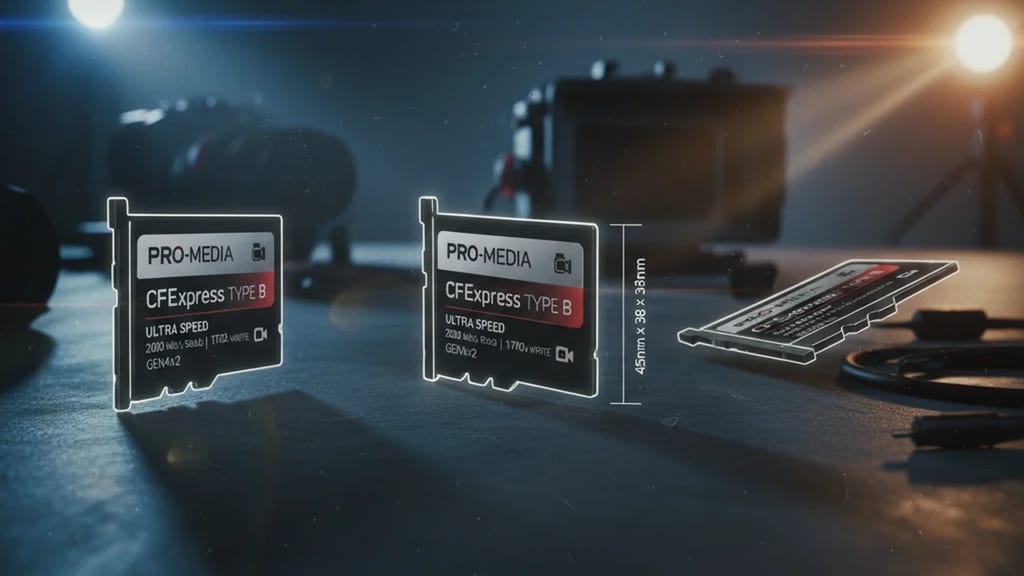
CFexpress Type B utilizes two PCIe 3.0 lanes, each at 8 GT/s, for a theoretical bandwidth of 2 GB/s. The NVMe 1.3 protocol enables parallel data processing and reduces latency to under 10 microseconds. The cards operate within a temperature range of -25°C to +85°C and support VPG (Video Performance Guarantee) 400, guaranteeing continuous write speeds of 400 MB/s. The electrical contacts are gold-plated and designed for over 10,000 insertion cycles.
History & Development
The CompactFlash Association introduced CFexpress in 2017, positioning Type B as a mid-range format between Type A (20×28 mm) and Type C (54×74 mm). Sony introduced the first camera with a CFexpress Type B slot in 2019 with the α7R IV. Canon followed in 2020 with the EOS R5, and Nikon in 2021 with the Z9. Manufacturers like SanDisk, Lexar, and Sony launched cards with 1 TB and more by 2022, with prices dropping from an initial 600 Euros per 128 GB to under 200 Euros.
Practical Application in Film
CFexpress Type B enables the recording of 8K RAW footage without buffer limitations, as seen with Canon's R5 at 8K/30p in Cinema RAW Light (2.6 GB/min). The Sony FX9 continuously writes XAVC-I 4K streams at 600 Mbps. The high speed significantly reduces offload times: 1 TB of footage transfers in under 10 minutes via a CFexpress card reader with Thunderbolt 3. Professional workflows utilize dual-slot cameras for simultaneous backup recording to CFexpress and SD cards.
Comparison & Alternatives
CFexpress Type B is 3-5x faster than UHS-II SD cards (up to 300 MB/s) and twice as fast as the predecessor XQD cards (up to 800 MB/s). While SD cards suffice for Full HD and standard 4K codecs, 6K/8K RAW formats require CFexpress speeds. Type A is suitable for compact cameras like the Sony α7S III, while Type B is for professional cinema cameras. SSD-based recorders like the Atomos Ninja V offer more capacity (up to 8 TB) but are bulkier and require external power.
Current News
Atomos has completely redesigned the Ninja V series after seven years with its new Ninja models. These new devices support CFexpress Type B cards for the first time, offering professional storage solutions for high-resolution video recording. Additionally, they feature a central battery mount and integrated camera control via USB-C.