Filmlexikon.
Support
CFast
Camera · Terms

CFast

Murnau AI illustration
avid media composer cardellini clamp cardioid cfexpress type a cfexpress type b cfexpress hypercardioid in medias res

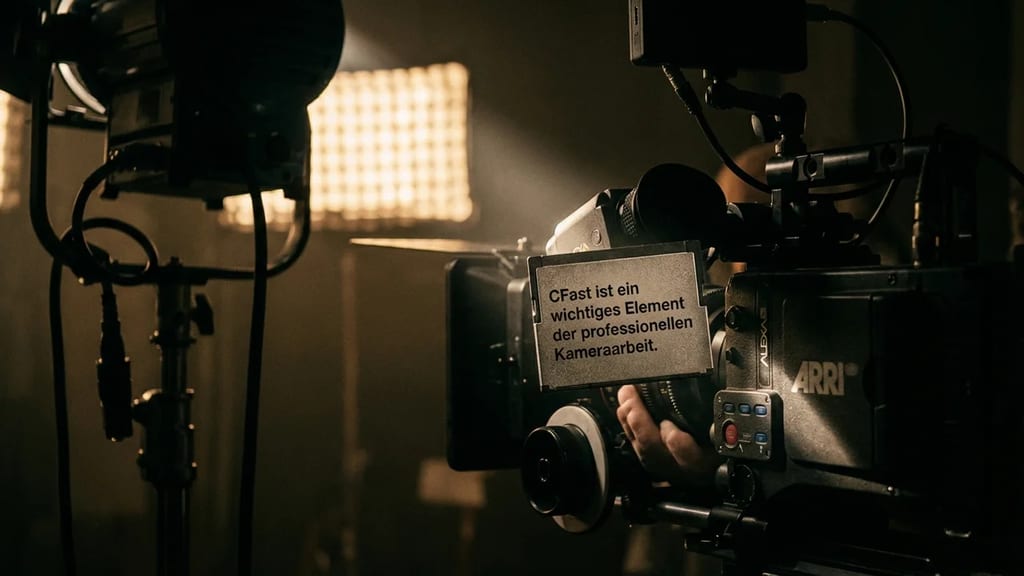
CFast is a compact memory card offering up to 525 MB/s transfer speeds for 4K cameras, using a SATA-based interface and supported by RED, Blackmagic, and Canon.

Technical Details

CFast cards are based on the SATA 3 interface and use NAND flash memory with a form factor size of 42.8 × 36.4 × 3.3 mm. CFast 1.0 theoretically achieves up to 300 MB/s, while CFast 2.0 manages up to 600 MB/s. The cards are available in capacities from 32 GB to 512 GB, with modern versions supporting VPG-130 (Video Performance Guarantee) and offering guaranteed minimum write speeds of 130 MB/s. The 7+15-pin SATA connector is fundamentally different from the parallel interface of CompactFlash predecessors.

History & Development

The CompactFlash Association introduced CFast 1.0 in 2009, followed by CFast 2.0 in 2012. Canon introduced one of the first CFast-compatible cameras in 2012 with the EOS-1D C. Blackmagic Design established the standard in 2013 with the URSA camera series in the independent film sector. SanDisk and Lexar dominated the early market, with Angelbird and Wise Advanced later developing their professional lines.

Practical Use in Film

CFast cards enable the recording of 4K RAW footage in cameras such as the Canon C300 Mark II, Blackmagic URSA Mini Pro, or RED DSMC2 systems. For 4K ProRes 422 HQ recording at 400 Mbps, CFast cards with VPG-130 certification are required. Typical workflows use CFast to USB 3.0 readers for data transfer, with a 128 GB card storing approximately 25 minutes of 4K RAW footage. The advantage lies in the reliable recording of high-bitrate formats without dropped frames; the disadvantage is the higher cost compared to SD cards.

Comparison & Alternatives

CFast differs from XQD in its SATA-based connector compared to PCIe technology, with XQD theoretically achieving higher speeds. CFexpress Type-B is replacing CFast as the successor standard, offering speeds up to 1,700 MB/s. Panasonic's P2 cards also use flash memory but are physically larger and more expensive. CFast is suitable for 4K productions with medium data rates, while CFexpress becomes indispensable for 8K RAW recordings or high-frame-rate shooting.

Current News

Blackmagic Design continues to rely on CFast 2.0 as the primary storage medium in its professional cameras. The new Pocket Cinema Camera 6K G2 uses CFast 2.0 alongside SD UHS-II and USB-C for recording 6K footage. This confirms the ongoing importance of the CFast standard for high-resolution film productions.
From the crafts

Perspectives

Cinematographer

Ich verwende CFast 2.0 in meiner C300 Mark III für 4K-Cinema-RAW-Light-Aufzeichnungen, da die garantierten 130 MB/s Schreibgeschwindigkeit Dropped Frames bei kritischen Takes verhindern. Die kompakte Bauform ermöglicht längere Handheld-Sessions ohne zusätzliches Gewicht durch externe Recorder. Bei mehrtägigen Drehs plane ich mindestens vier 256-GB-Karten ein, um kontinuierlich arbeiten zu können, während eine Karte im Reader kopiert wird.

Director

CFast-Aufzeichnung gibt mir die Sicherheit, spontane Momente in voller 4K-Qualität zu capturing, ohne mir Gedanken über technische Limitierungen machen zu müssen. Besonders bei dokumentarischen Arbeiten oder improvisierten Szenen kann ich längere Takes fahren, da die Karten zuverlässig hohe Datenraten bewältigen. Die schnelle Datenübertragung ermöglicht es mir, bereits am Set erste Schnitte zu sichten und Entscheidungen für weitere Takes zu treffen.

Producer

CFast-Karten kosten etwa das Dreifache von vergleichbaren SD-Karten, aber die Investition rechtfertigt sich durch reduzierte Post-Production-Zeiten und weniger technische Ausfälle am Set. Für eine vierwöchige 4K-Produktion kalkuliere ich 8-12 CFast-Karten à 200-400 Euro, plus entsprechende Reader für den DIT-Workflow. Die höhere Zuverlässigkeit gegenüber günstigeren Alternativen minimiert das Risiko kostspieliger Wiederholungsaufnahmen.

More in the lexikon

Related terms

Test your knowledge

Quiz

1. Was beschreibt „CFast" am besten?

2. Zu welchem Department gehört „CFast"?

3. Wie viele verschiedene Fachperspektiven bietet dieser Eintrag?

Report an error
From the Filmfarm ecosystem

Understand visual language, budget productions, connect crew.

The Lexikon is part of the Filmfarm ecosystem — alongside budgeting (FilmBalance), an industry magazine (FilmCircus) and crew networking (FilmCall, CrewMesh). One shared vocabulary for the whole production.

FilmFarm FilmRadarComing soonFilmPulseComing soonFilmNumbersComing soonFilmCapitalComing soonFilmLabComing soonFilmBalanceComing soonFilmCircusComing soon