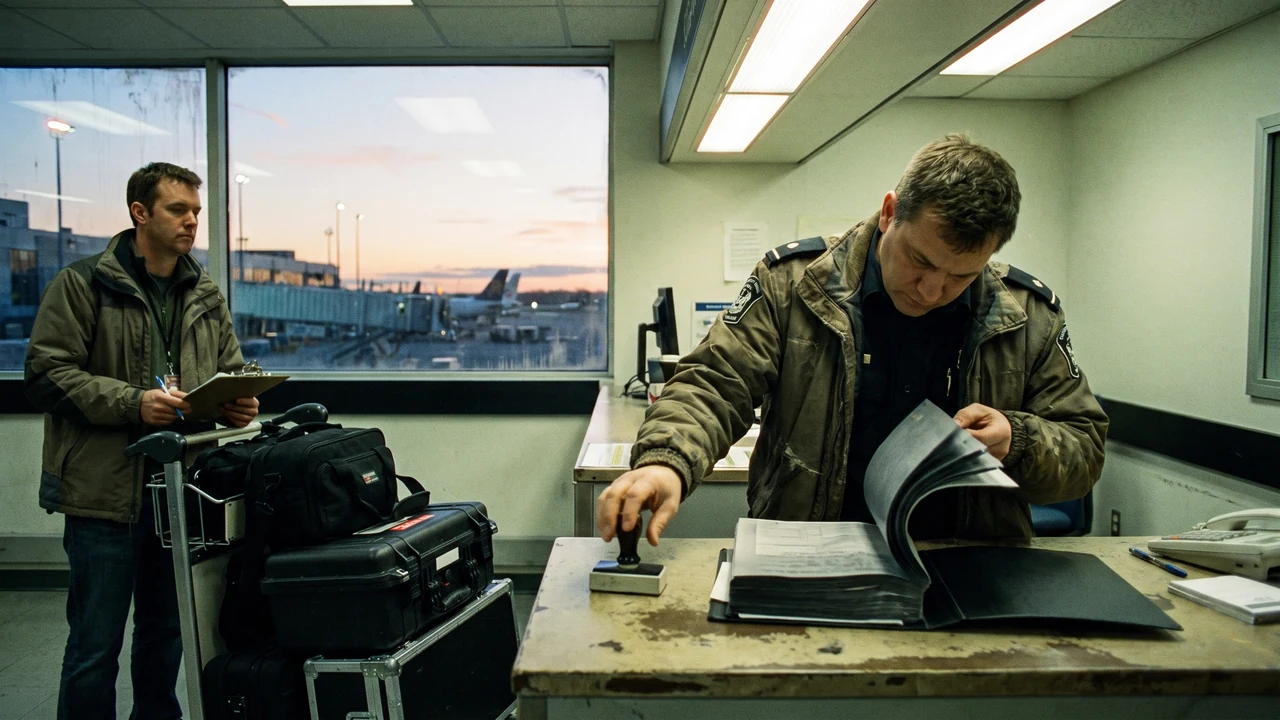
Customs document for the temporary export of professional equipment — for shoots outside the EU, the paperwork without which camera and lens packages do not cross the border. Issued and guaranteed by the chambers of commerce.
The ATA Carnet is a customs pass for the temporary use of goods abroad. The abbreviation stands for French admission temporaire and English temporary admission. Colloquially, it's called a passport for goods, and that accurately describes its function: the booklet travels with the equipment, is stamped at every border, and returns with it.
Two Functions in One Document
The Carnet is customs declaration and security at the same time. The declaration replaces the import procedures usually required in the destination country. The security consists of the Chamber of Commerce organization guaranteeing to the customs authority of the importing country that no customs debt will arise—provided the goods leave the country again within the specified period. Without this guarantee, security would have to be deposited upon each entry and reclaimed upon exit.
What Falls Under This for Film Productions
One of the three main categories of goods is professional equipment, and press, radio, and television equipment is explicitly mentioned there. In practice, this means camera bodies, lenses, lighting, tripods, sound equipment, and monitoring gear can be covered by a Carnet. The prerequisite is a complete, itemized list of goods with serial numbers and values—it cannot be supplemented later, and anything not on the list is not covered.
Scope of Application
The procedure applies in around 80 countries. No Carnet is needed within the EU—the internal market has no imports. It becomes relevant for shoots in Switzerland, Great Britain, the USA, North Africa, or Asia.
Digital Mandate Since June 1, 2026
The EU, Switzerland, Great Britain, and Norway have transitioned to a fully digital Carnet. All Carnets issued from June 1, 2026, onwards must be opened digitally. Older production manuals and internal procedures that rely on the paper booklet and physical stamp are outdated in this regard.
Why It Belongs in Production Planning, Not Logistics
Issuing a Carnet requires lead time, and the Carnet is tied to the registered list of goods. If the camera package changes at short notice—a different body, a different set of lenses—the document no longer matches. In practice, this is where productions falter: not because the Carnet is rejected, but because it's not available by the departure date or doesn't match the actual equipment packed. A substitute device not classified as a cinema camera at the border is a common workaround—but it merely shifts the problem, as compact devices also require registration.
Related terms
Quiz
1. Zu welchem Department gehört „Carnet A.T.A."?