Technical Details
Standard Cam-Lok systems are designed for 400 amperes at 120/208V or 240/415V, with contact pins having a diameter of 16mm. The housings are made of glass-fiber reinforced nylon with an IP44 rating against splashing water. Three-phase versions use four contacts (L1, L2, L3, N), while single-phase high-current variants use three contacts (L, N, PE). Cable connections are made via screw terminals for cross-sections up to 120mm². Special designs like Socapex-compatible systems reduce 19-pin multicore cables to individual Cam-Lok outputs.
History & Development
The Cam-Lok system evolved in the 1960s from stage technology, as theatrical productions increasingly required mobile high-current connections. The company Hubbell established the standard in 1967 with the Twist-Lok system, which was quickly adopted by the film industry. In Europe, the CEE system gained traction in parallel, while in North America, Cam-Lok became the de facto standard for mobile film lighting. Modern developments integrate LED status indicators and non-contact voltage detection.
Practical Application in Film
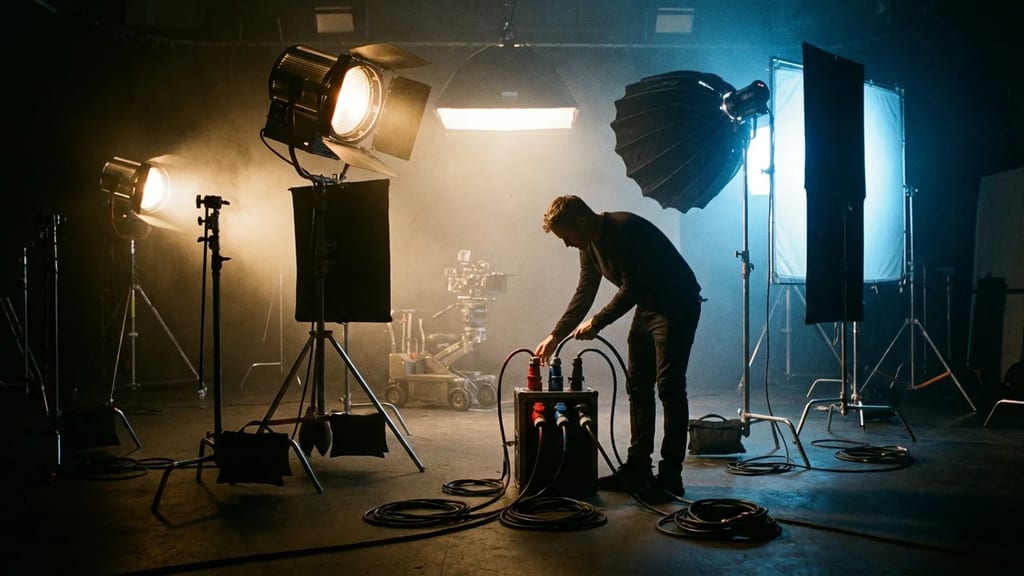
On exterior shoots, Cam-Lok cables connect generator trucks to main distribution boxes, from which power is distributed to individual lights. Typical setups use 100-meter Cam-Lok cables between the generator and dimmer racks. In "Blade Runner 2049," Cam-Lok installations enabled the rapid redistribution of 18kW HMI lights between different set areas. The tool-less connection significantly reduces setup times compared to screwed industrial connectors, although connections can become loose under heavy mechanical stress.
Comparison & Alternatives
Cam-Lok differs from CEE connectors by its quick-release mechanism instead of screw locking, and from Socapex systems by its individual wire routing instead of multicore bundling. PowerCON connectors are increasingly replacing Cam-Lok for smaller LED panels under 10 amperes, while True1 connectors, as a modern advancement, offer better contact security. For permanent installations, electricians prefer CEE connectors due to higher mechanical stability; mobile teams choose Cam-Lok for speed during rigging.