Definition & Origin
Bollywood is not simply "Hindi Cinema" but the entire industry of Hindi-language films produced primarily in Mumbai. Bollywood is a global cultural force – not just a film industry but a way of life, a music culture, a fashion culture, and an aspiration for hundreds of millions of people. Bollywood films are legendary for their extravagant musical numbers, emotional hyperbole, mass appeal, and hybrid genre structure.
Bollywood emerged from several traditions: Indian Theater (especially the classical Kathak dance tradition), Western film conventions, Indian emotionality, and spirituality. The industry has a 100-year history, but its "Golden Age" was from the 1950s to the 1980s, with later blockbuster eras in the 1990s and 2000s.
Visual Characteristics & Stylistic Techniques
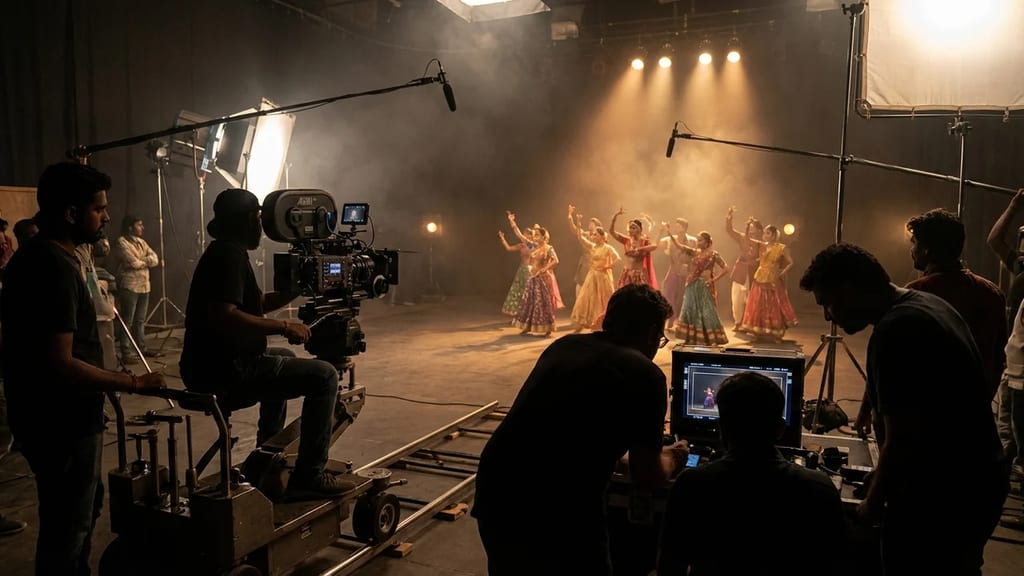
Extravagant Musical Numbers: Bollywood films often feature 4-8 musical numbers that are not strictly narrative necessities but are expressions of emotion. A wedding number can last 10-15 minutes, with dozens of dancers, color design, and location changes. The music is not accompanied by dialogue but is a narrative reality – the characters sing and dance as an expression of their inner emotional states.
Emotional Hyperbole: Bollywood allows for extreme emotional expressions that would be unrealistic in Western cinema. A character might collapse and weep for minutes without psychological context. Another might make exaggerated gestures. This is acceptable aesthetics, not flaws.
Hybrid Genre Structure: A Bollywood film can mix action, romance, comedy, and drama. Not in a New Wave deconstructive way, but in a "Masala" way (everything together). A film will have dramatic sequences, musical numbers, action sequences, and comedy sequences, often without narrative transitions.
Color Saturation & Visual Spectacle: Bollywood utilizes extremely saturated colors, vibrant costume design, and visually overwhelming sets. The aesthetic is operatic and ornamental rather than realistic.
Song Picturization: The way music is staged ("picturization") is an art form. Grand dance numbers with hundreds of backup dancers, location changes, and camera effects create visual spectacles of the music.
Star-Centricity: Bollywood is built on stars – famous actors are cultural gods. The star is not just a character but a persona, and fans come to see the star, not the story. This influences the entire film's construction.
Historical Context
Bollywood emerged from several factors:
- Indian Independence: After independence in 1947, India needed its own distinct culture. Bollywood became a support for Indian identity.
- Popular Culture for the Masses: India has a large, impoverished population. Bollywood films are entertainment for the masses with low levels of formal education – hence the extreme emotional hyperbole and musical interludes (people need breaks for comprehension).
- Classical Art Traditions: Indian Kathak dance, classical music, and theater traditions shaped Bollywood. The musical numbers are an access point to classical Indian art.
- Western Film Conventions: Bollywood adapted Western film techniques (cinematography, editing) with Indian content traditions.
- Music Industry: Music is central to Indian culture. Bollywood music became its own industry parallel to films.
Key Figures & Filmmakers
Raj Kapoor (1924-1988) – A legendary actor-director whose films like "Awara" (1951) and "Shree 420" (1955) are classics. Kapoor's films combined social realism with emotional appeal.
Dilip Kumar (1922-2021) – A legendary actor, famous for his intense acting style and romantic roles. Kumar was the paradigm of the Bollywood superstar.
Amitabh Bachchan (1942-) – The "Shahenshah" (Emperor) of Bollywood. Bachchan dominated the 1970s-1980s with roles as the "Angry Young Man." His films like "Sholay" (1975) and "Deewar" (1975) defined Bollywood action.
Shahrukh Khan (1965-) – A modern Bollywood superstar, famous for charismatic romance. His films like "Dilwale Dulhania Le Jayenge" (1995) defined 1990s Bollywood.
Yash Chopra (1932-2012) – A legendary director-producer, famous for musical films and romance. Chopra created the "Yash Raj" brand, which became a Bollywood standard.
Mani Osai – A visual innovator, famous for spectacular musical numbers and visually lush films.
Key Films & Masterpieces
Sholay (1975, Ramesh Sippy) – A legendary action melodrama about two outlaws who reform to defeat a villain. The film defined action Bollywood and features an iconic melodrama musical number ("Yeh Dosti"). Its length (3+ hours), musical numbers, and spectacle combined with emotional depth created a Bollywood standard.
Dilwale Dulhania Le Jayenge (1995, Aditya Chopra) – A romantic melodrama about an Indian-American and an Indian-British woman who fall in love in Europe. The film defined modern Bollywood with gentle musical numbers, sweet emotionality, and a family focus. The film became an international blockbuster.
Lagaan (2001, Aamir Khan) – A grand epic about Indian struggles against British occupation through cricket. The film combines action, drama, music, and sports in a massive spectacle. It was internationally acclaimed.
Devdas (2002, Sanjay Leela Bhansali) – A visually opulent melodrama about a tragic love triangle. Director Bhansali is known for extreme visual spectacle – color, musical numbers, emotional hyperbole. The film is operatic and magnificent.
Kabhi Khushi Kabhi Gham (2001, Karan Johar) – A film about family, love, and tradition. The film defines "Masala" – all emotions, all music styles, all spectacle together.
Piku (2015, Shoojit Sircar) – A modern Bollywood film that combines subtle humor and psychological realism with family drama. The film shows the shift in modern Bollywood – fewer musical numbers, more dialogue-driven, psychological.
Technical Aspects & Cinematic Innovation
Bollywood developed specific techniques:
- Playback Singing – The actor mimes while a singer records the music. This became standard in Indian cinema.
- Music Choreography – Specialized dance choreographers create complex dance numbers with many dancers.
- Color Grading & Visual Effects – Modern Bollywood utilizes extreme color grading and VFX.
- Fast Montage – Quick cuts in musical numbers, especially in modern Bollywood.
- Location Shooting – Often in exotic locations (Switzerland, Fiji) for visual spectacle.
Influence & Legacy
Bollywood has a global impact:
- Global Soft Power: Bollywood is a major form of Indian cultural soft power worldwide. Indian films are shown all over the world.
- Musical Cinema Legitimation: Bollywood proved that musical numbers in cinema could be contemporary and powerful, not just old-fashioned. This inspired Western filmmakers (Baz Luhrmann's musicals).
- Hybrid Aesthetics: Bollywood demonstrated that genre mixing doesn't have to be a Western indie practice but can be a legitimate popular aesthetic.
- Global Blockbusters: Modern Bollywood films like "Dangal" (2016) and "Secret Superstar" (2017) became global blockbusters, transcending Western dominance in global markets.
Comparison & Contextualization
vs. Classical Hollywood: While Hollywood strictly separated musical and dramatic-narrative films, Bollywood integrated both.
vs. Hong Kong Cinema: Both are non-Western film cultures that reject Western conventions, but Bollywood focuses on music and melodrama, while Hong Kong focuses on action.
vs. European Art Cinema: While European art cinema sought psychological realism, Bollywood sought emotional truth through hyperbole and ecstasy.
Transformation & Modern Bollywood
Bollywood has transformed in the 2010s-2020s:
- Psychological Realism: Modern Bollywood embraces more psychological realism, less pure spectacle.
- Reduced Musical Numbers: Modern films often have 2-3 musical numbers instead of 6-8.
- Digital Technology: Modern Bollywood utilizes digital cameras and VFX technology.
- Global Themes: Modern films address global themes (feminism, education, class) rather than pure romance.
- Female Perspective: Modern Bollywood offers more space for female perspective and agency.
But the fundamental principles remain – music, melodrama, emotional spectacle, mass appeal.
Legacy & Global Future
Bollywood remains a dominant global force. It is the largest film industry in the world by the number of films produced. With the digital streaming revolution (Netflix, Amazon Prime), Bollywood films have global access. Contemporary Bollywood will continue to have global influence, especially with films that blend Western and Indian aesthetics.