Technical Details
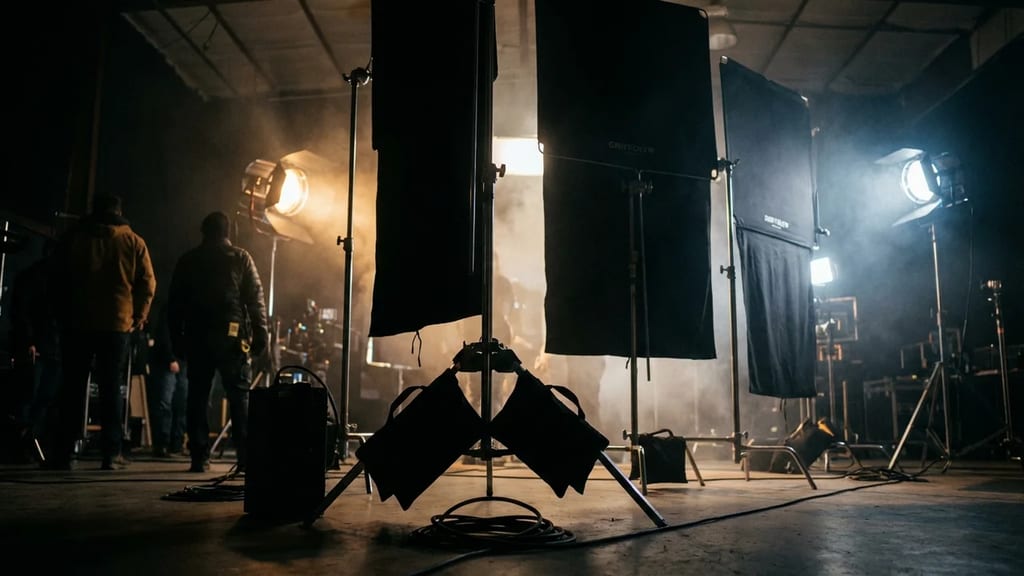
Standard Griffolyn tarpaulins consist of a three-layer construction: two black polyethylene outer layers (0.08mm each) enclose a nylon fabric with 10x10 threads per square inch. The total thickness is 0.25mm with a weight of 180g/m². Commercially available sizes for film sets range from 1.2x1.8m to 6x12m, with 2.4x3.6m and 3.6x7.2m being the most frequently used. The material can withstand temperatures from -40°C to +82°C and offers a tensile strength of 45kg in the longitudinal and 40kg in the transverse direction. Reinforced eyelets every 60cm allow for attachment to C-stands or grip arms.
History & Development
Griffolyn was developed in 1963 by Reef Industries as a waterproof industrial tarp and found its way into Hollywood studios from the mid-1970s onwards. Gaffers like Conrad Hall first systematically used the material on "Butch Cassidy and the Sundance Kid" (1969) as a cost-effective alternative to heavy duvetyne curtains. In the 1980s, black Griffolyn established itself as a standard flag material due to its easier transportability compared to traditional wood-duvetyne constructions. Modern variants like "Duvetyne-Griffolyn" have combined the stability of the polyethylene base with even better light absorption from laminated cotton fabrics since the 1990s.
Practical Use in Film
Roger Deakins used large-format Griffolyn flags on "Blade Runner 2049" (2017) for precise control of LED panel illumination in interior scenes. Typical workflow: 6x12m tarpaulins are stretched over menace arms or mombo combos to block daylight from windows or to selectively shade LED walls. During night shoots, 3.6x7.2m flags are used to shield streetlights or unwanted light sources. Advantages: low weight (20kg for 6x12m), quick setup and takedown, cost-effective. Disadvantages: susceptible to wind gusts from 25km/h, not flame-retardant according to DIN standards.
Comparison & Alternatives
Unlike Duvetyne (pure cotton, 320g/m²), Griffolyn offers better weather resistance with less weight. Modern alternatives such as "Black Commando Cloth" (ripstop nylon, flame-retardant) or "Ultra Bounce/Black" (double-sided use) are increasingly displacing classic Griffolyn. Solid flags made of aluminum frames with stretched duvetyne remain standard in studio productions, while Griffolyn flags are mainly used on location shoots. For precise light cuts under 1m², solid flags (cutters, dots) are still preferred.