Filmlexikon.
Support
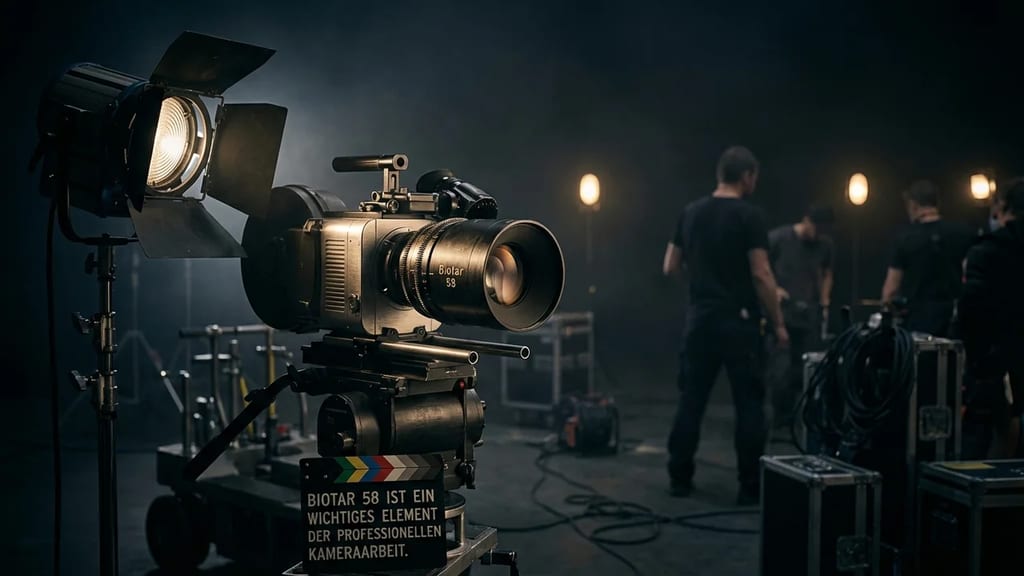
Biotar 58
Camera · Terms

Biotar 58

Murnau AI illustration
flow para roll take

Carl Zeiss lens, 58mm focal length, f/2.0 aperture; prized for dreamy background blur and distinctive swirly bokeh rendering.

Technical Details

The Biotar 58/2.0 weighs 285 grams with a filter diameter of 52mm. The symmetrical Gauss design consists of two three-element groups with high-refraction heavy flint glass in the inner elements. The aperture range extends from f/2.0 to f/16 with twelve blades for circular aperture openings. The minimum focusing distance is 0.6 meters, and the angle of view is 40°. The lens was originally designed for the M42 mount (Pentax mount) and was later also available for the Exakta bayonet.

History & Development

Carl Zeiss developed the first Biotar in 1927 as an evolution of the Planar design. The 58mm variant appeared in 1936 specifically for Exacta cameras and quickly established itself as a standard lens for high-end 35mm cameras. After World War II, Carl Zeiss Jena continued to produce the Biotar until 1970, while the West German Zeiss division further developed the design into the Planar 50/1.4. Production ended with the introduction of more modern multi-layer coatings.

Practical Use in Film

Cinematographer Conrad Hall used the Biotar 58 for close-ups in "In Cold Blood" (1967) to exploit its characteristic out-of-focus rendering. At wide apertures, the lens produces a soft background blur with a slight "swirly bokeh" – circular out-of-focus highlights that become oval towards the edges of the frame. Modern film productions use adapted Biotar lenses for vintage looks, especially on digital cameras, where the warm color rendition softens the sterile sensor look.

Comparison & Alternatives

The Biotar 58 differs from the later Planar in having less contrast and softer gradation. Modern alternatives like the Zeiss Planar 50/1.4 or the Leica Summilux offer higher sharpness performance but less character. The Helios 44-2, produced in the Soviet Union, is based on the Biotar design and delivers similar optical properties at a significantly lower cost. For digital productions, the Biotar is particularly suitable in available light situations where its speed and organic look are in demand.

From the crafts

Perspectives

Cinematographer

Ich schätze das Biotar 58 für seine einzigartige Bokeh-Charakteristik - bei Offenblende entstehen diese typischen "Swirl"-Effekte, die modernen Optiken fehlen. Die Schärfeleistung ist zwar nicht mit aktuellen Objektiven vergleichbar, aber genau diese leichte Weichheit verleiht digitalen Aufnahmen eine filmische Anmutung, die ich bei Porträts und emotionalen Szenen gezielt einsetze.

Director

Das Biotar hilft mir dabei, eine nostalgische, fast traumhafte Atmosphäre zu schaffen - die warme Farbwiedergabe und das charakteristische Bokeh unterstützen perfekt Rückblenden oder intime Charaktermomente. Wenn ich eine Geschichte in den 60ern oder 70ern erzähle, verleiht diese Optik den Bildern automatisch die richtige zeitliche Einordnung, ohne dass ich in der Postproduktion nachhelfen muss.

Producer

Vintage-Objektive wie das Biotar bedeuten längere Drehzeiten durch manuelle Fokussierung und weniger Flexibilität bei schwierigen Lichtverhältnissen. Die Anschaffungskosten für gut erhaltene Exemplare liegen bei 300-800 Euro, dafür spare ich mir teure Postproduktions-Effekte für den gewünschten Retro-Look. Allerdings muss ich einen erfahrenen Focus Puller einplanen und Backup-Objektive vorhalten.

More in the lexikon

Related terms

Test your knowledge

Quiz

1. Zu welchem Department gehört „Biotar 58"?

2. Wie viele verschiedene Fachperspektiven bietet dieser Eintrag?

Report an error
From the Filmfarm ecosystem

Understand visual language, budget productions, connect crew.

The Lexikon is part of the Filmfarm ecosystem — alongside budgeting (FilmBalance), an industry magazine (FilmCircus) and crew networking (FilmCall, CrewMesh). One shared vocabulary for the whole production.

FilmFarm FilmRadarComing soonFilmPulseComing soonFilmNumbersComing soonFilmCapitalComing soonFilmLabComing soonFilmBalanceComing soonFilmCircusComing soon