Cinematographer
Aus DoP-Perspektive ist dieses Element essentiell für die visuelle Gestaltung. Es ermöglicht mir die gewünschte Farbstimmung und das ästhetische Bild konsistent umzusetzen.
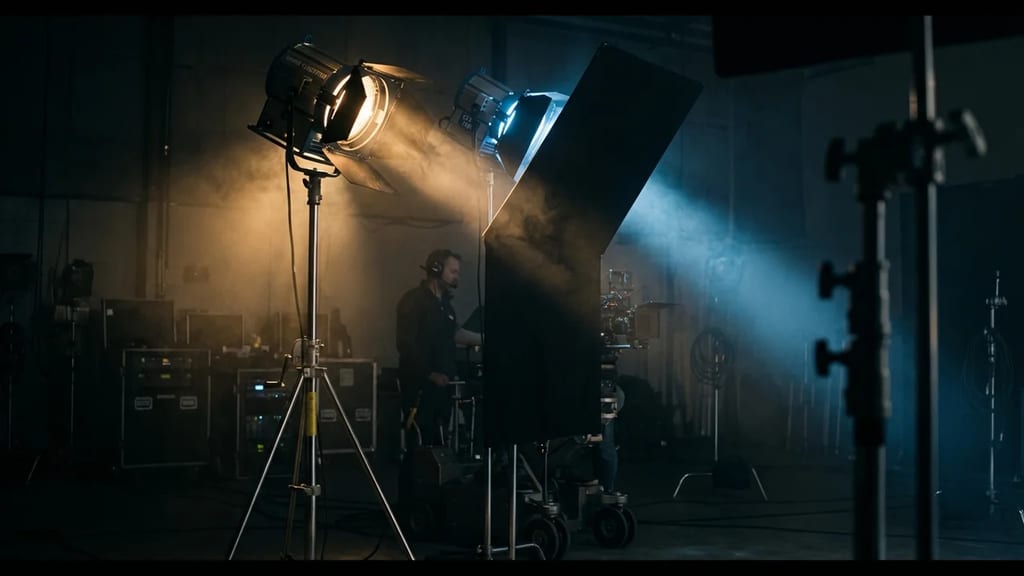
Lighting fixture with two independently controlled LED arrays (warm and cool) enabling continuously variable color temperature, typically 2700 K to 6500 K.
"Bicolor" (also Bi-Color or two-tone) does not refer to a single fixture or brand, but to a design of LED lights and panels. The housing contains two independently controllable LED groups: one warm white (close to artificial light/tungsten, usually around 2700–3200 K) and one cool white (close to daylight, usually 5600–6500 K). By dimming both groups separately, the resulting color temperature (CCT) can be continuously adjusted between the two endpoints. Instead of two separate LED rows, some models use a single, two-color tunable white SMD chip; the mixing principle remains the same.
Bicolor thus sits between simpler single-CCT lights (fixed to daylight or artificial light balance) and more complex RGB(W/WW) lights, which additionally allow for saturated colors and green/magenta correction. The main advantage: the light color is adjusted directly on the device, via app or DMX, without changing conversion gels (CTO/CTB) in front of the fixture.
The color temperature is created additively from the mixture of both emitter groups. If the cool white group is increased and the warm white is reduced (or vice versa), the mixed light passes through the range between the two endpoints. In the middle (mixed operation, both groups active), a neutral white of approximately 4000–4500 K is achieved.
Because both emitter groups overlap additively, a bicolor fixture delivers its highest light output in the mixed range (middle, around 4100 K) – here, warm and cool white LEDs contribute together at full power. At the endpoints, only one group is active at a time, so the output is lower. Between the two extremes themselves, the daylight endpoint provides more output than the tungsten endpoint because warm white LEDs require more phosphor and thus lose light efficiency.
However, the mixing principle leads to the typical weaknesses of bicolor compared to single-CCT lights, primarily affecting color quality:
Bicolor lights are common for interviews, documentaries, ENG/EFP, and run-and-gun shoots, where the light needs to be quickly adapted to changing ambient light (daylight through a window vs. warm room lighting) without changing gels. For demanding shots, the fixtures are often deliberately operated at one of the endpoints (e.g., full daylight) because the color rendering is best there; mixing is only done when an intermediate color temperature is needed. Conversely, those who need maximum output will run it in the mixed range, as the fixture is brightest there due to the additive mixing of both groups.
Aus DoP-Perspektive ist dieses Element essentiell für die visuelle Gestaltung. Es ermöglicht mir die gewünschte Farbstimmung und das ästhetische Bild konsistent umzusetzen.
Diese professionelle Lösung erhöht die Produktionseffizienz und reduziert Post-Production-Anforderungen. Sie ermöglicht flexible, schnelle Anpassungen während des Drehs.
Als Gaffer ist dies ein unverzichtbares Werkzeug meines täglichen Handwerkszeugs. Es ermöglicht mir professionelle Lichtkontrolle und schnelle Anpassungen auf Set, was Zeit spart und Qualität sichert.
1. Zu welchem Department gehört „Bicolor"?
2. Wie viele verschiedene Fachperspektiven bietet dieser Eintrag?
The Lexikon is part of the Filmfarm ecosystem — alongside budgeting (FilmBalance), an industry magazine (FilmCircus) and crew networking (FilmCall, CrewMesh). One shared vocabulary for the whole production.