Filmlexikon.
Support
Baltar
Camera · Lenses

Baltar

Murnau AI illustration
flow para roll take

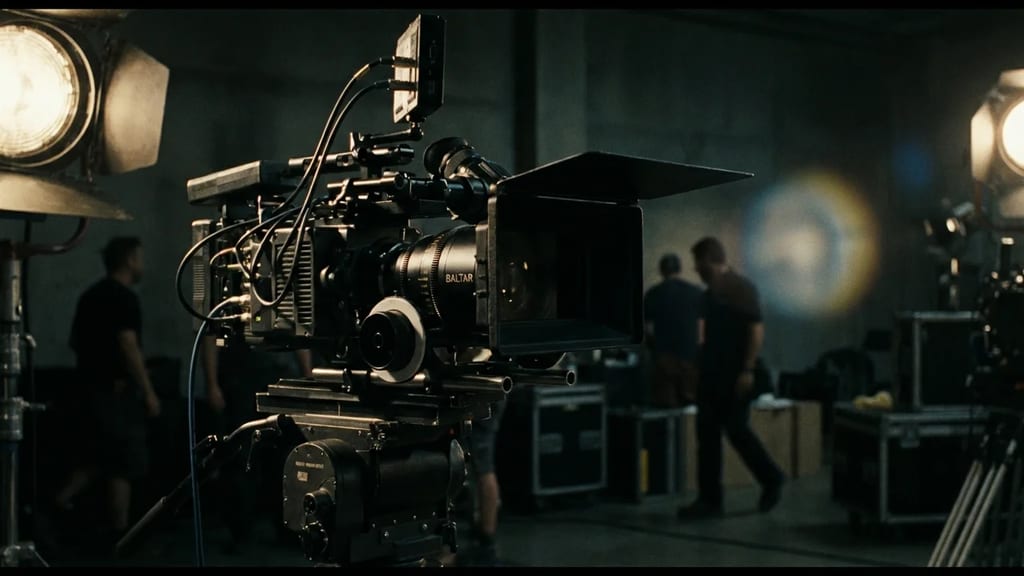
Bausch & Lomb lens series (1938–1973) renowned for soft focus and distinctive bokeh; dominated 1950s Hollywood cinematography.

Technical Details

The Baltar series encompassed focal lengths from 25mm to 152mm, with the standard 50mm lens at f/2.3 being the most widely used. The optical design was based on a modified Cooke triplet design with 4-6 lens elements, depending on the focal length. The 50mm model weighed 1.2 kg with a front diameter of 67mm and used 52mm filter threads. Typical for Baltar lenses was the shallow depth of field at wide apertures and a characteristic bokeh due to the optical spherical aberrations.

History & Development

Bausch & Lomb developed the first Baltar lenses in 1938 in response to the increased demands of color film. In 1942, the company received a Technical Achievement Award from the Academy of Motion Picture Arts and Sciences for the Baltar series. In the 1950s, Baltar lenses dominated Hollywood productions until they were gradually replaced by sharper Zeiss and Angenieux optics from the 1960s onwards. Production ended in 1973 when Bausch & Lomb withdrew from the cinema lens business.

Practical Use in Film

Director John Ford used Baltar lenses for "The Quiet Man" (1952) to capture the romantic atmosphere of Ireland. Cinematographer James Wong Howe used them in "Sweet Smell of Success" (1957) for the nighttime New York scenes, as they allowed for manageable shutter speeds even in low light. The soft look of Baltar lenses was particularly suitable for portraits of female leads, as skin imperfections were naturally concealed. The close minimum focusing distance of 0.9m on the 50mm lens allowed for intense close-ups without additional diopters.

Comparison & Alternatives

In contrast to the sharper Cooke Speed Panchros, Baltar lenses produced a "softer" look with less micro-contrast. Modern reissues such as the Bausch & Lomb Super Baltar or the Cineovision Baltar adaptations attempt to preserve the characteristic look for digital cameras. Today, vintage enthusiasts use original Baltar lenses on ARRI Alexa or RED cameras for music videos and commercials when a nostalgic look is desired.

From the crafts

Perspectives

Cinematographer

Baltar-Objektive zwingen mich zu bewussteren Entscheidungen bei der Schärfenführung, da die geringe Schärfentiefe bei f/2.3 präzises Fokussieren erfordert. Die weiche Bildwiedergabe kaschiert digitale Härten moderner Sensoren und verleiht Hautfarben einen natürlichen, warmen Ton ohne aufwendige Filterung.

Director

Ich nutze Baltar-Objektive gezielt für emotionale Szenen, da ihr weicher Charakter Intimität verstärkt und Gesichter traumhafter erscheinen lässt. Die begrenzte Schärfentiefe hilft mir, Aufmerksamkeit zu lenken und Nebendarsteller oder störende Hintergrundelemente sanft verschwimmen zu lassen.

Producer

Originale Baltar-Objektive kosten zwischen 3.000-8.000 Euro pro Stück auf dem Vintage-Markt, eine komplette Serie schlägt mit 25.000-40.000 Euro zu Buche. Der Wartungsaufwand ist hoch, da 50-80 Jahre alte Mechanik regelmäßige Kalibrierung braucht und Ersatzteile nur noch bei Spezialwerkstätten verfügbar sind.

More in the lexikon

Related terms

Test your knowledge

Quiz

1. Zu welchem Department gehört „Baltar"?

2. Wie viele verschiedene Fachperspektiven bietet dieser Eintrag?

Report an error
From the Filmfarm ecosystem

Understand visual language, budget productions, connect crew.

The Lexikon is part of the Filmfarm ecosystem — alongside budgeting (FilmBalance), an industry magazine (FilmCircus) and crew networking (FilmCall, CrewMesh). One shared vocabulary for the whole production.

FilmFarm FilmRadarComing soonFilmPulseComing soonFilmNumbersComing soonFilmCapitalComing soonFilmLabComing soonFilmBalanceComing soonFilmCircusComing soon