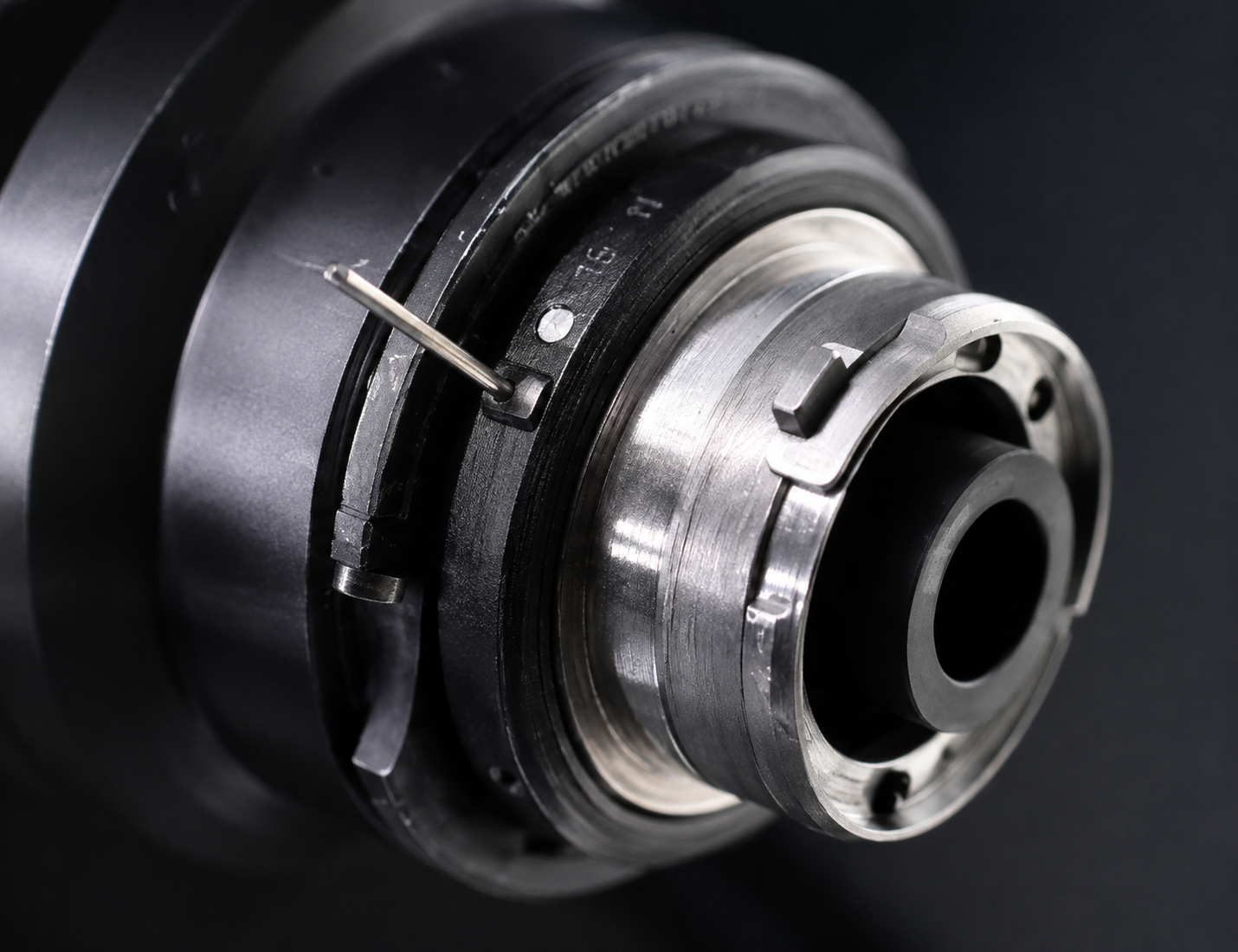
The camera's lens mount: the mechanical and often electronic interface between body and lens, defined by diameter, locking mechanism, and flange focal distance. In cinema, PL and LPL are the cross-manufacturer standard.
The lens mount is the camera's lens connection—the point where the optics and body meet. The name comes from the locking principle: attach, twist, click, like mounting a bayonet. A mount is defined by three things: the diameter of the opening, the type of locking mechanism, and the flange focal distance—the exact distance between the mount surface and the sensor plane. In addition, most modern mounts feature an electronic interface: contacts or pins that handle aperture control, metadata (focal length, focus distance, aperture), and sometimes autofocus.
PL and LPL: The Cine Standard
In the cinema sector, ARRI's PL-Mount (Positive Lock) has established itself as a cross-manufacturer standard: instead of rotating the lens itself, a locking ring tightens it—play-free and robust enough for heavy cine lenses with an attached focus motor. Nearly every cine camera and cine lens is available with PL, allowing rental houses and productions to mix brands. The newer LPL-Mount is the evolution for large-format sensors: larger diameter, shorter flange focal distance, more freedom for lens design. Metadata in the cine environment is transmitted via systems like ARRI's LDS or Cooke's /i protocol through contacts in the mount. Alongside these are the still camera mounts—such as Canon's EF and Sony's E mounts—which, via adapters and autofocus, also extend into the moving image world.
Adapters: What Works and What Doesn't
The rule of adaptation follows from the flange focal distance: a mount with a short flange focal distance (e.g., mirrorless mounts like Sony E or LPL) can accept lenses with a longer flange focal distance via an adapter—the adapter simply fills the distance. The reverse is not possible without an additional lens within the adapter, and every intermediate lens costs image quality. Therefore, PL-to-E adapters are common, while E-to-PL adapters are virtually nonexistent. Electronics are the second hurdle: a purely mechanical adapter transmits neither aperture control nor metadata—for lenses without a manual aperture ring, this becomes a disqualifying factor.
- Before using any third-party body, check the flange focal distance or have it shimmed—a misaligned mount renders any focus scale useless.
- When using adapters, ensure they are play-free: a wobbly adapter ruins the image of heavy lenses and endangers the mount.
Related terms
Quiz
1. Was beschreibt „Bajonett" am besten?
2. Zu welchem Department gehört „Bajonett"?