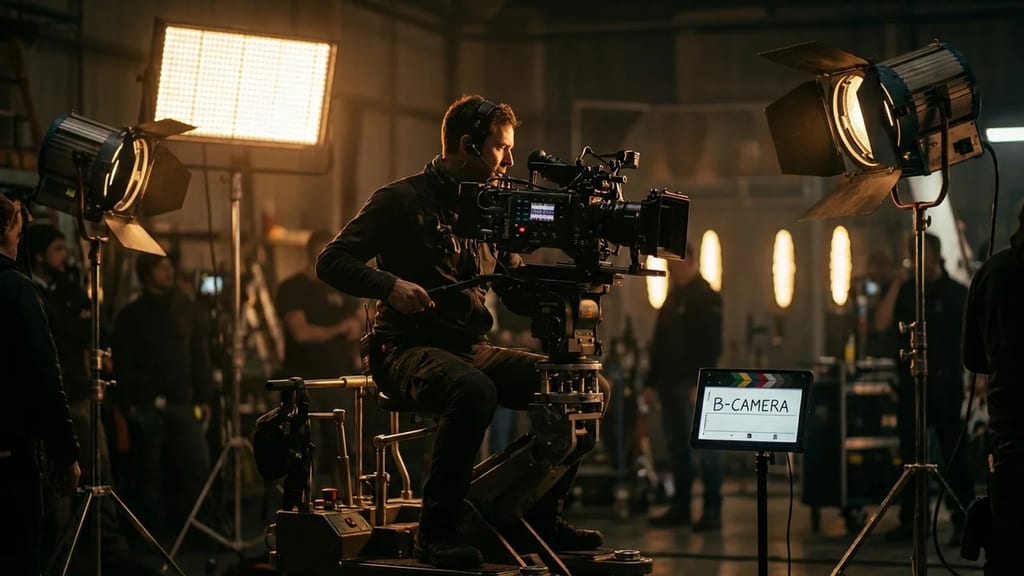
Technical Details
B-camera operators typically work with identical camera models to the A-camera to maintain consistent color temperature and image characteristics. With RED cameras, for example, both the A-camera and B-camera are operated with the same sensor generation (Helium 8K S35, Gemini 5K S35) and identical LUT settings. Synchronization is achieved via timecode generators with an accuracy of ±1 frame at 24fps. Lenses are distributed according to focal length hierarchy: the A-camera receives primary focal lengths (35mm, 50mm, 85mm), while the B-camera handles intermediate values (40mm, 65mm, 100mm) or specialized optics such as macro lenses for insert shots.
History & Development
The systematic use of B-cameras became established in 1927 with William Wyler's "Ben-Hur," where four cameras simultaneously recorded the chariot race sequence for the first time. In 1935, MGM introduced standardized B-camera positions for dialogue scenes to reduce editing time. With the introduction of 16mm cameras in the 1960s, mobile B-camera teams emerged for handheld shots. Digital cameras since 2005 have enabled more cost-effective multi-camera setups, making B-camera operators a standard even in independent productions.
Practical Application in Film
In Christopher Nolan's "Dunkirk" (2017), six B-camera operators coordinated the IMAX and 65mm shots of the aerial combat scenes. Marvel productions utilize up to eight B-cameras for action sequences, with each operator assigned specific tasks: stunt coverage, reaction shots, or VFX plates. In "Mad Max: Fury Road" (2015), B-camera teams filmed with edge-arm systems in parallel to the main shots, generating 480 hours of footage. Series like "The Mandalorian" employ B-cameras for StageCraft volume recordings, where precise camera positioning is crucial for LED wall parallax.
Comparison & Alternatives
B-camera operators differ from focus pullers through independent compositional decisions within predefined parameters. Second-unit cinematographers, on the other hand, work autonomously without DoP supervision. Splinter units use C- and D-cameras for specialized insert shots. Remote head systems like Technocrane SuperTechno replace B-camera operators in dangerous or inaccessible positions. Motion control systems take over the role of traditional B-cameras in VFX-intensive productions, but require programming expertise rather than operational camera skills.