Technical Details
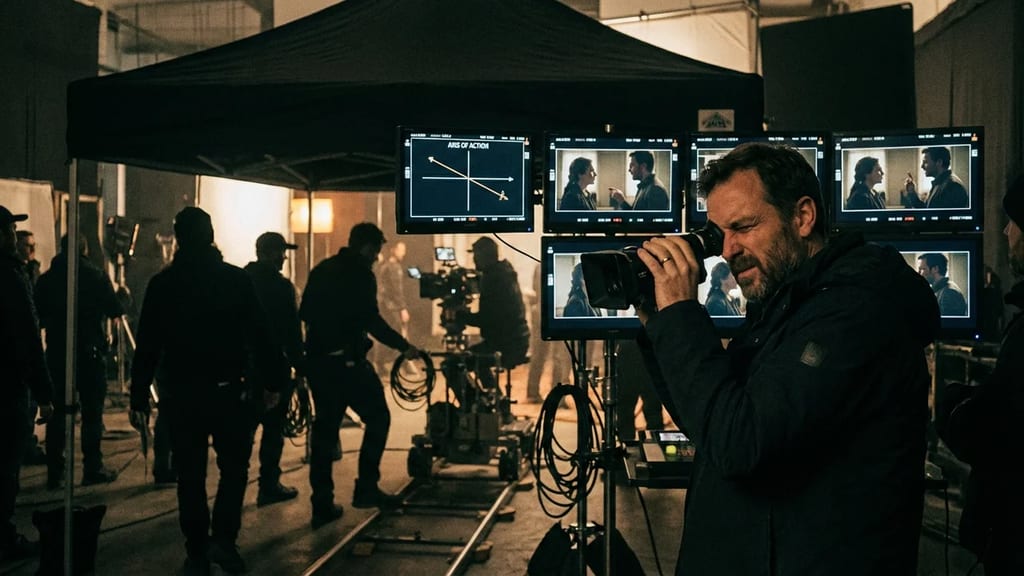
The 180° rule dictates that cameras must be positioned within a 180° semicircle around the axis of action. In dialogue scenes, the axis runs through the eyeline of the speakers; in action sequences, it follows the direction of movement. Crossing the axis requires a neutral shot (90° to the axis) or a visible camera movement. TV productions often utilize three standard camera positions: Master (widest shot), Over-the-Shoulder Left, and Over-the-Shoulder Right, all within the 180° segment.
History & Development
The concept evolved in the 1920s alongside the establishment of Classical Hollywood Cinema. D.W. Griffith experimented with spatial continuity as early as 1915, but it was the studio productions of the 1930s that systematized the 180° rule. Frank Capra and John Ford significantly shaped its application. In the 1960s, Nouvelle Vague directors like Jean-Luc Godard consciously broke this convention. Today, the rule is considered a foundation but is handled flexibly depending on genre and narrative style.
Practical Application in Film
Classic application can be found in dialogue scenes like the restaurant conversation in "Goodfellas" (1990), where Scorsese strictly adheres to the axis. Chase sequences follow the direction of movement: in "Mad Max: Fury Road" (2015), the direction of travel continuously defines new axes of action. Deliberate rule-breaking creates disorientation: Stanley Kubrick intentionally crosses axes in "The Shining" (1980) to generate unease. In multi-group scenes, multiple axes emerge, requiring separate treatment.
Comparison & Alternatives
The axis of action differs from the eyeline, which only defines gaze directions, and the motion axis, which solely describes locomotion. Match cuts can conceal axis jumps by continuing movements across edits. 360° cameras and VR productions render traditional axis rules obsolete. With Steadicam shots or drone usage, fluid camera movements can organically integrate axis changes without causing continuity breaks.