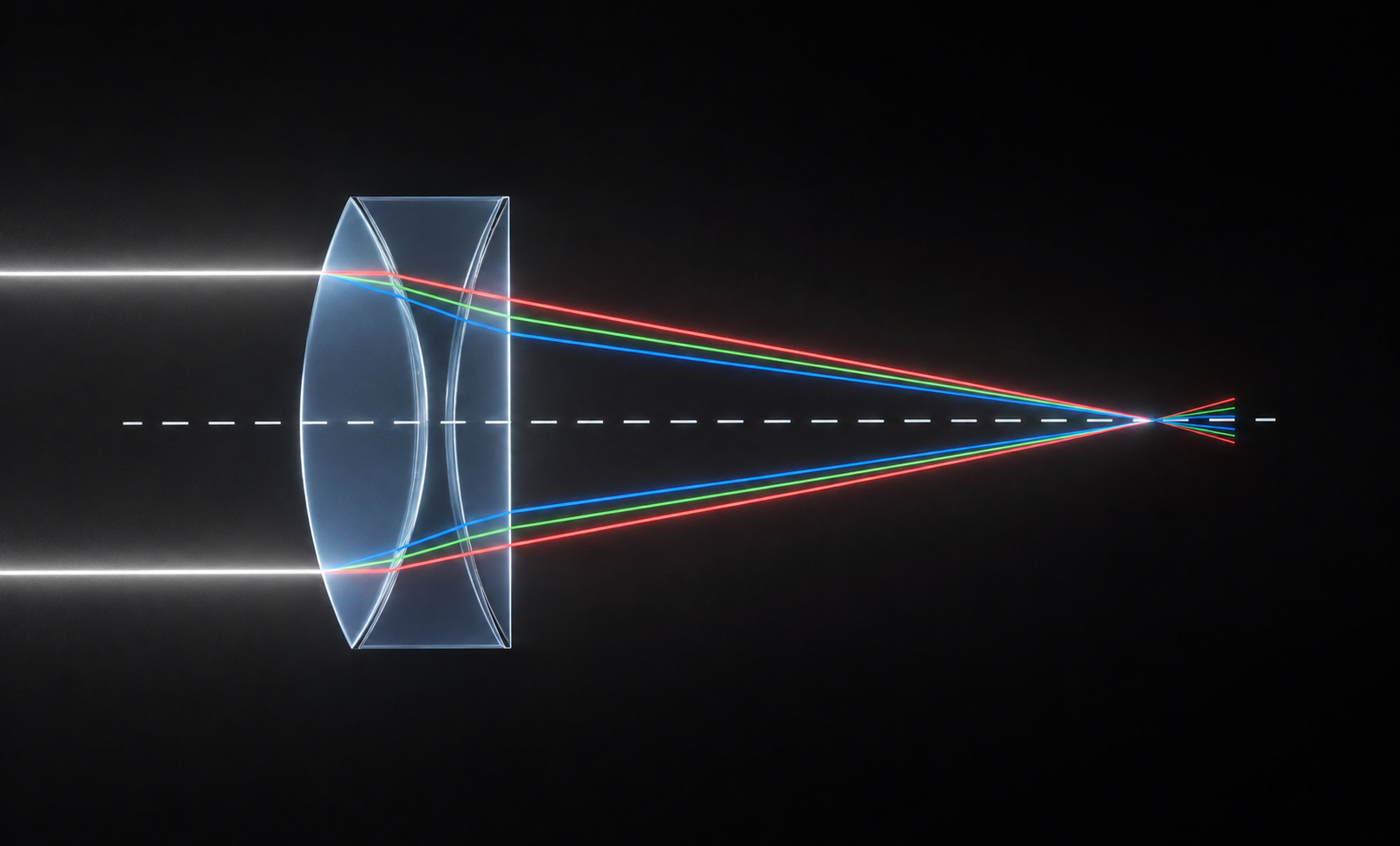
Lens correction that brings three wavelengths (red, green, blue) to the same focal plane, largely eliminating chromatic aberration. A hallmark of high-end cine lenses, often labeled APO.
Apochromatic (APO for short) refers to a lens design that brings three wavelengths of light—red, green, and blue—to the same focal plane. Simple lenses focus each color minimally differently because glass refracts short-wavelength light more strongly than long-wavelength light. An achromatic design corrects two wavelengths; an apochromatic design goes a step further and captures the third as well. This is made possible by special glasses with anomalous partial dispersion, such as fluorite elements, combined with carefully calibrated lens calculations.
Why It Matters on Set
Chromatic aberration appears as colored fringes on high-contrast edges—a branch against a bright sky, a chrome trim in backlight, highlights on water. In a 4K or 8K presentation on the big screen, these fringes are immediately noticeable, and in post-production, they can only be corrected to a limited extent because the color information at the edge is already smeared. APO-corrected optics deliver clean edges directly in-camera, or in the recording—which is why cine lens manufacturers prominently advertise this designation.
Distinction and Limitations
APO is not a protected term, and strictly speaking, the correction only applies to the center of the image and specific focus distances. Longitudinal chromatic aberration (color fringes in front of and behind the plane of focus, visible in the bokeh) and lateral chromatic aberration towards the edge of the image behave differently—a lens can be ideally corrected in the center and still show fringing at the edges. If you rely on the abbreviation, you should still test: place highlights slightly out of focus and check for magenta and green fringes.
- When testing lenses, specifically film high-contrast edges in backlight—that's where the correction shows up first.
- Also check defocused areas: longitudinal chromatic aberrations live in the bokeh, not in the plane of focus.
- APO correction makes optics heavier and more expensive—for a deliberately vintage, soft look, an uncorrected lens might be the better choice.
Related terms
Quiz
1. Was beschreibt „Apochromatisch" am besten?
2. Zu welchem Department gehört „Apochromatisch"?