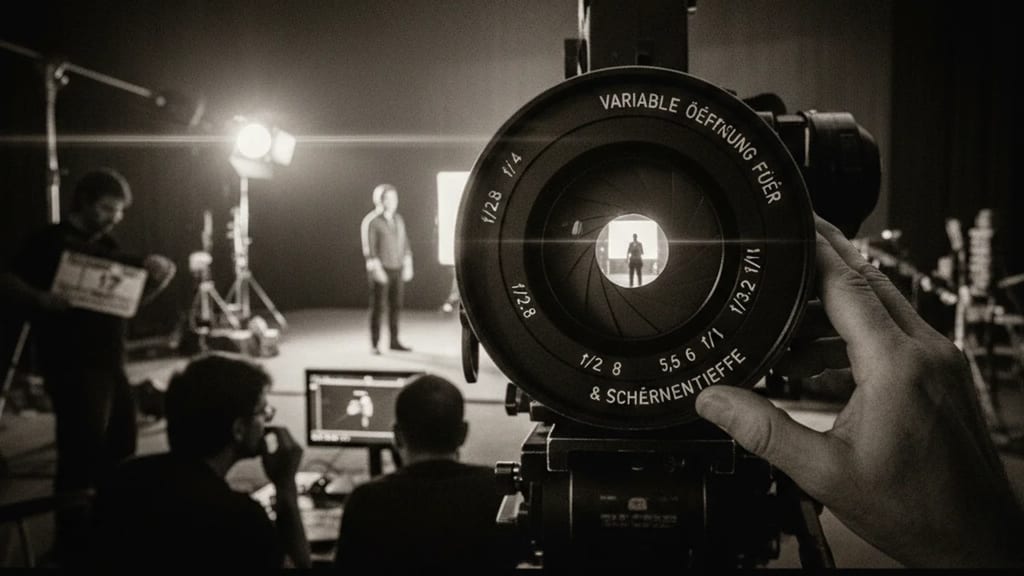
Aperture
The aperture is the variable opening in the lens that controls the amount of light falling onto the sensor or film. It is regulated by a mechanical or electronic iris diaphragm with multiple movable blades. The aperture opening influences three critical factors of image composition: exposure, depth of field, and the optical quality of the image.
Technical Fundamentals
F-Stop (f-number)
The f-stop is a ratio calculated from:
f-number = Focal Length / Diameter of Aperture Opening

Example: 50mm Focal Length ÷ 25mm Opening = f/2.0
Standard Aperture Series:
f/1.0 - f/1.4 - f/2.0 - f/2.8 - f/4.0 - f/5.6 - f/8 - f/11 - f/16 - f/22 - f/32
Each stop doubles or halves the amount of light. From f/2.8 to f/2.0, approximately 2x more light enters; from f/2.8 to f/4.0, only half.
T-Stops vs. F-Stops
For cinematography, the distinction between F-Stops and T-Stops is crucial:
- F-Stop: Theoretical aperture opening (Focal Length ÷ Diameter)
- T-Stop: Actual light transmission, accounting for glass loss and reflections
Example: A lens with f/1.4 might actually be T/2.0 if 40% of the light is lost through the glass elements.
Cooke, ARRI, and Zeiss premium lenses always specify T-stops for accurate exposure planning.
Aperture Values and Their Characteristics
| Aperture | Light Ratio | Depth of Field | Typical Application |
|---|
| T/1.3 | Very Bright | Very Shallow | Available Light Drama, Night Scenes |
| T/2.0 | Bright | Shallow | Portraits, Emotional Intimacy, Premium Primes |
| T/2.8 | Medium | Medium | Standard for many productions |
| T/4.0 | Dim | Deep | Documentary, Adventure, Spatial Scenes |
| T/5.6 | Very Dim | Very Deep | Action, Ensemble, Wide-Angle Scenes |
| T/8 – T/16 | Extremely Dim | Maximum | External Lighting Required |
Cinematographic Perspectives
Depth of Field and Composition (DP Perspective)
Aperture is the primary tool for controlling depth of field:
- Wide Open Aperture (T/1.3–T/2.8): Shallow depth of field isolates subjects from the background. Creates psychological proximity and focus. Especially effective in close-ups.
- Application: Portraiture, emotional moments, isolating details
- Premium Lenses: Zeiss Master Prime T/2.0, ARRI Signature Prime T/1.8, Cooke S4/i T/2.0
- Mid-Range Aperture (T/4.0–T/5.6): Balances isolation with contextual representation. Allows for subtle movements without focus pulling.
- Application: Dialogue scenes, medium shots, standard production work
- Lenses: ARRI Signature Prime T/2.0 stopped down to T/4.0, Cooke Anamorphic T/2.3
- Closed Aperture (T/8–T/16): Maximum depth of field. All planes of the image remain sharp. Requires intense lighting.
- Application: Action sequences, wide-angle shots, architecture
- Historical Reference: "Citizen Kane" (1941) consistently used f/8 for maximum spatial definition
Bokeh and Optical Quality
The aperture opening directly influences the quality of bokeh (the blur in the background):
- Round Opening (7+ blades): Soft, round bokeh
- Examples: ARRI Signature Primes, Cooke Anamorphic, Zeiss Supreme Prime
- Polygonal Opening (fewer blades): Angular, geometric bokeh
- Can appear artificial, often avoided
- Lens Flare/Starburst at closed apertures: At f/16+, the aperture opening creates visible diffraction patterns (starbursts)
Look and Style
The choice of aperture defines the cinematic style of a production:
- Cinematic Look: Constant aperture of T/2.8 or wider creates depth of field gradation
- TV Look: Constant aperture of T/5.6–T/8 appears flat and documentary-like
- Indie Look: Variable aperture between T/2.0 and T/8 follows the actor's focus point
Practical Applications
Lighting Planning and Aperture Strategy
Professional ACs (Assistant Cameramen) plan the aperture based on:
- Minimum Light Conditions: Available Light ÷ ISO ÷ Shutter Speed = Required Aperture
- Desired Depth of Field: Closer = Wider; Further Away = Narrower
- Production Look: Documentary (f/5.6+) vs. Drama (f/2.0–f/2.8)
- Focal Length Combinations: Longer focal lengths require wider apertures for the same depth of field
Aperture Range by Production Type
TV Feature Film (Standard):
- Wide Angle (14mm): T/2.8–T/4.0
- Normal Range (35–50mm): T/2.0–T/2.8
- Telephoto (75–135mm): T/2.0–T/2.8 (due to shallower depth of field at longer focal lengths)
Documentary Film:
- Consistently T/5.6–T/8 for handheld usability and focus tolerance
Available-Light Drama (Indie):
- Exclusively T/1.3–T/2.0 with high-sensitivity sensor and minimal artificial light
Action/Adventure:
- T/4.0–T/5.6 for continuous sharpness during fast movements
Technical Aspects
Iris Diaphragm Types
Mechanical Iris Diaphragm:
- Multiple overlapping blades
- Manual or motorized control
- Standard on Zeiss, ARRI, Cooke Primes
Electronic Aperture:
- Integrated into modern cameras (e.g., RED, Alexa Mini)
- Allows for precise aperture ramping during recording
- Accuracy up to 1/100th of a stop
Electro-Iris:
- Post-production electronic control for manual lenses
- Example: Movicon eMotion for ARRI/Zeiss Primes
Aperture Ramping (Follow Focus Ramping)
Professional productions utilize variable aperture during a shot:
- Zoom-In Effect: Aperture opens during zoom movement → enhances spatial depth
- Drama Effect: Aperture closes during dialogue → draws attention to the face
- Technically demanding: Requires electromagnetic aperture control and a follow-focus operator
Frequently Asked Questions
Q: Why is T-Stop used instead of F-Stop?
A: T-stops are empirically measured light values, while F-stops are theoretically calculated. On set, the gaffer and AC need the actual amount of light, not a formula.
Q: Can I combine a wide aperture with variable ND filters?
A: Yes, and it's standard practice. With Variable ND (e.g., Schneider Variable ND), the aperture can be kept constant at T/2.0 while the ND density (2 to 8 stops) is adjusted for changing light conditions.
Q: How do I calculate depth of field?
A: Rule of thumb for Super-35:
- Depth of Field (mm) ≈ (2 × Focus Distance × f-number × CoC) / Focal Length²
- CoC (Circle of Confusion) = Sensor Width ÷ 1000
Related Terms: T-Stop, F-Stop, Depth of Field, Bokeh, Hyperfocal Distance, Follow Focus, Exposure Triangle