Overview
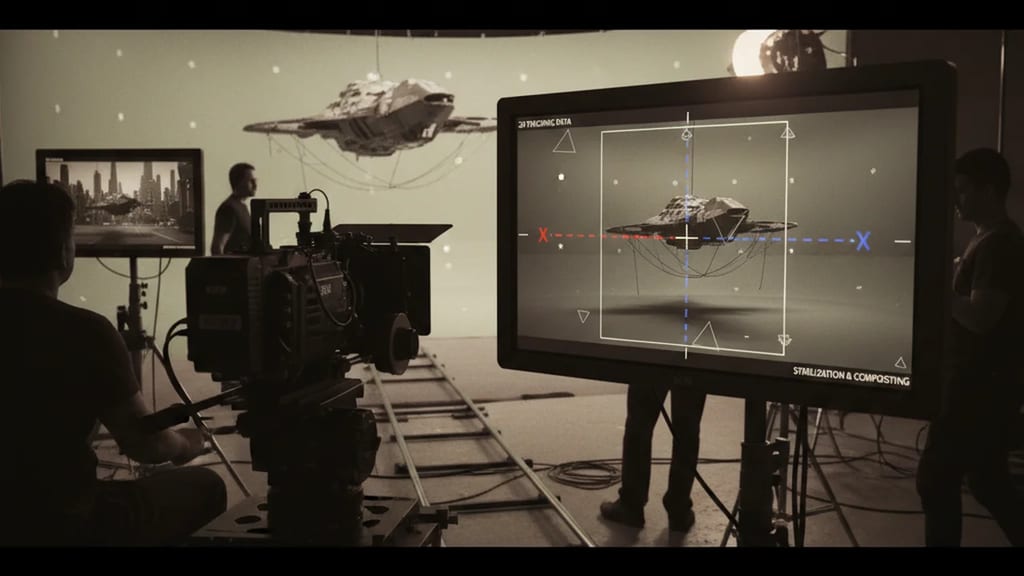
2D Tracking (also 2D Motion Tracking) refers in post-production and compositing to the tracking of image features in the two-dimensional image plane over the course of a shot. In contrast to 3D tracking (Camera Solving / Matchmoving), which reconstructs spatial camera movement including depth information, 2D tracking works exclusively in screen coordinates X and Y, without capturing depth (Z-axis).
The determined tracking data is used to couple elements to the movement in the image – for example, inserted graphics, text overlays, sign replacement, screen replacement, or for stabilizing shaky footage. From the perspective of camera and set, 2D tracking is therefore not a device or equipment term, but a software/post-production technique closely linked to image design on set (e.g., placing tracking markers).
Tracking Methods
2D tracking can be differentiated by the number and type of reference points tracked:
| Method | Tracked Data | Typical Use |
|---|
| Single-Point (1 point) | Position (X/Y) | Coupling an element to a point, e.g., logo/text |
| Two-Point (2 points) | Position, Rotation, Scale | Simple tracking with rotation and size change |
| Corner-Pin (4 points) | Four corner points / perspective distortion | Screen replacement, sign and poster replacement |
| Planar Tracking | Tracking of entire surfaces and textures | Perspective, parallax, occlusions |
While a point tracker tracks a single image point based on its immediate vicinity – and tends to drift when encountering occlusions, perspective changes, or lighting shifts – a planar tracker follows a contiguous, preferably flat surface, and therefore copes much better with occlusions and perspective shifts.
Application and Tools
2D tracking is used for, among other things, image stabilization, inserting motion graphics and text, object removal and replacement, and for screen/sign replacements. The method reaches its limits with fast movements, strong camera pans, or shots with significant depth stratification; 3D tracking is used instead in such cases.
Common tools with 2D tracking functionality include Boris FX Mocha Pro (Planar Tracker), Adobe After Effects, Foundry Nuke, and Blender. Mocha Pro handles both 2D and 3D tracking equally well.