Overview
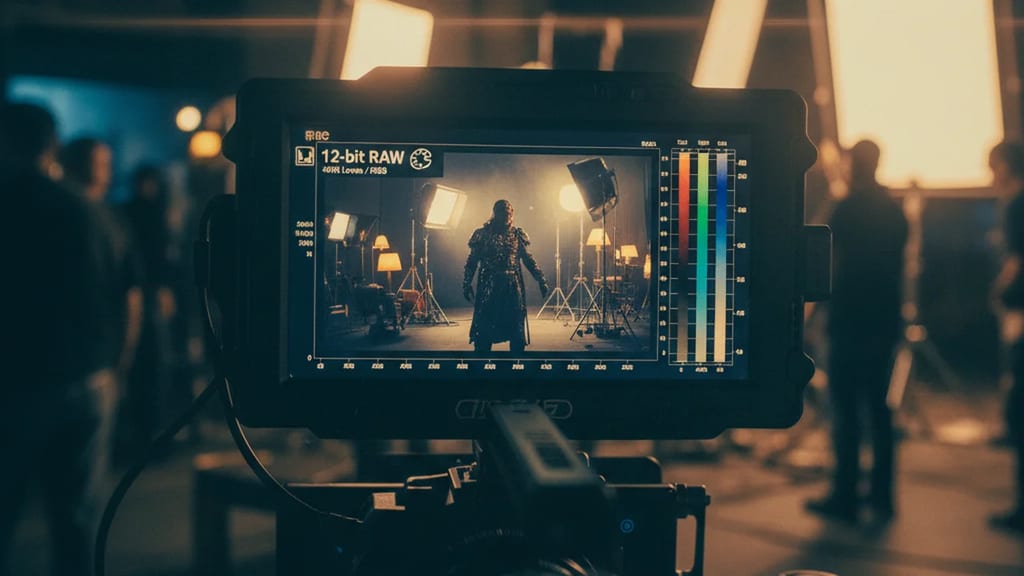
12-bit does not refer to a light or grip equipment, but to a color depth (bit depth) in camera and post-production technology. The specification describes how many gradations each color channel (red, green, blue) of a pixel is stored with. At 12-bit, there are 4,096 tonal steps available per channel (212 = 4,096).
Higher bit depth means finer gradations between brightness values. This primarily affects smooth gradients (sky, skin tones, shadows) and reduces the risk of banding (visible brightness steps). In practice, 12-bit is closely linked to RAW recording and log workflows of digital cinema cameras, where the additional tonal range secures color correction (grading).
Technical Classification
The number of tonal steps doubles with each additional bit (2n). Comparing common bit depths:
| Bit Depth | Tonal Steps per Channel | Typical Use |
|---|
| 8-bit | 256 | Consumer video, web, broadcast delivery |
| 10-bit | 1,024 | Professional video, HDR delivery, many log codecs |
| 12-bit | 4,096 | RAW and high-end cine recording |
| 14-bit | 16,384 | Photo RAW, sensor readout |
| 16-bit | 65,536 | Post-production, intermediate working files |
Combined across all three RGB channels, 12-bit theoretically results in approximately 68.7 billion possible color combinations (4,0963). The bit depth should be distinguished from resolution (number of pixels) and color sampling (chroma subsampling, e.g., 4:2:2 or 4:4:4) – it exclusively describes the fineness of the tonal gradation per channel.
Use on Set and in Post
12-bit is the typical tonal depth of many RAW formats from digital cinema cameras. ARRIRAW, for example, delivers 12-bit log data from the sensor; RAW workflows from Blackmagic (Blackmagic RAW) and ProRes RAW also operate in this depth range. The advantage is not apparent on set, but in grading: the wide tonal range allows for reconstructing highlights and shadows, shifting exposure, and creating strong looks without gradients breaking down into visible steps.
- Acquisition: RAW or log recording in 12-bit for maximum post-production flexibility.
- Grading: Robustness against banding during significant curve and color corrections.
- Delivery: The finished master is usually down-converted to 10-bit (HDR) or 8-bit (SDR/web) – the high bit depth is primarily a working format, not a distribution format.
For lighting, bit depth is relevant because it determines how much detail is preserved in extreme light and shadow areas – a 12-bit workflow is more forgiving of over- and underexposure within the dynamic range than an 8-bit workflow.