gimbal steadicam m 1 steadicam m 2 steadicam operator steadicam volt tiffen steadicam dji ronin 2 dji ronin 4d
Mechanical stabilization system enabling fluid camera movement without rails or dolly—the operator wears the camera on the body.
Definition
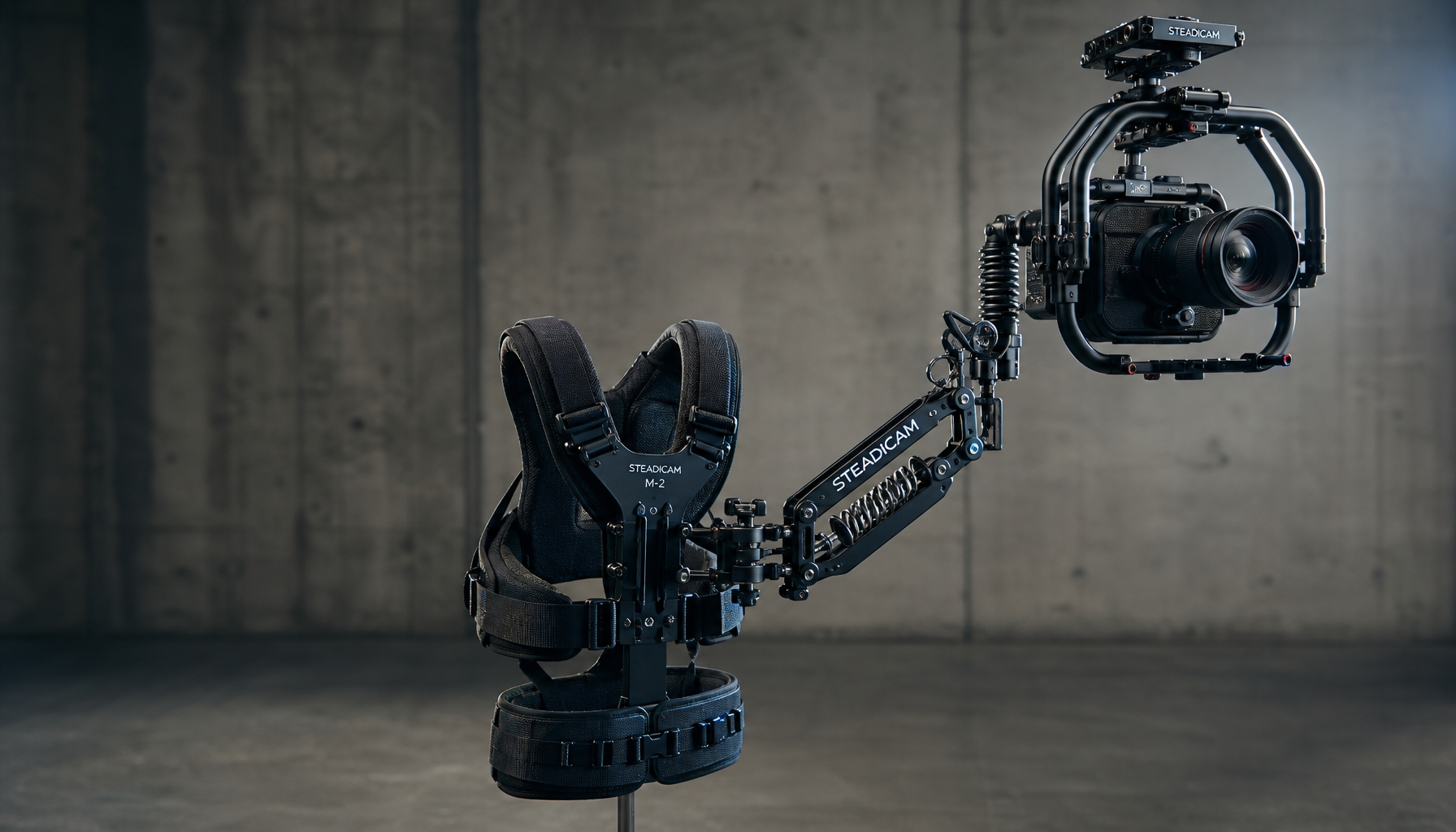
The Steadicam (a brand name that has become a generic term) is a mechanical stabilization system for film cameras. The operator wears a support system (vest) with a spring-loaded arm, to which the camera is attached on a sled. This construction decouples the camera from the operator's body movements and enables fluid, "floating" shots.
Components
The System
 ┌──────────┐
 │ MONITOR │
 └────┬─────┘
 │
 ┌─────────┴─────────┐
 │ SLED │ ← Camera on top
 │ │
 │ │ ← Gimbal in the middle
 │ [BATTERIES] │ ← Weight at the bottom
 └─────────┬─────────┘
 │
 ┌────┴────┐
 │ ARM │ ← Iso-elastic arm
 │ │
 └────┬────┘
 │
 ┌─────────┴─────────┐
 │ VEST │ ← Support system
 │ │
 └───────────────────┘
The Components in Detail
Sled
- Carries camera (top) and batteries/monitor (bottom)
- Gimbal in the middle as a pivot point
- Balance between top and bottom is critical
Arm (Iso-elastic Arm)
- Spring system absorbs vertical movements
- Keeps the camera at a constant level
- Enables smooth up/down motion
Vest
- Distributes weight to hips/shoulders
- Transmits horizontal movement
- Comfort for long takes
Principle of Operation
- Inertia: Heavy mass (sled) wants to maintain its position
- Gimbal: 3-axis suspension decouples movements
- Arm: Springs absorb vertical shocks
- Operator: Guides, but does not directly move
Steadicam vs. Other Systems
| System | Strength | Weakness |
|---|---|---|
| Steadicam | Organic, long, flexible | Heavy, learning curve |
| Gimbal | Lightweight, precise | Electronic, battery-dependent |
| Dolly | Perfect, repeatable | Requires tracks |
| Handheld | Fast, raw | Shaky |
Typical Applications
Ideal for
- Long takes (extended uncut sequences)
- Pursuits through complex spaces
- Stair climbing (impossible with a dolly)
- POV shots with movement
Less suitable for
- Extreme precision (better: Dolly)
- Very long shooting days (physically demanding)
- Tight spaces (arm needs room)
The Steadicam Operator
Requirements
- Physical fitness and stamina
- Timing and choreography
- Technical understanding
- Artistic sensibility
Training
- Workshops at Tiffen/Steadicam
- Months to years of practice
- Own equipment often necessary
History
- 1975: Garrett Brown invents the Steadicam
- 1976: "Rocky" – First major use
- 1980: "The Shining" – Art form established
- Today: Standard tool alongside gimbals
Manufacturers and Models
Tiffen (Original)
- Steadicam M-1, M-2
- Ultra2
- Archer2
Alternatives
- Arri Trinity (Hybrid)
- MōVI (electronic)
- DJI Ronin (Gimbal)
See also
- Gimbal – Electronic alternative
- Steadicam Operator – The specialist
- Long Take – Typical application
- Dolly – Track-based alternative
More in the lexikon
Related terms
Camera · Terms
Gimbal / Motorized Gimbal
A gimbal is a motorized stabilization system with three axes that electronically…
Camera · Terms
Steadicam M-1
Camera · Terms
Steadicam M-2
Camera · Terms
Steadicam Operator
Camera · Terms
Steadicam Volt
Tiffen camera stabilizer with 3-axis gyroscopic technology combining mechanical Steadicam…
Camera · Terms
Tiffen Steadicam
Camera · Equipment
DJI Ronin 2
DJI 3-axis motorized gimbal stabilizer for cameras weighing 1.8–13.6 kg, offering ±0.02°…
Camera · Equipment
DJI Ronin 4D