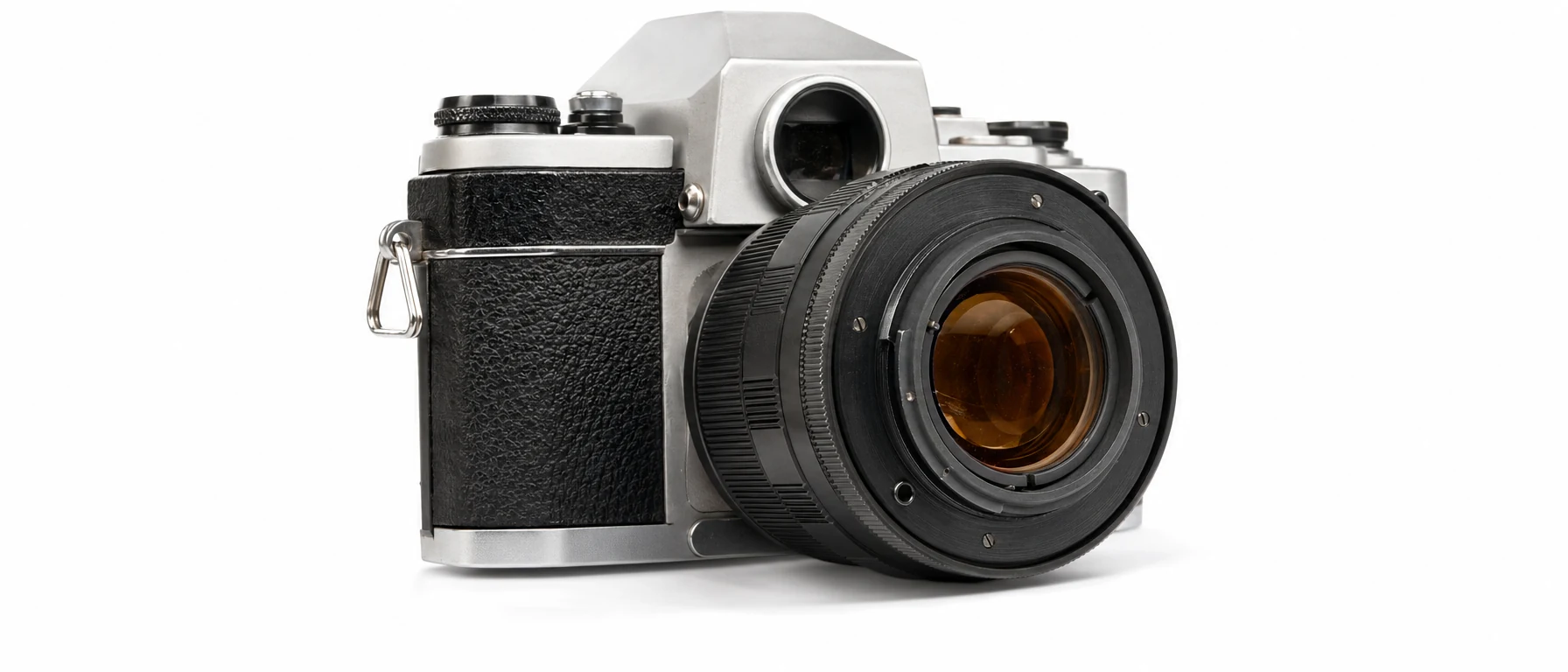
Lens made with thorium oxide glass (1943–1982) for enhanced light transmission and refractive index; avoided today due to radioactivity.
Technical Details
Thorium oxide was used as a glass additive to increase the refractive index to values between 1.7-1.9 and optimize the Abbe number. This primarily affects lenses with complex optical formulas: Zeiss Planar 50mm f/0.7, Canon FD 55mm f/1.2 S.S.C., Pentax Super-Takumar 55mm f/1.8, and various Leica Summicron variants. The radioactive elements are usually located in the front or rear lens groups. Modern Geiger counters measure the highest values at the rear of the lens, as the thorium elements are often concentrated there.
History & Development
The first radioactive lenses were developed in 1943 by Zeiss for military applications. Kodak introduced thorium glass into consumer lenses in 1947, followed by Canon (1959), Pentax (1962), and other manufacturers. The peak was between 1960-1975, when over 200 lens models used thorium glass. In 1978, most manufacturers ceased production after health concerns and stricter radiation protection regulations made their use unprofitable. Pentax was the last major manufacturer to fully switch to thorium-free glasses in 1982.
Practical Use in Film
Stanley Kubrick used modified Zeiss Planar 50mm f/0.7 lenses (originally for NASA moon missions) for the candlelight scenes in "Barry Lyndon" (1975). Many documentary filmmakers of the 1970s valued the high speed of radioactive Takumar lenses for available-light shooting. The lenses develop a characteristic yellow tint due to the radiation, which produces warm skin tones but reduces UV transmission. Modern film productions avoid them due to insurance regulations and occupational safety rules.
Comparison & Alternatives
Radioactive lenses deliver similar optical performance to modern ED (Extra-low Dispersion) glasses or fluorite elements, but without the health risks. The radiation exposure is equivalent to approximately a two-hour transatlantic flight per workday with the lens. Collectors today pay premiums of 300-800% for un-yellowed examples. Professional users replace them with modern Zeiss Otus, Canon L-series, or Cooke S4/i lenses, which offer comparable sharpness without radioactive components.