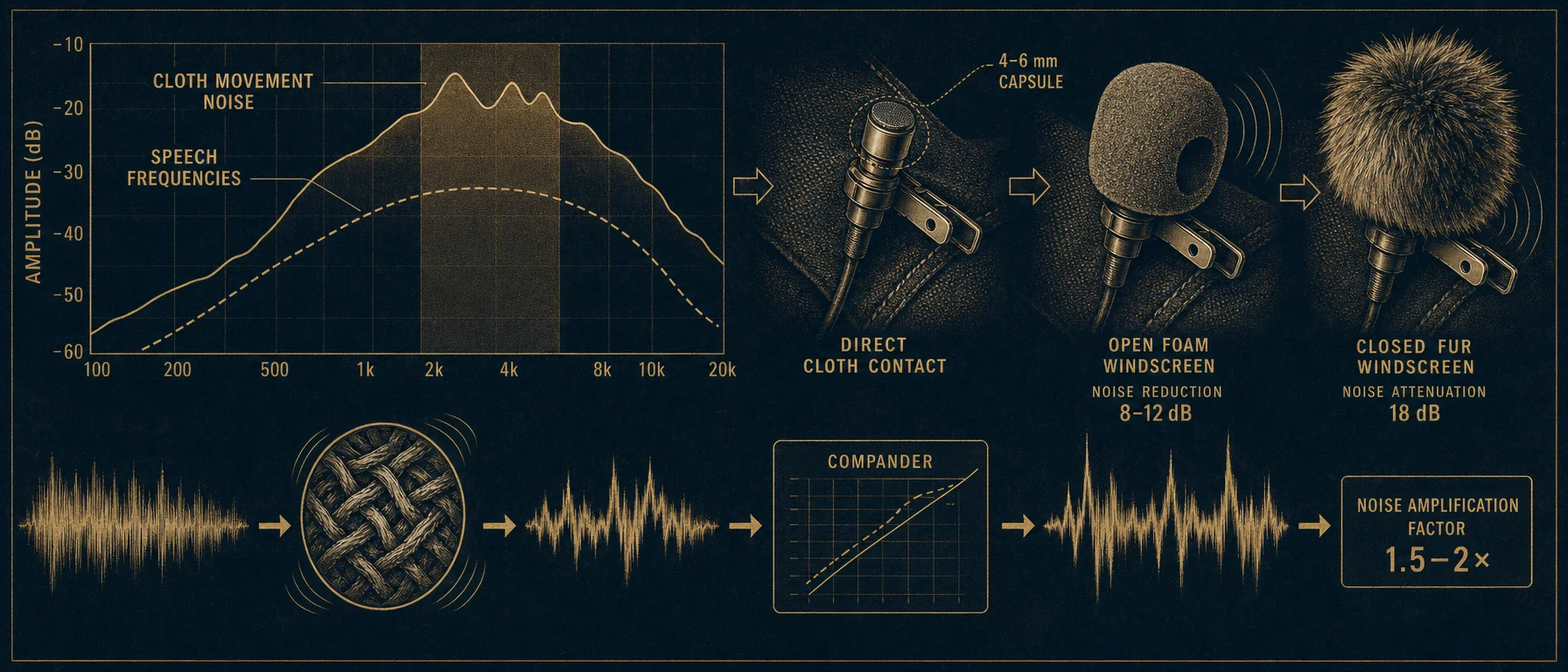
Rustling noise from clothing friction against lavalier microphones, masking critical speech frequencies at 2–4 kHz; exacerbated with wireless systems.
Technical Details
Typical cloth movements exhibit amplitude peaks between -20 dB and -10 dB, overlapping critical speech frequencies around 2-4 kHz. Lavalier microphones with capsule diameters of 4-6 mm are particularly susceptible due to direct fabric contact. Open-foam windscreens reduce cloth noise by 8-12 dB, while closed furry windscreen systems achieve up to 18 dB attenuation. In wireless systems, compander systems amplify cloth noise by a factor of 1.5-2, as these fall within the upper dynamic range of the transmission channel.
History & Development
The first documented issues with cloth noise occurred in 1962 during the filming of "Lawrence of Arabia," when wireless lavalier systems failed in flowing robes. In 1967, Sennheiser developed the first direction-dependent anti-clothing system with the MKE 2. In the 1980s, Sanken introduced interference tubes that minimized fabric contact through directivity. Modern digital systems since 2010 utilize spectral notch filters that suppress cloth noise in real-time by up to 20 dB.
Practical Application in Film
For "Dunkirk" (2017), Christopher Nolan commissioned special underwear made of silent merino material to avoid interference during combat scenes. Sound mixer Gary Rydstrom used skin adhesive instead of magnetic mounts on "Minority Report" (2002), thereby reducing cloth noise by 15 dB. Standard workflow includes microphone placement under the first layer of fabric, fixation with medical tape, and a minimum distance of 5 cm from button plackets or zippers. For action sequences, backup microphones are positioned on low-noise body areas such as the forehead or back.
Comparison & Alternatives
Handling noise is generated by touch and is more impulsive, whereas cloth noise is a continuous rustle. Shotgun microphones eliminate the problem through distance but reduce speech intelligibility by 3-6 dB. Modern AI-based restoration software like iZotope RX can reduce cloth noise retrospectively by 10-15 dB without affecting speech quality. Headworn microphones have offered the best compromise since 2015: 8 dB better noise suppression than lavaliers with comparable speech quality.