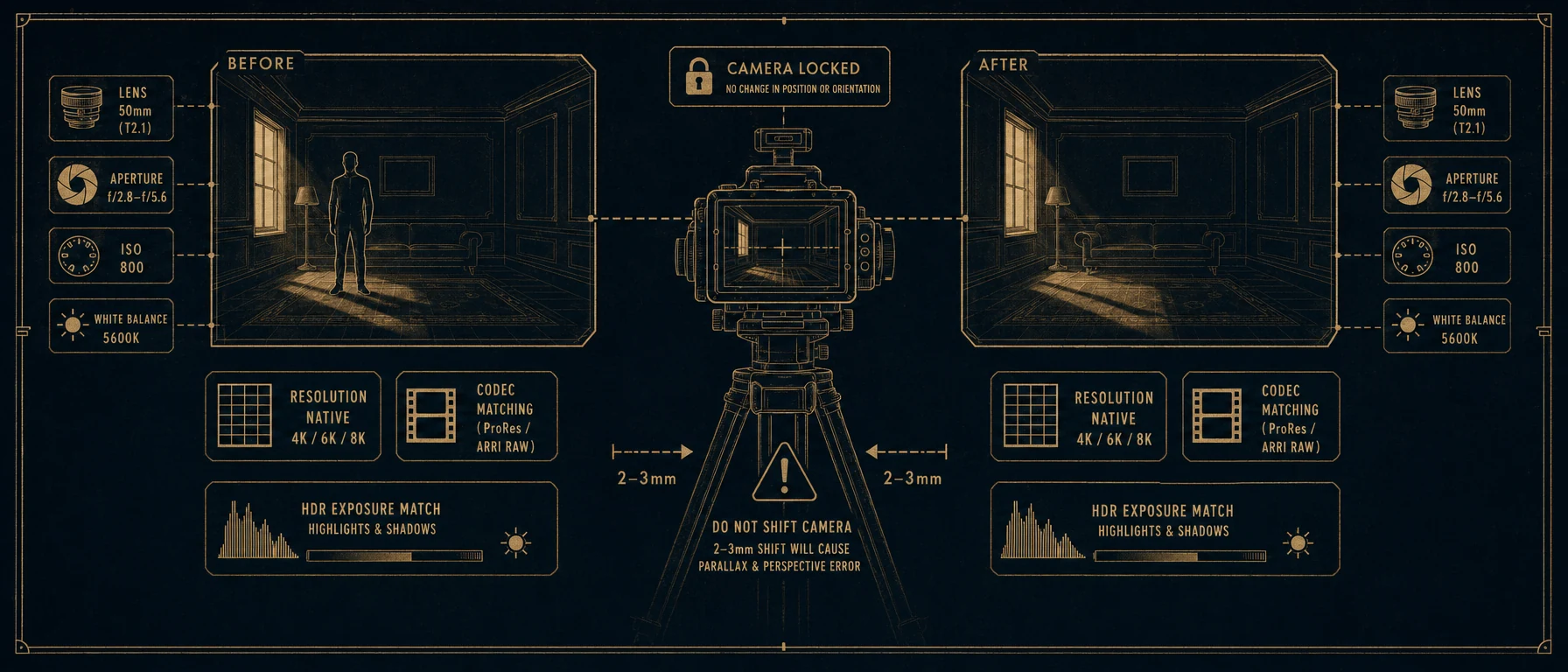
A shot of the background plate with no actors or objects present, used for wire removal, digital retouching, and compositing fixes.
Technical Details
Clean plates are recorded with identical camera settings: same focal length, aperture (typically f/2.8-f/5.6), ISO values, and white balance. The camera must not be moved between the actual shot and the clean plate – even a 2-3mm shift renders the shot unusable. Modern digital workflows require clean plates in native resolution (4K, 6K, or 8K) and in the same codec as the main footage. For HDR productions, clean plates are created with identical exposure values for highlights and shadows.
History & Development
The technique originated in the 1930s in Hollywood studios when matte paintings were combined with live-action. Linwood Dunn at RKO Pictures pioneered this from 1932. The clean plate workflow became established digitally in 1993 with "Jurassic Park," where ILM used clean plates for dinosaur composites. Since 2010, machine learning algorithms have automated clean plate creation by removing objects from existing takes.
Practical Application in Film
In "The Lord of the Rings" (2001-2003), WETA Digital used hundreds of clean plates for scale manipulation between Hobbits and humans. "Mad Max: Fury Road" (2015) utilized clean plates to remove stunt rigs from vehicle scenes. The standard workflow involves: shooting the main scene, immediately capturing the clean plate, and synchronizing both takes with timecode. VFX supervisors demand clean plates even for seemingly simple scenes, as subsequent reconstruction costs 10-15 times more in render time.
Comparison & Alternatives
Clean plates differ from backplates (background shots for greenscreen) due to the identical camera position. Content-Aware Fill (Adobe After Effects) and Wire Removal Tools are increasingly replacing clean plates for simple object removal. For complex scenes with shadows, reflections, or depth-of-field gradients, clean plates remain indispensable. Virtual sets and LED walls reduce the need for clean plates, as backgrounds are already digitally present.