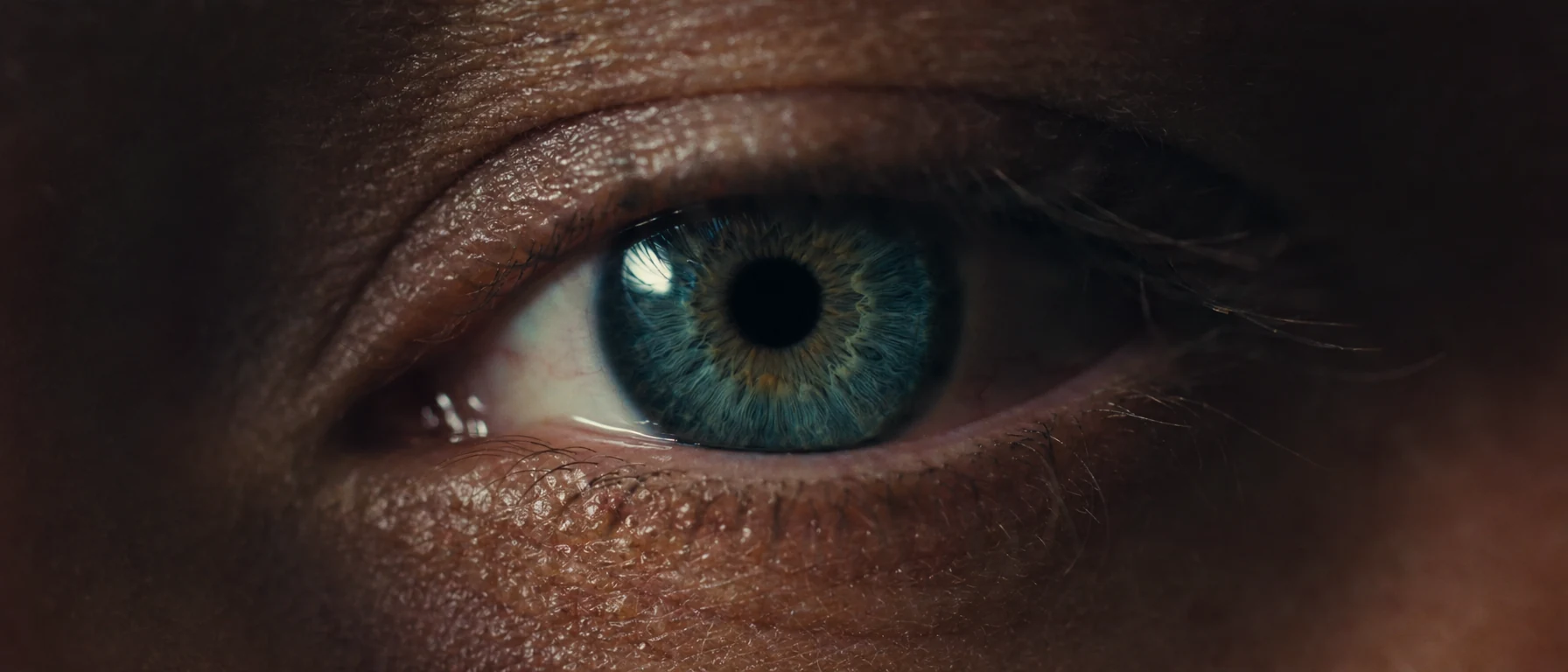
Extreme close-up framing the face from forehead to chin with minimal depth of field. Requires telephoto lens (85mm+) and precision focus at 2–5 cm range.
Technical Details
Telephoto lenses from 85mm (full-frame equivalent) are typically used for Big Close-Ups, but more often 135mm to 200mm. The shooting distance for facial details is between 0.5 and 2 meters. Depth of field is critical: at an aperture of f/2.8 and 135mm, the focus range is only 2-5cm, requiring precise focusing. Three variants differ by framing: the standard BCU (forehead to chin), the detail BCU (individual facial features), and the insert BCU for objects smaller than 10cm.
History & Development
D.W. Griffith established the first extreme close-ups in 1913 in "The Birth of a Nation," but met resistance from cinema owners who feared "half actors." Carl Theodor Dreyer's "The Passion of Joan of Arc" (1928) revolutionized the BCU in 1928 through systematic use for emotional intensity. Sergio Leone perfected the technique in the 1960s with anamorphic lenses, creating iconic eye duels. Since 2000, Digital Cinema has enabled even more extreme magnifications without loss of quality through 4K resolution.
Practical Application in Film
The BCU is classically used in moments of tension: Leone's mouth corner detail in "Once Upon a Time in the West" or the eye close-up in Kubrick's "2001." Workflow-wise, the BCU requires special preparation: makeup artists work with 4K-compatible techniques, and actors receive eye drops for dryness during long takes. The shallow depth of field significantly limits actor direction – a head movement of just 2cm leads to unsharpness.
Comparison & Alternatives
Distinction from a standard Close-Up: A Close-Up shows the complete face from hairline to chin, while the BCU captures only partial areas. The American Medium Close-Up, on the other hand, ends at the shoulders. Modern alternatives include macro lenses for extreme object details or focus-pulling systems that allow smooth transitions between different close-up sizes. In documentary work, detail shots with standard lenses often replace the elaborate BCU technique.