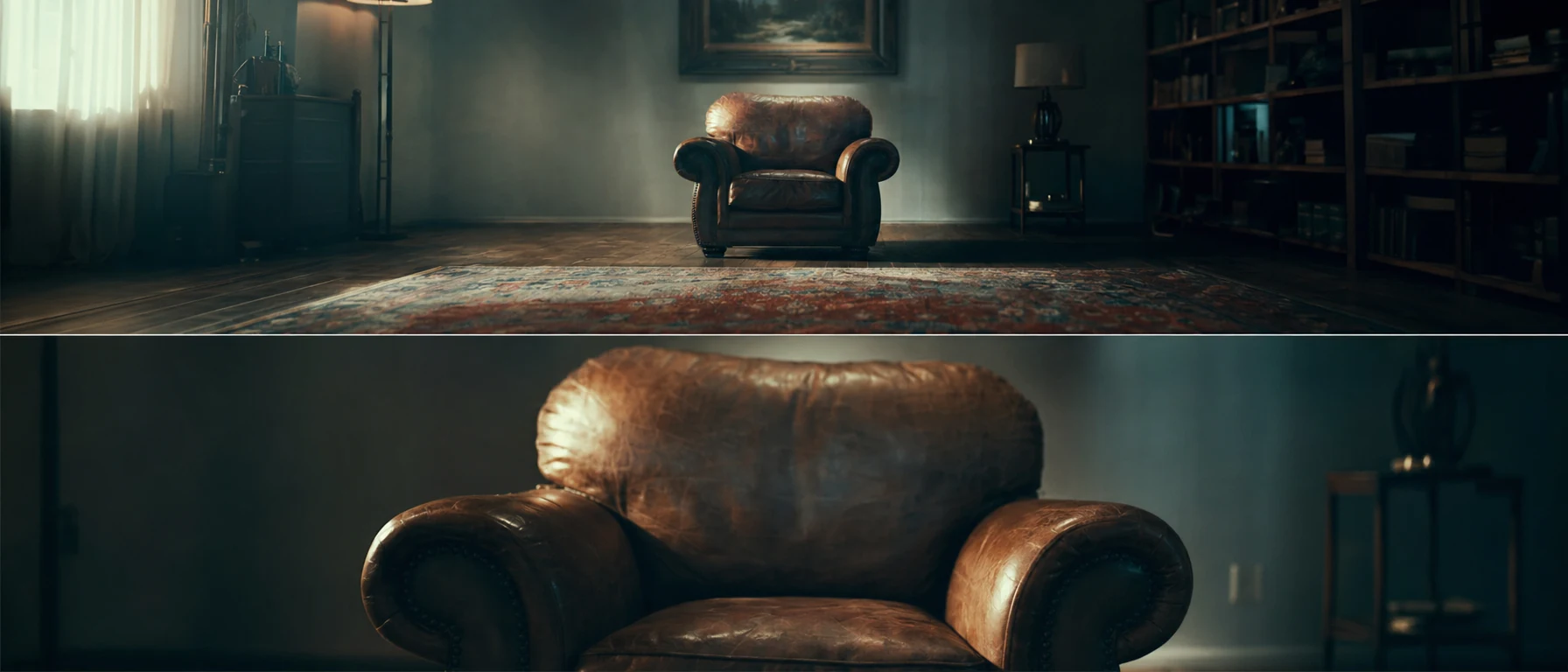
Cut between shots with identical camera axis but different frame sizes, achieved through focal length or camera position change.
Technical Details
In an axial cut, the camera axis remains constant with 0° deviation from the original viewing direction. The focal length can vary between 24mm and 200mm to achieve different shot sizes without losing central subject positioning. In digital post-production, axial cuts can be simulated through zooms (digital punch-in) with resolutions of 4K and above, although image quality noticeably decreases with magnification factors exceeding 200%. Technically, a distinction is made between the true axial cut with camera position change and the pseudo-axial cut achieved by changing focal length at the same location.
History & Development
The axial cut was established as early as 1903 in Edwin S. Porter's "The Great Train Robbery," where different shot sizes of the same subject were systematically cut for the first time. Sergei Eisenstein perfected the technique in 1925 in "Battleship Potemkin," thereby defining the theoretical foundations of axial montage. Stanley Kubrick revolutionized the axial cut in 1968 in "2001: A Space Odyssey" through precise mathematical progression of shot sizes – his Bone-to-Spaceship sequence uses exact magnification factors of 1:2:4:8. With the introduction of digital editing systems from 1990 onwards, post-production axial cuts became possible through scaling.
Practical Application in Film
In "There Will Be Blood" (2007), Paul Thomas Anderson uses axial cuts with extreme focal length jumps from 35mm to 200mm to visualize Daniel Plainview's psychological isolation. The cut works optimally with static subjects and requires at least a 30% size difference between shots to avoid jump cuts. The technique is particularly effective with centered character faces or symmetrical objects. The axial cut becomes problematic with moving subjects, as minimal positional deviations between shots are perceived as disturbing jumps.
Comparison & Alternatives
In contrast to the match cut, which connects identical shot sizes, the axial cut deliberately changes the distance to the subject. The jump cut, on the other hand, violates the 30° rule through minimal camera shifts, while the axial cut bypasses this by radical size changes. A modern alternative is the digital push-in, where 6K or 8K footage is scaled in post-production – more cost-effective than additional camera setups, but qualitatively limited. The dolly zoom (Vertigo effect) combines axial movement with counteracting focal length changes, creating spatial distortion rather than pure size variation.