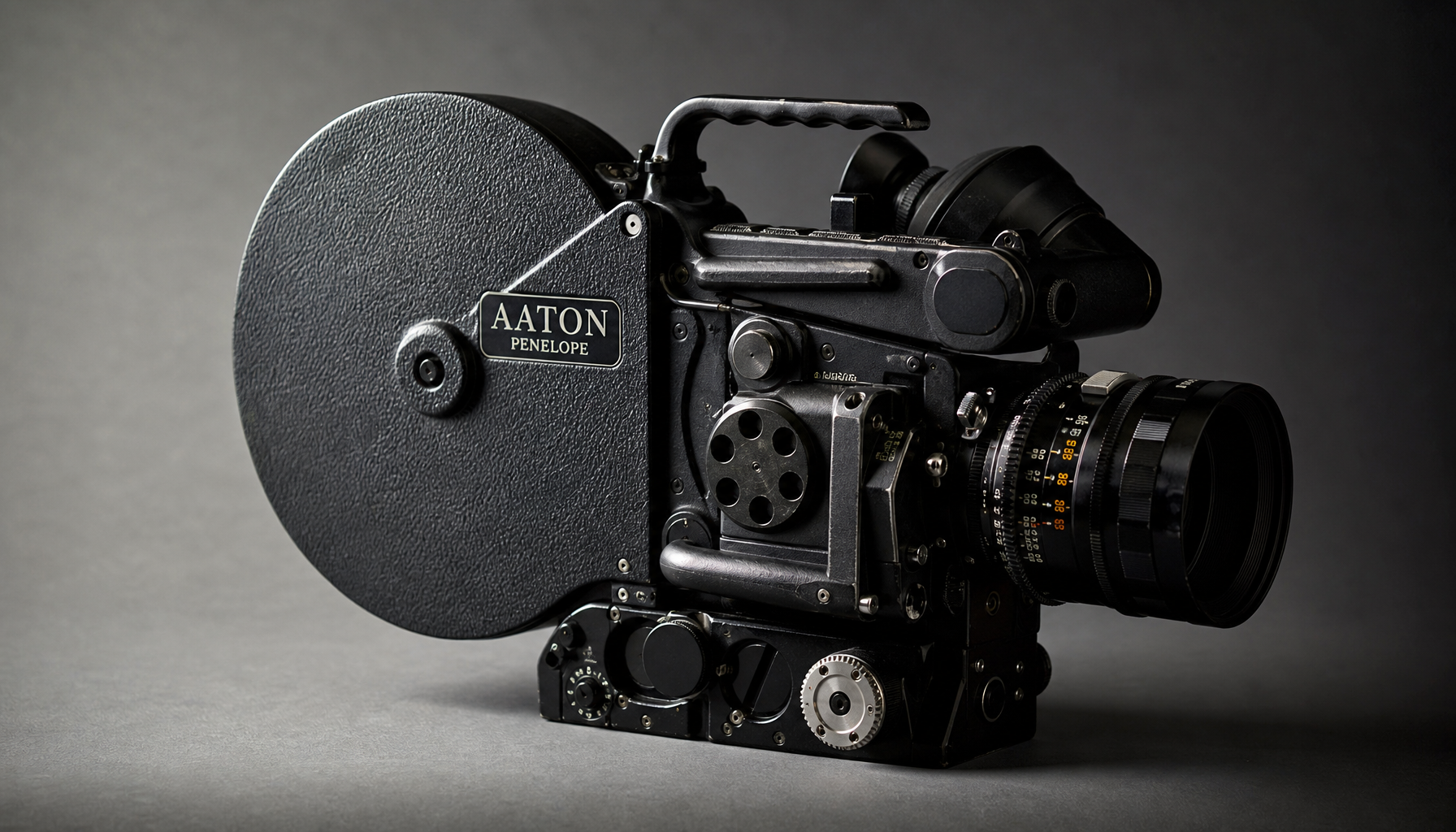
35mm camera switchable between 2-perf and 3-perf formats. Cuts film stock consumption by 25-33%. Aaton's final camera design before closing production in 2008.
What is the Aaton Penelope?
The Aaton Penelope (2008) was Jean-Pierre Beauviala's last analog camera – and perhaps his best. Weighing only 3.5 kg and featuring revolutionary 2-perf/3-perf modes for massive film savings, it was technically brilliant. Tragically, it arrived just as digital was supplanting film.
Technical Specifications
| Feature | Value |
|---|---|
| Format | 35mm (2-perf, 3-perf, 4-perf) |
| Weight (Body) | 3.5 kg |
| Dimensions | Compact (smaller than 35-III) |
| Frame Rate | 1–50 fps |
| Shutter | 11.2°–180° |
| Noise Level | <20 dBA |
| Mount | PL Mount |
| Magazine | 400 ft / 1000 ft |
The Perforation System
| Mode | Aspect Ratio | Film Savings | Usage |
|---|---|---|---|
| 4-perf | 1.33:1 (Academy) | 0% | Classic Format |
| 3-perf | 1.78:1 / 1.85:1 | 25% | TV/Cinema Standard |
| 2-perf | 2.40:1 | 50% | Scope/Cinemascope |
The Penelope could switch between modes – a technical masterpiece.
The 3-Perf Revolution
The 3-perf format was Beauviala's major innovation:
Advantages
- 25% lower film costs per shooting day
- 1.85:1 native – no cropping needed
- Longer magazines – more runtime per roll
- Fewer roll changes – faster workflow
Calculation
| 400 ft Roll | 4-perf | 3-perf | 2-perf |
|---|---|---|---|
| Runtime @ 24fps | 4:26 min | 5:56 min | 8:53 min |
| Number of Frames | 2,560 | 3,413 | 5,120 |
The Tragic Story
2008: Perfect Timing, Wrong Moment
| Month | Event |
|---|---|
| January 2008 | Penelope World Premiere at BSC Expo |
| March 2008 | First Production Units |
| April 2008 | RED One Goes Mainstream |
| Fall 2009 | ARRI Alexa Announced |
| 2010 | Digital Overtakes Film |
| 2013 | Aaton Bankruptcy |
The Penelope was technically perfect, but historically obsolete.
Penelope Delta: The Failed Rescue Attempt
Aaton attempted to develop a digital Penelope in 2012:
- Penelope Delta – Super-35 Digital Sensor
- Problem: Too late, too expensive, no buyers
- Result: Aaton bankruptcy in 2013
Notable Productions
The Penelope was used in only a few films:
| Film | Year | DP | Notes |
|---|---|---|---|
| A Prophet | 2009 | Stéphane Fontaine | Jacques Audiard |
| Amour | 2012 | Darius Khondji, ASC | Michael Haneke, Palme d'Or |
| Rust and Bone | 2012 | Stéphane Fontaine | Jacques Audiard |
| The Artist | 2011 | Guillaume Schiffman | Oscar for Best Cinematography (partially) |
Penelope vs. Competition
| Feature | Penelope | Arri 535B | Panavision Millennium |
|---|---|---|---|
| Weight | 3.5 kg | 6.2 kg | 5.9 kg |
| 3-perf | Yes, native | Conversion needed | Conversion needed |
| Noise | <20 dBA | <19 dBA | <18 dBA |
| Market Share | <1% | ~40% | ~40% |
The Penelope was the lightest 35mm camera – but it wasn't enough.
Beauviala's Vision
Jean-Pierre Beauviala designed the Penelope as the culmination of his career:
"A camera that the cinematographer forgets because it becomes part of his body."
Design Principles
- Minimalism – only what is necessary
- Ergonomics – "Cat on the shoulder" perfected
- Efficiency – less film, more creativity
- Quality – 35mm without compromise
Today
The Aaton Penelope is a collector's item:
- Very low production numbers – fewer than 100 produced
- Museum-worthy – symbol of a bygone era
- Film enthusiasts – occasionally used for retro productions
- Historical significance – last major analog innovation
The Legacy
The Penelope failed commercially, but its influence lives on:
- 3-perf was later adopted by Arri and Panavision
- Lightweight philosophy influences modern cameras
- Ergonomic standards of the XTR series live on in digital
- Beauviala's spirit – cameras should enable freedom