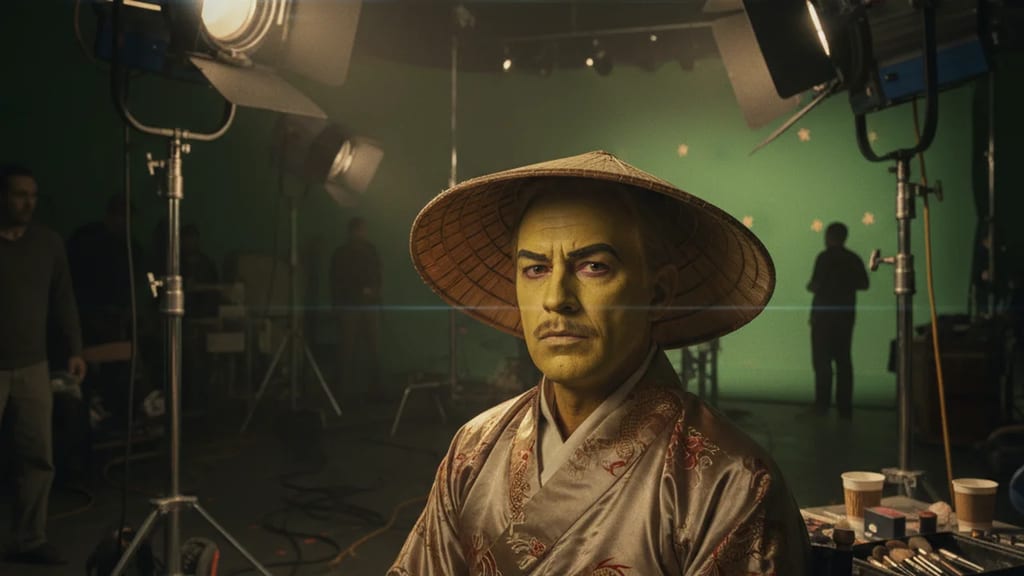
Non-Asian actors cast as Asian characters with exaggerated makeup or racial caricature — discredited practice rooted in structural discrimination. Still happens; remains indefensible.
The practice of casting non-Asian actors in Asian roles and altering their faces with makeup, prosthetics, and caricatures permeated decades of cinema and theater. On set, this concretely meant: makeup stations with special shades, eyelid tape, artificial cheekbones — entire departments of makeup artists whose craft involved transforming European features into racist parodies. This was not artistic freedom, but structural exclusion backed by a technical budget.
Historically, the system simply worked: studios needed A-list names for the box office, and Asian actors were invisible in casting hierarchies or only received supporting roles. Instead of restructuring the industry, a cosmetic solution was applied — literally. Anyone working as a director or cinematographer on such a set had to go along with lighting setups calculated for a white skin surface. The lighting, the lens system, the color grading — everything was adapted to the fake, constructed surface, not to authentic diversity.
Today, in a professional context, yellowface is a career risk. Not out of moral trendiness, but because the industry has recognized that authenticity and inclusion are not only ethically unavoidable but also economically sensible. A casting director who accepts yellowface signals a lack of assertiveness against studios. An actor who accepts the role risks lasting reputational damage. A DP who sets up the lighting "uncritically" for a racist masquerade will be confronted with it later.
The trace of yellowface runs through classics — old Hollywood productions that are now considered documented scandals. What's interesting for practical filmmaking: it was not an exception or artistic aberration at the time, but a business standard. This is a cautionary tale. Modern casting policies do not mean foregoing big names, but rethinking role assignments. A Chinese or Japanese lead actor brings different authenticity, different lighting qualities, different narrative truth. This is not a compromise — it is craftsmanship on a new level.
Related terms
Quiz
1. Was beschreibt „Yellowface" am besten?
2. Zu welchem Department gehört „Yellowface"?