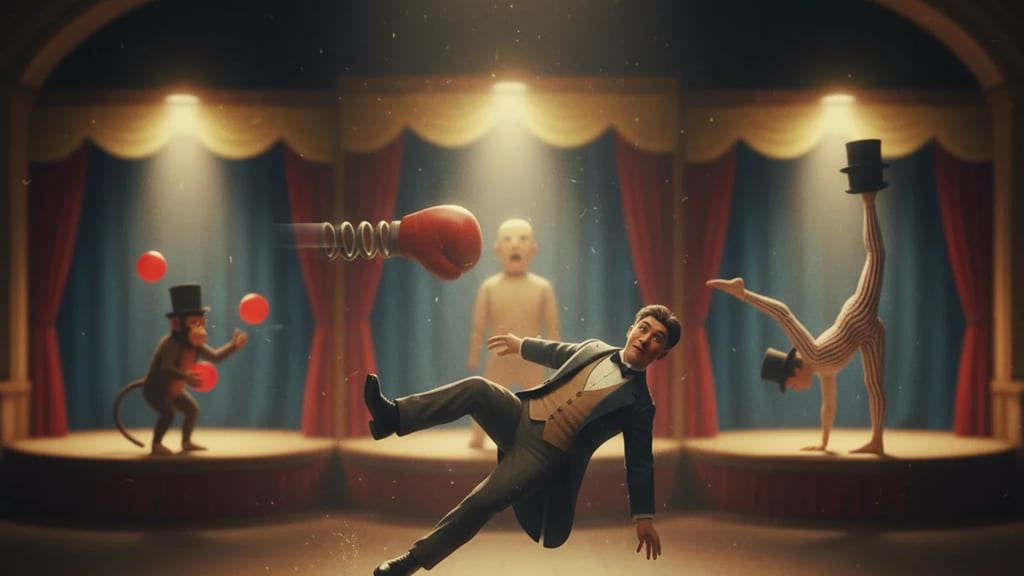
Early 20th-century variety theater format — rapid cuts between acts, absurdist humor, visual gag timing. Shaped slapstick editing rhythm to this day.
Anyone working in film early on can't avoid Vaudeville – not as a historical phenomenon, but as visual editing DNA that still resonates today. The American variety theater of the early 20th century wasn't just entertainment; it was a school for timing that fundamentally shaped film. The Vaudeville stage showed how to captivate an audience in 90 seconds, then quickly jump to the next act – precisely this became the editing grammar of silent film.
The direct influence lies in the gag structure and editing rhythm. Chaplin, Keaton, Lloyd – they all came from Vaudeville, and their films function like consecutively edited stage acts. A gag lasts three, four seconds, then you cut to the next visual punchline. It wasn't slow or deliberate; it was choppy, precise, cumulative. On set, this still means today: Visual storytelling needs speed. The viewer grasps a slapstick scene not through long takes, but through cuts that rhythmize the action itself. You don't just film a fall – you cut it so that the editing itself becomes the gag.
In practice, this is particularly evident in comedy productions and physical comedy in general. The editor works like a Vaudeville director: Which images follow each other to achieve maximum comedic effect? Timing is everything – not just in performance, but in the edited image. A silent film copy of Buster Keaton still shows this more clearly than a thousand words: The editing is the comedy. The opposite would be a long, static take, and that wouldn't work.
Anyone dealing with comedy editing or historical slapstick should understand Vaudeville principles – not as nostalgic material, but as an operative aesthetic. The tempo, the sequence, the visual clarity of each act – these are not old tricks, they are the foundation of craftsmanship. Modern comedy series inherit this DNA directly, even if the source is often forgotten.
Related terms
Quiz
1. Zu welchem Department gehört „Vaudeville"?