Filmlexikon.
Support
Underwater Shot
Camera · Terms

Underwater Shot

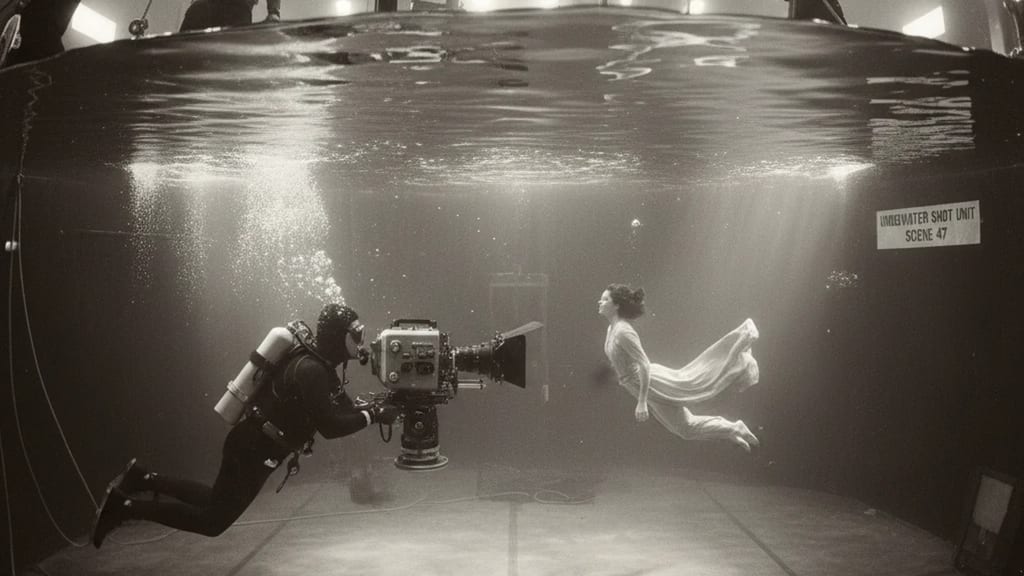
Murnau AI illustration
15lb sandbag 20 c stand 216 diffusion 250 diffusion 251 diffusion 25lb sandbag 35lb sandbag 40 c stand

Camera in waterproof housing submerged. Red wavelengths absorb immediately, artificial lighting becomes essential. Colors desaturate with depth — lighting must be precisely planned beforehand.

Technical Details

Professional underwater housings like the Hydroflex Epic cost 45,000-60,000 Euros and are waterproof up to 150 meters. Standard housings from Ikelite or Nauticam cover depths up to 60 meters (2,500-8,000 Euros). Underwater, the refractive index increases from 1.0 to 1.33, making objects appear 25% larger and 33% closer. Special dome ports with a 230mm diameter correct wide-angle distortions. From a depth of 5 meters, auxiliary lights with at least 10,000 lumens are required. Underwater follow focus systems operate with enlarged gears and waterproof motors.

History & Development

In 1916, biologist Ernest Williamson shot the first underwater sequences for "20,000 Leagues Under the Sea" using a self-built glass sphere camera. In 1954, Henri Broussard developed the first professional underwater housing for 35mm cameras. The breakthrough came in 1977 with "Jaws" – cinematographer Michael Ballhaus used the revolutionary Elemack underwater housing. In 1989, "The Abyss" introduced CGI underwater worlds, and in 2003, "Finding Nemo" combined fully digital underwater worlds with photorealistic light refraction effects for the first time.

Practical Application in Film

"Life of Pi" (2012) used 85% tank shots in the 1.7 million-liter tank at Pinewood Studios. "Aquaman" (2018) shot close-ups in 4-meter tanks with blue/green screen extensions for wide-angle shots. Typical workflow: Pre-dive with camera dummy, maximum dive time 45 minutes, immediate rinse with fresh water. Continuous communication is via underwater radio (Ocean Reef GSM G.divers). Disadvantages: Reduced depth of field, color loss from 3 meters onwards, risk of corrosion, limited battery life.

Comparison & Alternatives

Dry-for-wet technique simulates underwater scenes in air through slowed movements, flowing hair, and particle effects – 70% more cost-effective than actual underwater shots. Partial submersion is limited to shots near the water surface without full sealing. Virtual Production with LED walls is increasingly replacing water tanks: "The Little Mermaid" (2023) used 90% virtual sets. Real underwater shots remain indispensable for authentic light refraction, bubble formation, and natural water dynamics in close-ups.
From the crafts

Perspectives

Cinematographer

Ich plane Unterwassersequenzen immer mit doppelter Pufferzeit, da die Gehäuse-Vorbereitung 45 Minuten dauert und jeder Tauchgang maximal 40 Minuten nutzbare Drehzeit liefert. Die Lichtführung verändert sich komplett – ich brauche mindestens vier 12.000-Lumen-HMI-Leuchten für gleichmäßige Ausleuchtung ab 3 Meter Tiefe. Der 1,33-Brechungsindex macht jeden Weitwinkel zum Fisheye, deshalb verwende ich ausschließlich Dome-Ports und rechne 25% Crop-Faktor ein.

Director

Unterwasseraufnahmen schaffen eine völlig andere emotionale Ebene – die verlangsamten Bewegungen und gedämpften Geräusche erzeugen automatisch Intimität oder Bedrohung. Ich nutze sie gezielt für Traumsequenzen oder Erinnerungen, da das veränderte Lichtspektrum eine unwirkliche, fast schon übernatürliche Stimmung erzeugt. Dialog funktioniert nur über Voice-Over oder extreme Nahaufnahmen der Lippen, was mich zu sehr visueller Erzählweise zwingt.

Producer

Echte Unterwasseraufnahmen verdoppeln mein Kamera-Budget durch die 50.000-Euro-Gehäuse und verlängern Drehtage um 40% durch Setup-Zeiten. Ich kalkuliere immer Backup-Kameras ein, da Wasserschäden nicht versicherbar sind. Pro Drehtag brauche ich zusätzlich Tauchlehrer, Sicherheitstaucher und Unterwasser-Kommunikationsequipment – das sind 8.000-12.000 Euro Mehrkosten täglich gegenüber Studio-Tanks.

More in the lexikon

Related terms

Test your knowledge

Quiz

1. Was beschreibt „Unterwasseraufnahme" am besten?

2. Zu welchem Department gehört „Unterwasseraufnahme"?

3. Wie viele verschiedene Fachperspektiven bietet dieser Eintrag?

Report an error
From the Filmfarm ecosystem

Understand visual language, budget productions, connect crew.

The Lexikon is part of the Filmfarm ecosystem — alongside budgeting (FilmBalance), an industry magazine (FilmCircus) and crew networking (FilmCall, CrewMesh). One shared vocabulary for the whole production.

FilmFarm FilmRadarComing soonFilmPulseComing soonFilmNumbersComing soonFilmCapitalComing soonFilmLabComing soonFilmBalanceComing soonFilmCircusComing soon